

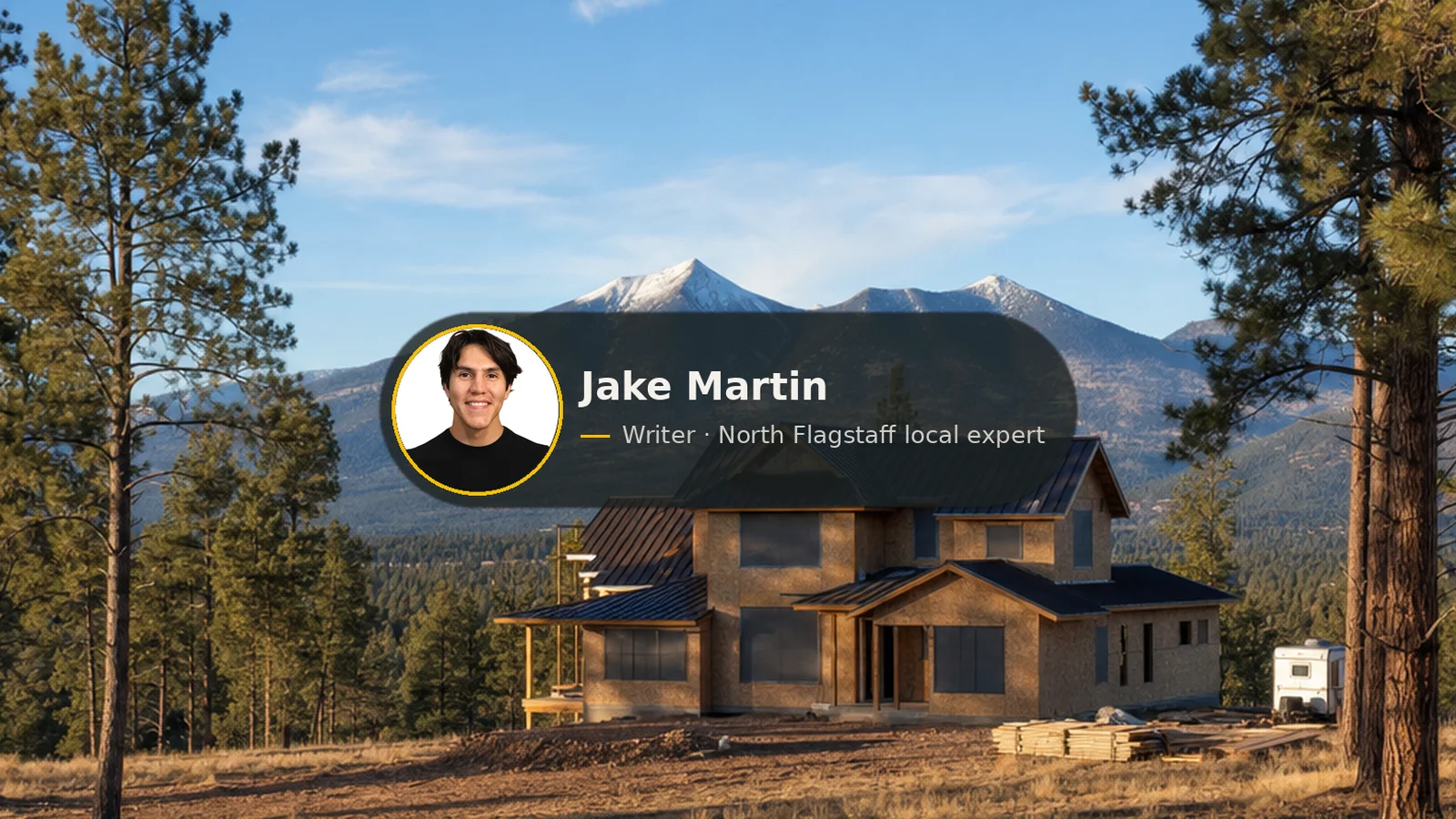
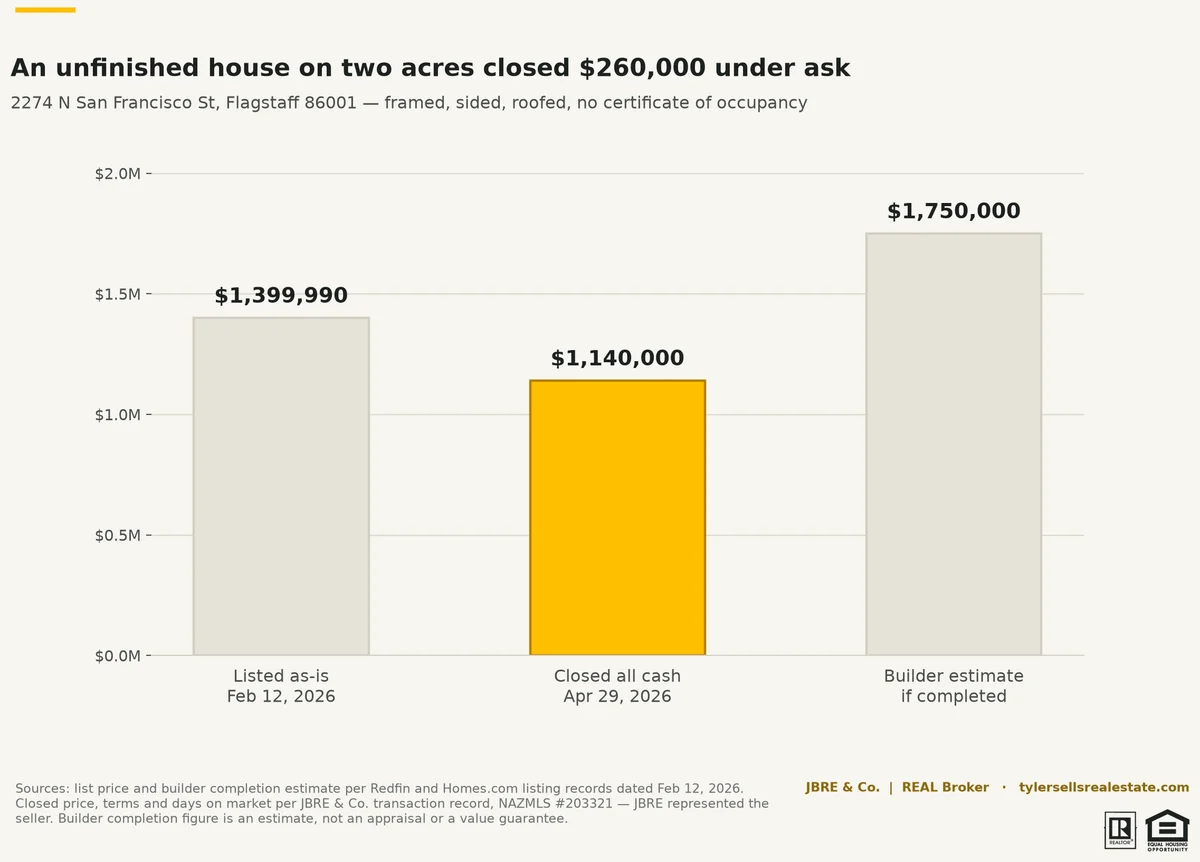
An unfinished home in Flagstaff has almost no comps. Framed, sided, roofed, plumbed — and then stopped. No certificate of occupancy, no finished interior, no closed sale down the street to point at. In February 2026 a two-acre property at the top of N San Francisco Street in north Flagstaff went on the market in exactly that condition at $1,399,990. Seventy-six days later it closed all cash at $1,140,000.
That $260,000 spread is the most useful number in the north end of 86001 right now, because it is not an opinion. It is what a real buyer, spending real money, decided the remaining work was worth at 7,000 feet.
Disclosure: JBRE & Co. represented the seller on this transaction. Jake Martin was the listing agent. The numbers below come from our own file, and we are publishing them because the market has nothing else to look at.
The short version
Listed February 12, 2026 at $1,399,990 as a partially built house on two acres (Redfin)
Closed April 29, 2026 at $1,140,000, all cash, 76 days list to close (JBRE & Co. transaction record, NAZMLS #203321)
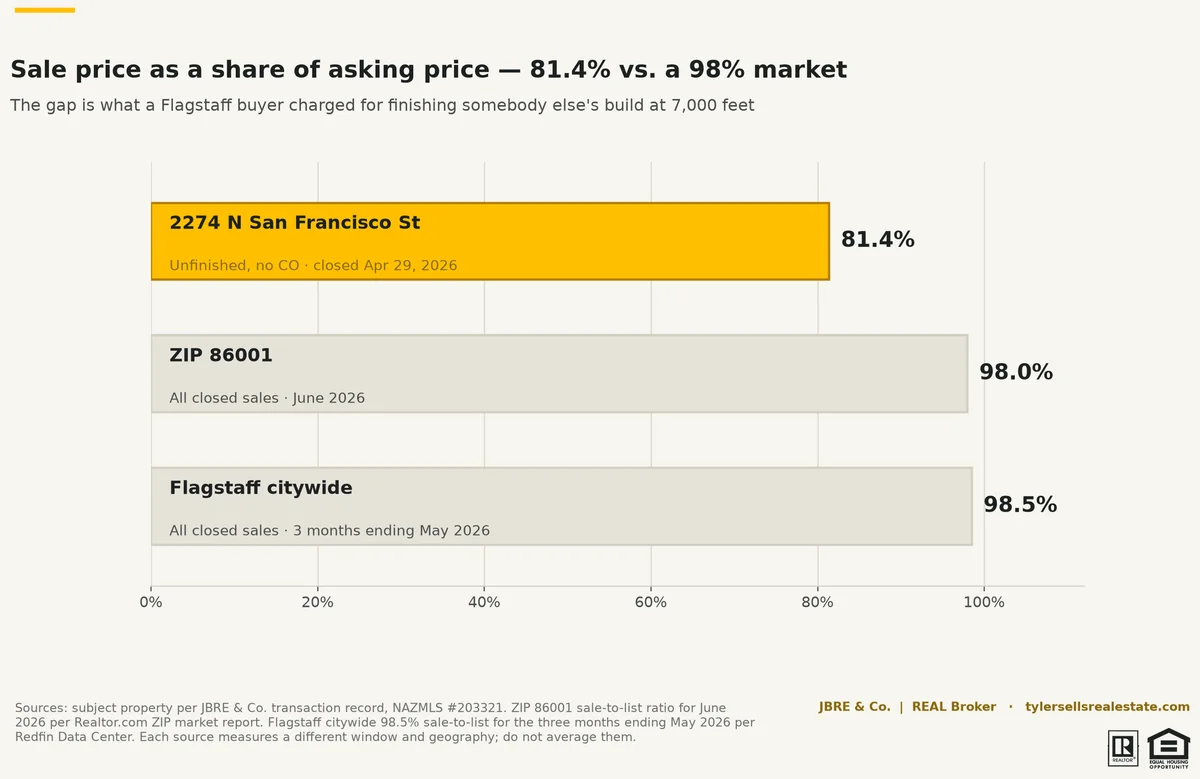
81.4% of ask — against a Flagstaff citywide sale-to-list ratio of 98.5% for the three months ending May 2026 (Redfin Data Center)
The $260,000 discount is the market's price on cost to complete, not a comment on the land or the location
No lender writes a standard purchase loan against a structure with no certificate of occupancy — which narrowed the buyer pool to cash and construction lending before the first showing
If you own a bungalow on Beaver or a fifties ranch on Dale, this is not your comp. If you own acreage or a stalled build north of town, it is the only one you have
The house at the top of N San Francisco Street
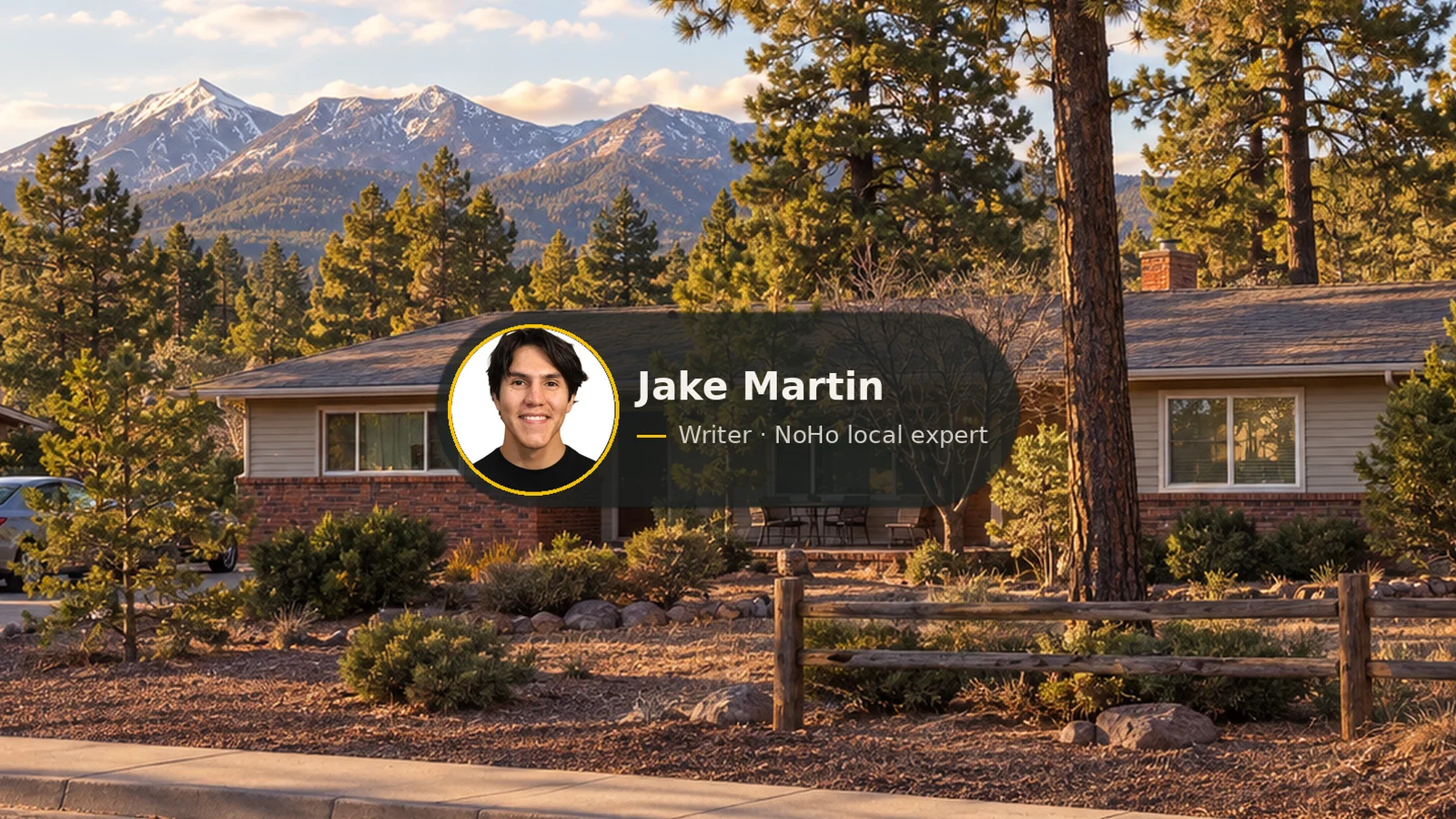
Drive north on San Francisco past the Elks Lodge — Lodge #499 sits on 8.3 acres at 2101 N San Francisco Street, at the top of the street (Elks.org) — and the grid quits. Pavement narrows to a private road. Two acres of ponderosa and open meadow, sloping gently, with the San Francisco Peaks off the shoulder.
It is the same street as the downtown core, which is centered at N San Francisco Street and E Aspen Avenue (Wikipedia), and it sits just north of Flagstaff Medical Center at 1200 N Beaver Street (Northern Arizona Healthcare). But it is not the historic grid and it is not in the city. The parcel is county-zoned, unincorporated Coconino County, on a shared well with gas and electric already run to the property.
That distinction — county, not city — turns out to matter more than anything else in this story.
What sold an unfinished home in Flagstaff
Three things, in order.
One: roughly two years of front-end work was already done
The expensive, invisible, slow part of building in northern Arizona was finished and paid for. Design. Permitting. Site work. Utilities pulled to the property. Frost-depth foundation, snow-load framing, sheathing, siding, roof. The structure was weather-tight.
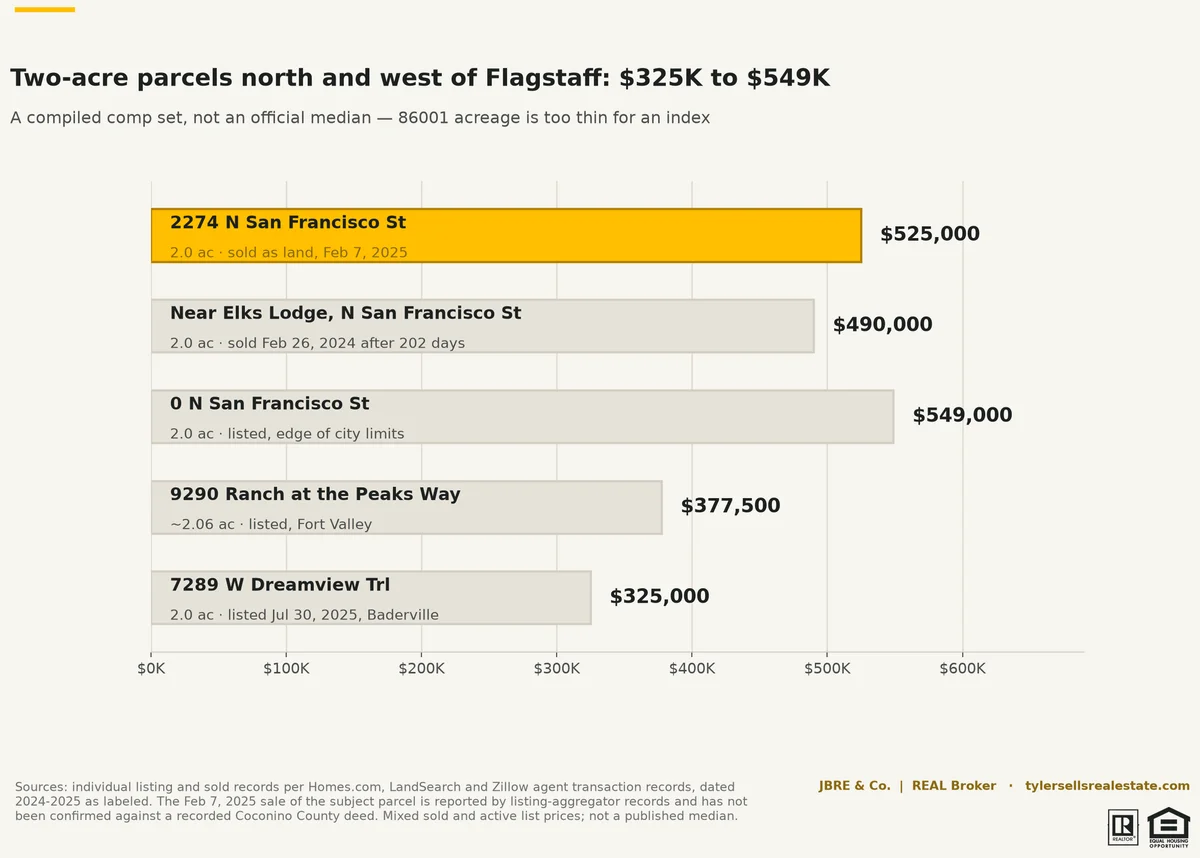
A buyer starting from raw dirt on a comparable two-acre parcel north of town buys the land first — comparable two-acre parcels in this pocket have traded and listed between roughly $325,000 and $549,000 across 2024 and 2025, including a two-acre lot near the Elks Lodge that sold for $490,000 in February 2024 after 202 days on market (Homes.com) and a two-acre Fort Valley parcel listed at $325,000 in July 2025 (LandSearch). Then they spend a year-plus in design and county review before a single truck shows up.
Buying here skipped all of it.
Two: the plan was still open
This is the part most sellers of stalled builds never think to market. Because no interior finish had gone in, the buyer could still move partitions, change the bedroom count, and redraw the interior around how they actually live. Once drywall goes up, that window closes and every change becomes demolition.
It is a narrow, temporary form of leverage, and it only exists at exactly this stage of construction.
Three: somebody put a real number on the work that was left
The listing carried the builder's own estimate that a completed home would run $1,750,000 or more depending on finishes and upgrades (Homes.com listing, February 12, 2026). At list, roughly 2,900 square feet at $1,399,990 penciled to about $483 per square foot in as-is condition.
Buyers did not have to guess at the remaining scope. They had a defensible number to argue with — and they argued it down $260,000. That is what a scoped, documented shell gets you instead of a staring contest.
Why a cash buyer was the only realistic buyer
This is the single most misunderstood thing about selling an unfinished home in Flagstaff, and it is not a local rule. It is federal underwriting.
FHA classifies a property from the first placement of permanent material through 100% completion, with no certificate of occupancy issued, as "Under Construction" (HUD Handbook 4000.1 glossary). For that category a lender has to obtain the building permit and the certificate of occupancy, or a ten-year warranty plus a final inspection by the local jurisdiction or an FHA Roster Inspector (FHA.com). A shell with no CO does not clear that bar.
Conventional is no easier. Fannie Mae's Selling Guide is explicit that improvements, alterations and repairs on the subject property must be complete when the loan is sold to Fannie Mae (Selling Guide B4-1.2-05). A plain thirty-year purchase loan against a house with no interior is not a product that exists.
What is actually left for a buyer of a Flagstaff shell home:
Cash. Which is what closed this one.
FHA 203(k) Standard. The Limited 203(k) caps total repair cost at $35,000 and excludes major structural work (FHA.com), so a genuinely unfinished house needs the Standard version.
Construction-to-permanent financing, converting to a standard mortgage once the CO is issued.
Portfolio or private construction lending, generally business-purpose rather than consumer.
One trap worth naming: Fannie Mae's HomeStyle Renovation program states it applies to an existing home, not new construction (Fannie Mae). A never-occupied spec shell may be disqualified from the loan people most often suggest for it. Get that answered by a lender in writing before it becomes a contract contingency.
If you are the seller, run the math on this before you price. Every financing door that closes shrinks your buyer pool, and a smaller pool is exactly where an 81.4%-of-ask outcome comes from.
What it costs to build in Flagstaff, and why nobody agrees
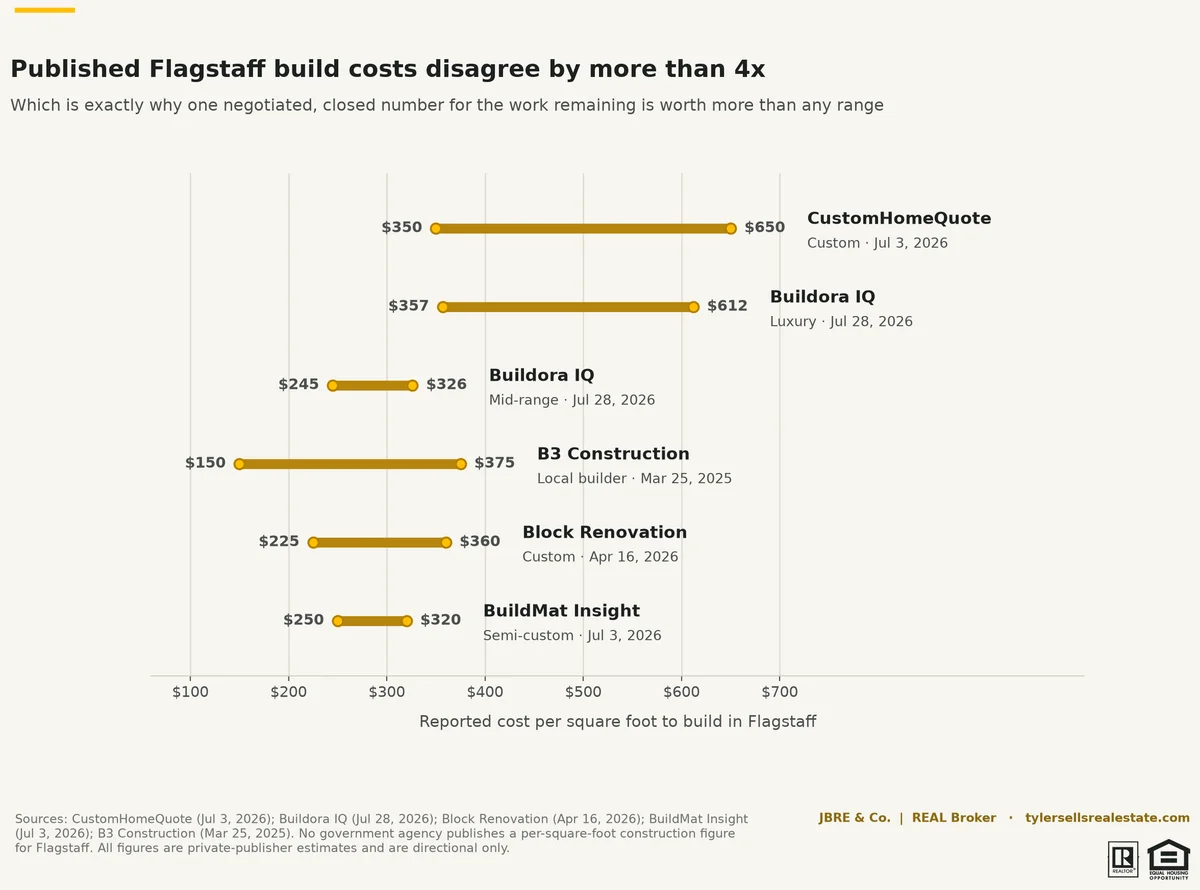
Here is the honest state of the data: published cost-per-square-foot figures for Flagstaff disagree by a factor of four.
Neither Coconino County nor any government agency publishes a per-square-foot construction figure for this market, which is why the private estimator sites fill the vacuum and contradict each other. Treat every number above as directional.
What everyone does agree on is why Flagstaff costs more than the valley: 48-inch frost-depth foundations, snow-load engineered trusses — ground snow loads in Coconino County can exceed 40 pounds per square foot — steep-slope grading, and wildland-urban-interface fire code (Block Renovation; BuildMat Insight). Site prep alone can add $50,000 to $100,000 before a foundation is poured.
Against that spread, a scoped, negotiated, closed number for the work remaining on a specific house at a specific elevation is worth more than any of the ranges above.
The three risks that almost killed the deal
The property was listed at finished value on purpose. Guessing the discount for the buyer costs you money — put the finished number up, make the market tell you what the remaining work is worth, then negotiate against a real scope. It worked, but it took 76 days and three risks that every buyer raised.
Cost risk. The builder's completion estimate was an estimate. Overruns at 7,000 feet are not a hypothetical, and a buyer who is wrong about scope eats the difference personally.
Time risk. Carrying a house you cannot occupy while you finish it means paying for two housing situations at once, through a construction season that closes for winter.
Unknown risk. Everything behind the sheathing was installed by somebody else's crew, to somebody else's standard, and inspected — or not — on somebody else's timeline. A buyer's third-party inspection of a partially built structure is not optional, and neither is pulling every permit and inspection record on file with the county.
Coconino County's permit clock runs faster than the city's
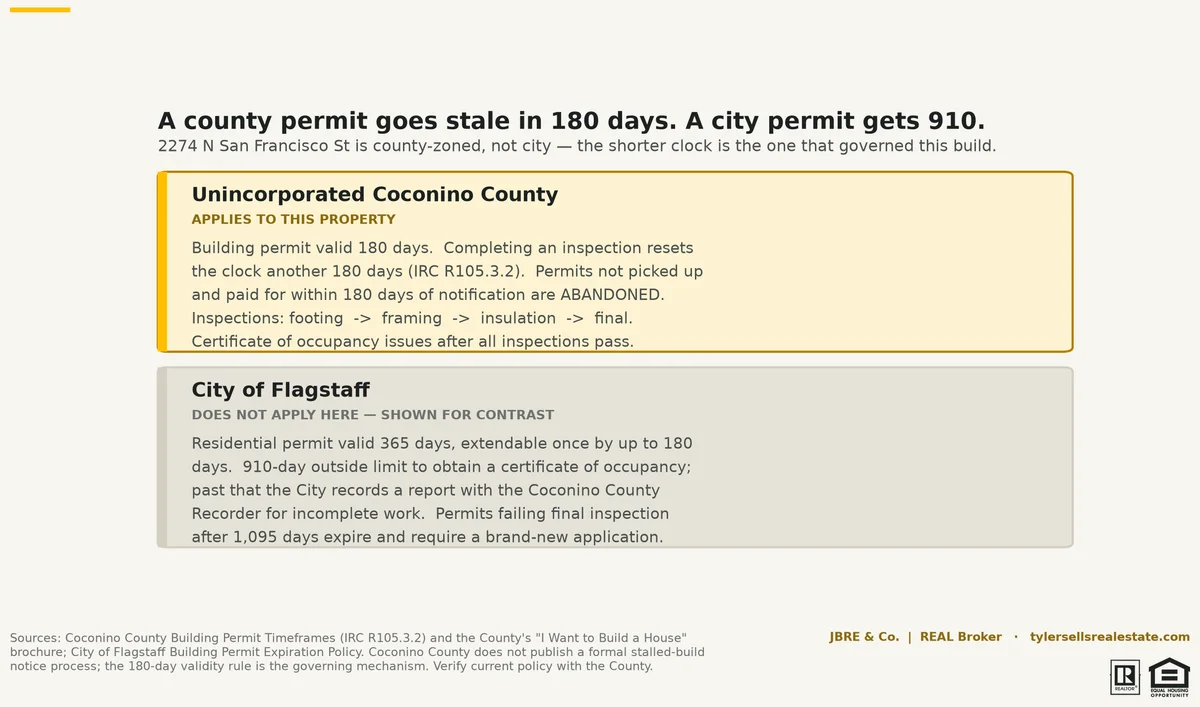
If your build is in unincorporated Coconino County — as this one was — you are on a much shorter leash than most people assume.
A Coconino County building permit is valid for 180 days. Completing an inspection resets the clock for another 180 days, per International Residential Code Section R105.3.2 (Coconino County Building Permit Timeframes). Permits not picked up and paid for within 180 days of notification are classified as abandoned. The inspection sequence for a single-family dwelling runs foundation and footing, framing, insulation, final — and the county issues the certificate of occupancy after all required inspections pass (Coconino County, "I Want to Build a House").
Inside city limits the rules are materially more forgiving: a City of Flagstaff residential permit is good for 365 days, extendable once by up to 180 days, with a 910-day outside limit to obtain a certificate of occupancy — after which the city records a report with the Coconino County Recorder for incomplete work. Past 1,095 days without passing final inspection the permit expires outright and requires a brand-new application (City of Flagstaff Building Permit Expiration Policy).
Do not conflate the two. A county build that goes quiet for six months without an inspection is in a different position than a city build that does the same thing.
Two acres, a shared well, and what a buyer has to verify
The property runs on a shared well, which is common north and west of town and routinely underexamined.
Under Arizona Department of Water Resources rules, a shared well may serve up to 14 service connections or up to 24 residents; past that it becomes a community water system under heavier regulation. Critically, a well-sharing agreement is a private contract. Arizona water law governs how a well is drilled and located — it does not govern the operation, management, terms, or enforcement of the sharing agreement, and no state agency can adjudicate a dispute over one (ADWR). ADWR also notes that sharing agreements are generally not in its imaged records, so the recorded document lives at the County Recorder (ADWR).
Before you write an offer on any shared-well property in Coconino County:
Pull the actual recorded well-sharing agreement from the Coconino County Recorder. Do not accept a summary.
Confirm how many parcels and connections share the well, and whether that count is under the 14-connection, 24-resident threshold.
Read who pays for maintenance, repair and replacement, and what happens when a party refuses. The contract is the only remedy you have.
Verify the well's permitted status and location under Arizona water law, separately from the sharing agreement.
What this means for the north end of 86001
Three different owners should read this sale three different ways.
If you own a bungalow on Beaver or a fifties ranch on Dale, this is not your comp. Nothing about it transfers. Different zoning, different acreage, different condition, different buyer. Pricing an in-town home off a two-acre county shell will cost you.
If you own acreage or an unfinished build north of town, this is your marker. For context on how thin that data is: across 24 months, the only other unfinished-structure sale we could find in the Flagstaff area was a partially installed Amish-built log tiny home on 1.18 acres in Elk Park Meadows, listed at $160,000 and marketed as a vacant lot with materials included (listing video, November 17, 2024). That is the entire comparable set. One tiny home and this house.
For reference on what completed inventory is doing around you: the 86001 ZIP had 279 active listings and a $746,402 median listing price in June 2026, with homes selling about 1.5% under asking at a 98% sale-to-list ratio (Realtor.com). Citywide, Redfin put the median sale price at $709,575 and days on market at 31 for the three months ending May 2026 (Redfin). These come from different sources with different windows and filters, so read them side by side rather than averaging them.
If you are mid-build and thinking about stopping
Pause the decision, not the project — and do it while the interior is still open.
That open plan is a real, marketable asset for exactly one phase of construction. Once you finish enough interior to lose the flexibility but not enough to earn a certificate of occupancy, you own the worst version of this property: too built to sell as land, too unbuilt to sell as a house, and unfinanceable either way.
If you are staring at that decision right now, the sequence is: get the remaining scope priced in writing by a licensed contractor, confirm your county permit and inspection status before the 180-day clock runs, and then compare finishing to selling with actual numbers on both sides. Do that math before the framing weathers another winter.
Frequently asked questions
Can you get a mortgage on a house with no certificate of occupancy? Not a standard purchase mortgage. FHA treats a structure with no CO as "Under Construction" and requires the permit plus the CO, or a ten-year warranty and final inspection (HUD 4000.1). Fannie Mae requires improvements to be complete when the loan is delivered (B4-1.2-05). Realistic paths are cash, an FHA 203(k) Standard, construction-to-permanent, or portfolio construction lending.
How long is a Coconino County building permit good for? 180 days, reset for another 180 days each time an inspection is completed (Coconino County). City of Flagstaff permits run on a separate and longer schedule.
How much does it cost to build a house in Flagstaff? Published estimates for 2026 range from roughly $150 to $650 per square foot depending on the source and the finish level, with no government-published figure to anchor them. Snow-load engineering, 48-inch frost-depth foundations, slope grading and wildfire code are the local cost drivers. Get a bid, not an index.
Should I list an unfinished house at finished value or discounted? This seller listed at finished value and let the market price the remaining scope, closing at 81.4% of ask. Discounting up front hands the negotiation away before it starts — but it only works if you can hand buyers a documented scope for the work that is left.
Is a shared well a problem in Flagstaff? Not inherently, but the agreement is a private contract with no state enforcement (ADWR). Read the recorded document from the County Recorder before you go under contract.
Talk to somebody who has actually closed one
Jake Martin was the listing agent on this sale. He was born and raised in Flagstaff, comes from a family construction background, and has now taken an unfinished house at the top of N San Francisco Street from list to cash close. If you own acreage north of town, own a stalled build, or are weighing whether to finish or sell, that is the conversation to have before you commit either direction.
Jake Martin, REALTOR® JBRE & Co. | brokered by Real Broker AZ, LLC (928) 707-0504 jake@jbreandco.com License #SA681649000
Want the wider picture on the neighborhoods around this one? Start with our guides to Hospital Hill and NoHo, Presidio in the Pines, and Railroad Springs.
JBRE & Co. is brokered by Real Broker AZ, LLC. Equal Housing Opportunity. This article is informational and is not legal, lending, tax, or construction advice. Market figures are attributed to their sources and dates above; sources measure different windows and geographies and should not be averaged. Transaction details for 2274 N San Francisco Street reflect JBRE & Co.'s own file for a transaction in which JBRE represented the seller and may not yet appear on public listing portals. Construction cost ranges are from private estimator publications, not government data. Verify all permit, well, and financing information with Coconino County, the Arizona Department of Water Resources, and a licensed lender before acting.

Written by
Tyler Vaughan
Northern Arizona's top-rated real estate agent with 350+ five-star reviews. Specializing in Sedona, Flagstaff, and Northern AZ luxury properties.
Ready to Make Your Move?
Whether you are buying or selling in Northern Arizona, Tyler is here to help you navigate the market with confidence.