


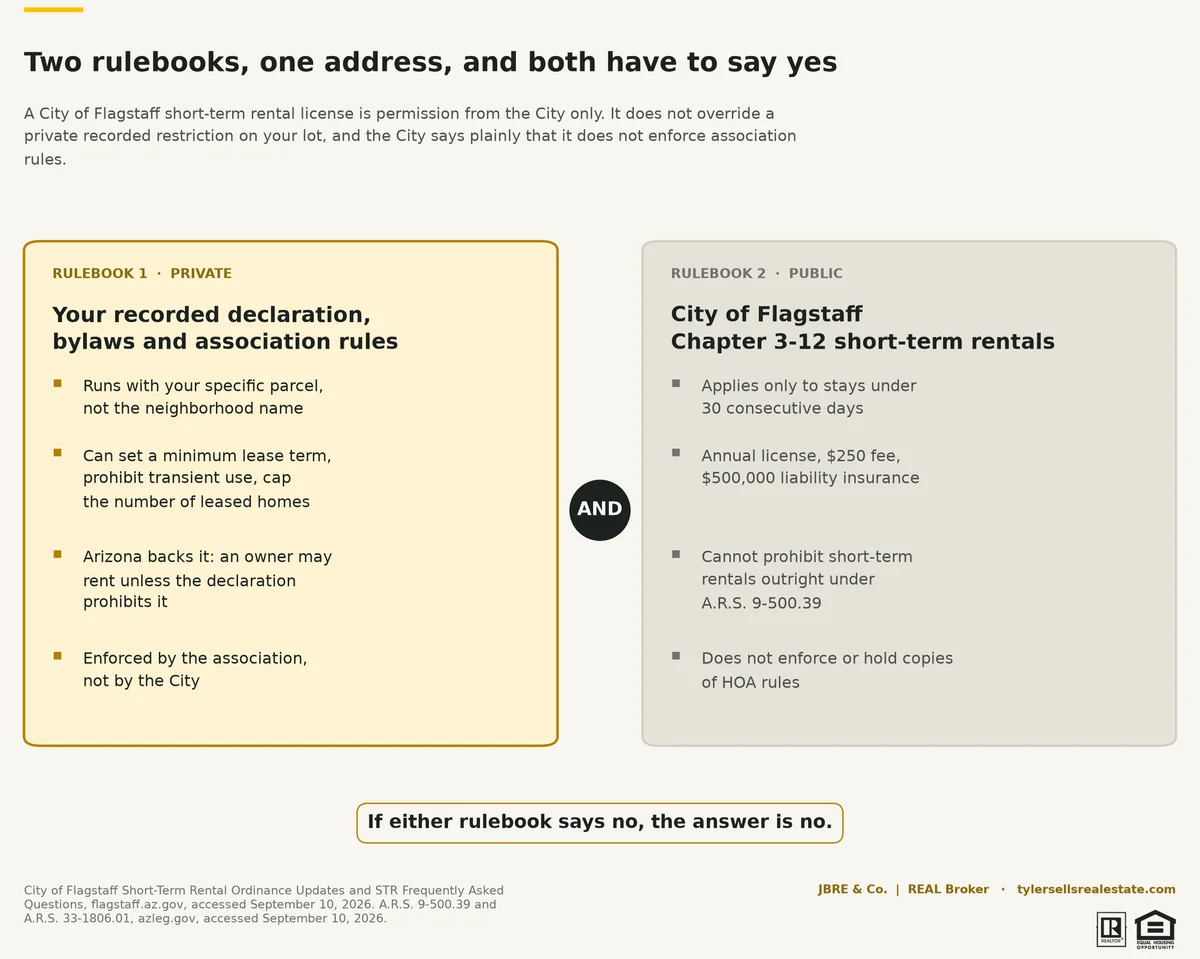
Railroad Springs rental rules are not one rule. They are two separate rulebooks that both have to say yes before you can put a tenant or a guest in a Flagstaff home, and the subdivision name printed on an MLS sheet does not tell you which one applies to your address.
The first rulebook is private. It is the recorded declaration, the bylaws, and the association rules that run with your specific lot or unit in Railroad Springs. The second is public. It is the City of Flagstaff short-term rental ordinance, Chapter 3-12 of the city code, plus the state law that limits what the City is allowed to require.
Owners get this wrong in one predictable direction. They confirm the City will issue a short-term rental license, assume that settles it, and never open the declaration that governs their own lot. The City is explicit that it does not play referee here: "The city does not enforce or have copies of HOA rules" (City of Flagstaff STR FAQ).
The short version:
A City short-term rental license is permission from the City only. It is not permission from your association.
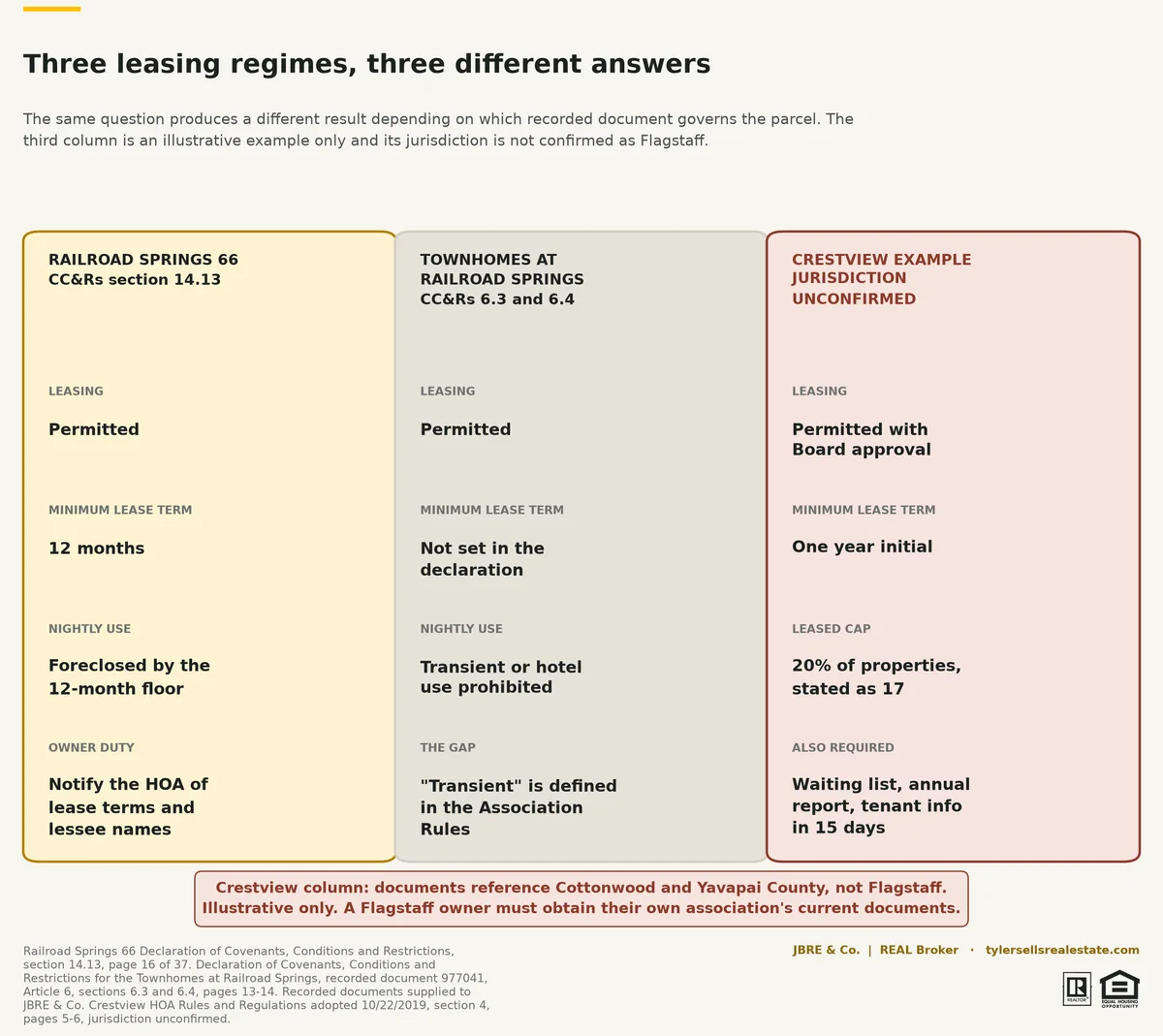
Railroad Springs 66 sets a minimum lease term of 12 months in its recorded CC&Rs. That closes the nightly-rental question on that side of the neighborhood before the City ever gets involved.
The Townhomes at Railroad Springs declaration permits leasing but prohibits transient or hotel use. The day count that defines "transient" lives in the Association Rules, not in the declaration.
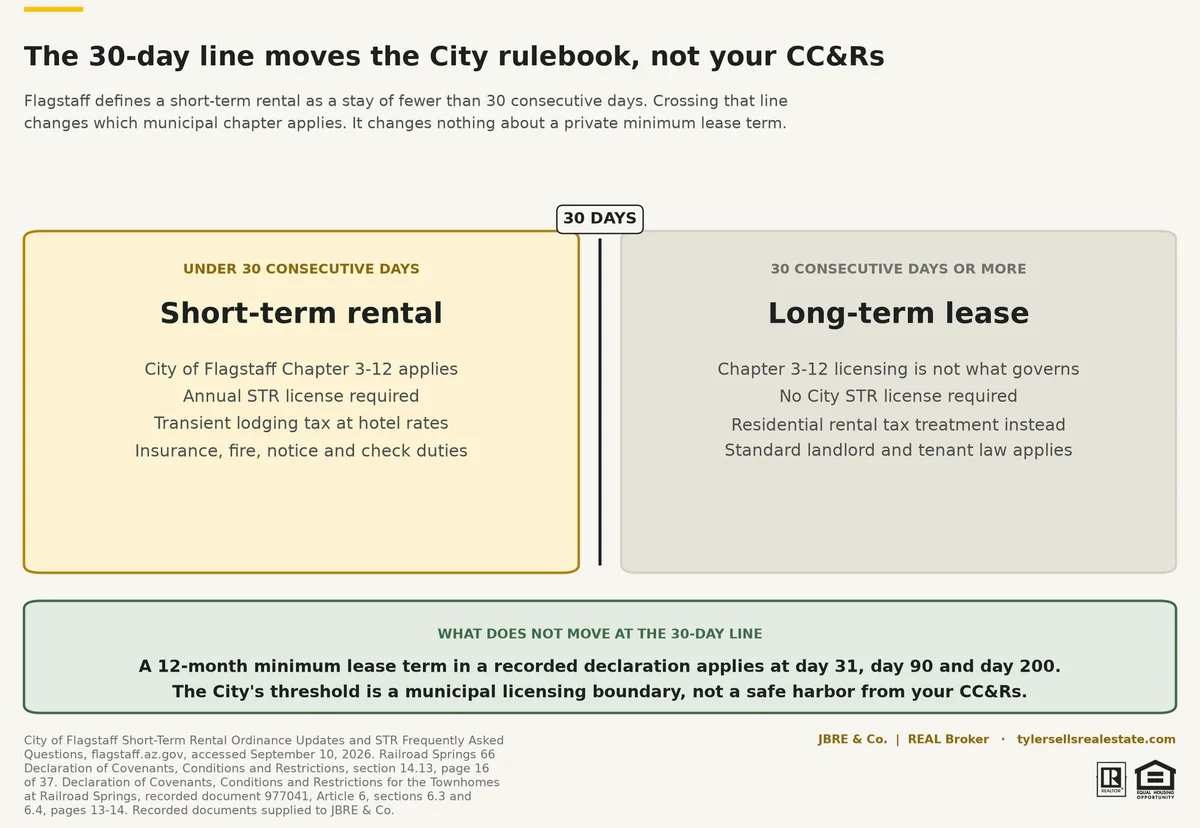
The City treats a stay of fewer than 30 consecutive days as a short-term rental (City of Flagstaff STR FAQ).
Arizona law backs the private document. A member may rent unless the declaration prohibits it, and must follow the declaration's rental time period restrictions (A.R.S. 33-1806.01).
This article is education, not legal advice. Get written confirmation from your association, and where money or a contract deadline depends on the answer, get title or real estate counsel involved before you treat a rule as settled.
Two rulebooks decide whether you can rent in Railroad Springs
Think of it as two gates in series, not two opinions you get to choose between.
Gate one is the private recorded restriction. Arizona is clear that this gate is real: under A.R.S. 33-1806.01(A), an owner may use the property as a rental "unless prohibited in the declaration," and must use it "in accordance with the declaration's rental time period restrictions" (A.R.S. 33-1806.01). A minimum lease term written into a declaration is exactly that kind of time period restriction.
Gate two is the City. Arizona also preempts cities from banning short-term rentals outright. A city or town "may not prohibit vacation rentals or short-term rentals," and the things Flagstaff is allowed to require are enumerated in statute: health and safety rules, zoning and nuisance ordinances applied evenhandedly, emergency contact information, a local license capped at $250, neighbor notification, and liability coverage of at least $500,000 (A.R.S. 9-500.39).
Both gates have to open. If the declaration says 12 months minimum, the City's willingness to license a nightly rental is irrelevant to you. If the declaration is silent and the City licenses you, you still have to operate inside the City's requirements.
Railroad Springs 66: a 12-month minimum lease
On the Railroad Springs 66 side of the neighborhood, the recorded declaration answers the question directly.
Section 14.13 of the Railroad Springs 66 Declaration of Covenants, Conditions and Restrictions sets a minimum lease term of 12 months. The same section requires the owner to promptly notify the Association of the lease terms and the name of each lessee.
Read plainly, that is a long-term rental community by private contract. A 12-month floor forecloses nightly and weekly use without the City having to say anything at all, and it forecloses the 29-day stay that would otherwise sit just under the City's short-term threshold.
The notification duty is the part owners skip. It is not optional paperwork. It is a covenant obligation triggered every time you sign a lease, and Arizona caps what the association can ask for in return: name and contact information for adults occupying the property, the lease start and end dates, and vehicle descriptions and plate numbers (A.R.S. 33-1806.01).
Railroad Springs 66 is managed by Peaks HOA Management Company, at 1016 W University Ave Suite 203 in Flagstaff, reachable at 928-556-1461 (Peaks HOA Management). That is where you request the current declaration, any amendments, and the rules in force today. If you are still shopping the area, the Railroad Springs homes for sale guide covers the product types you will be choosing between.
Townhomes at Railroad Springs: leasing allowed, transient use prohibited
The townhome side is governed by a different recorded document with a different structure, which is the whole reason this article exists.
The Declaration of Covenants, Conditions and Restrictions for the Townhomes at Railroad Springs, recorded as document 977041, addresses leasing in Article 6. Sections 6.3 and 6.4 permit leasing, then prohibit transient or hotel use of a unit.
Here is the trap. The declaration does not define "transient" with a number. The definition lives in the Association Rules, which are a separate instrument that a board can adopt and amend outside the declaration. Any day count you have heard quoted for this community, from anyone, is unverified until you have the current Association Rules in hand.
So the honest answer for a Townhomes at Railroad Springs owner is: leasing is permitted, hotel-style use is not, and the threshold that separates the two is a number you have to pull from the Association before you rely on it. Do not assume it matches the City's 30-day line. There is no requirement that a private document track a municipal definition.
Townhomes at Railroad Springs is managed by Vision Community Management, reachable at 928-286-3080 or townhomesrailroadsprings@wearevision.com (Vision Community Management). Ask for the declaration, the current rules, and every amendment. Ask in writing.
Why the subdivision name on an MLS sheet does not settle Railroad Springs rental rules
Two homes can sit a quarter mile apart on Railroad Springs Boulevard, both described as Railroad Springs in casual conversation, and be governed by entirely different recorded documents with different leasing regimes.
That is why "Railroad Springs" as a neighborhood label is not an answer to a rental question. The unit of analysis is the parcel and the recorded declaration that runs with it, not the neighborhood name a listing agent typed into a field.
The MLS makes this worse in a specific way. A "Short Term Rental Allowed" field on a listing is an input field. Someone typed a value into it. It is not a legal determination, it is not a title search, and it does not bind the association. The same conflict shows up in our archive of a Railroad Springs manufactured home sale, where the paperwork and the listing fields were telling two different stories.
Treat the field as a lead to verify, never as the verification. If a rental strategy is the reason you are buying, make the governing documents a contingency item and read them inside your inspection period.
What a strict leased-cap regime can look like
Read this section as an illustration only. The Crestview documents reviewed here reference Cottonwood and Yavapai County, not Flagstaff and Coconino County. Their jurisdiction is unconfirmed, and they are not published here as the rules for Flagstaff's Crestview. A Flagstaff Crestview owner must obtain their own association's current documents. Nothing below should be applied to a Flagstaff address.
With that stated plainly, the example is worth studying because it shows how far a private leasing regime can go beyond a simple minimum term. The Crestview HOA Rules and Regulations adopted 10/22/2019, section 4, pages 5 through 6, layer on:
A cap of 20% of properties leased at any time, stated as 17 properties
A written application plus Board approval before leasing
A waiting list when the cap is full
A one-year minimum initial lease
An annual status report from the owner
Registration with the assessor within 10 days
Tenant information delivered to the Association within 15 days
The point is not the specific numbers. The point is the shape. A cap plus an approval plus a waiting list means an owner in that kind of community can be fully compliant, fully licensed, and still unable to lease this year because the quota is full. No city ordinance produces that outcome. Only a private document does.
If you are comparing how differently two Flagstaff communities handle this, our breakdown of Presidio in the Pines short-term rental rules walks through another association's approach in detail.
The City of Flagstaff layer: what a licensed short-term rental requires
If, and only if, your private documents permit a stay of fewer than 30 consecutive days, the City layer comes into play.
Flagstaff has required an annual short-term rental license since November 2023, valid for one year and renewed annually (City of Flagstaff STR Property Owners). In 2026 the City adopted Ordinance 2026-11, amending Chapter 3-12 and Chapter 3-10, effective July 1, 2026 (Ordinance 2026-11).
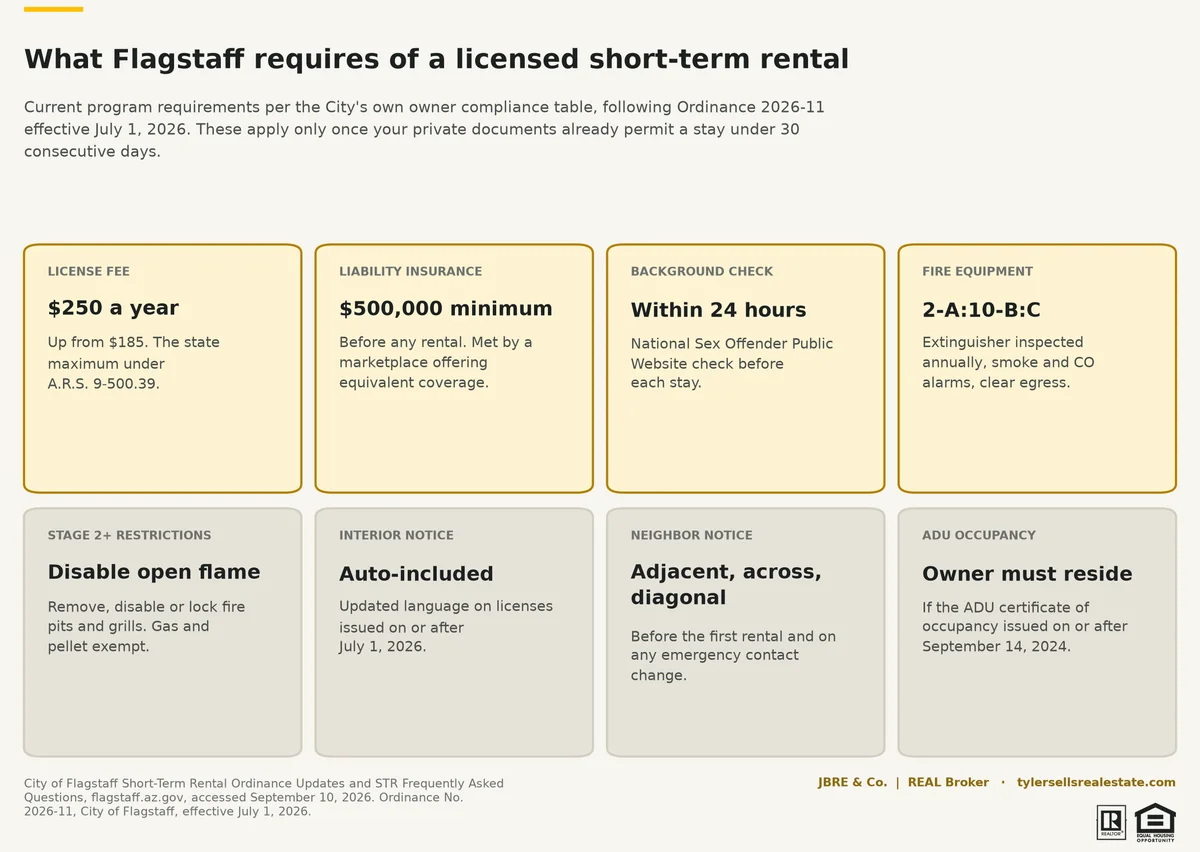
What the current program requires of an owner, per the City's own compliance table (Short-Term Rental Ordinance Updates, accessed September 10, 2026):
License fee of $250, up from $185, due at annual renewal. That is the state maximum, which A.R.S. 9-500.39 caps at the lesser of actual cost or $250.
Liability insurance of at least $500,000, in place before any rental. Satisfied if you advertise through an online marketplace providing equivalent coverage.
A sex-offender registry check against the National Sex Offender Public Website no later than 24 hours before each stay. Also satisfied if your marketplace performs it.
Fire safety equipment: working smoke alarms, carbon monoxide detectors where applicable, a fire extinguisher rated at least 2-A:10-B:C and inspected annually, and clear egress paths at all times.
Stage 2+ fire restrictions: remove, disable, or securely lock any fire pit, open-flame barbecue, or grill. Gas and pellet appliances with a functional on/off switch are exempt.
Updated interior notice, now covering winter parking restrictions, fire restriction information, waste and recycling collection, and the human trafficking hotline. The updated language is included automatically on licenses issued on or after July 1, 2026.
Neighbor notification to adjacent, across, and diagonally adjacent single-family properties before the first rental and whenever emergency contact information changes.
ADU owner-occupancy: if the property contains an accessory dwelling unit with a certificate of occupancy issued on or after September 14, 2024, the owner must reside on the property as a primary residence to license the short-term rental.
Prohibited uses: no retail, restaurant, banquet, or event center use, and nothing requiring a Temporary Use Permit or Special Event Permit.
Two prerequisites come before the application itself: an Arizona Department of Revenue transaction privilege tax license, and completed written neighbor notifications (City of Flagstaff STR Property Owners). The City has seven business days to review a complete application.
The 30-day line, and which rulebook each side triggers
The City's definition is the cleanest number in this entire article: "A short-term rental refers to the rental of part or all of any legally permitted dwelling unit for fewer than 30 consecutive days" (City of Flagstaff STR FAQ).
Below 30 consecutive days, you are in the City's short-term rental program and you owe transient lodging tax at hotel rates. At 30 consecutive days or more, the City's short-term rental licensing chapter is not what governs you.
What does not change at that line is the private document. A 12-month minimum in a declaration keeps applying at day 31, at day 90, and at day 200. The City's 30-day threshold is a municipal licensing boundary, not a safe harbor from your CC&Rs.
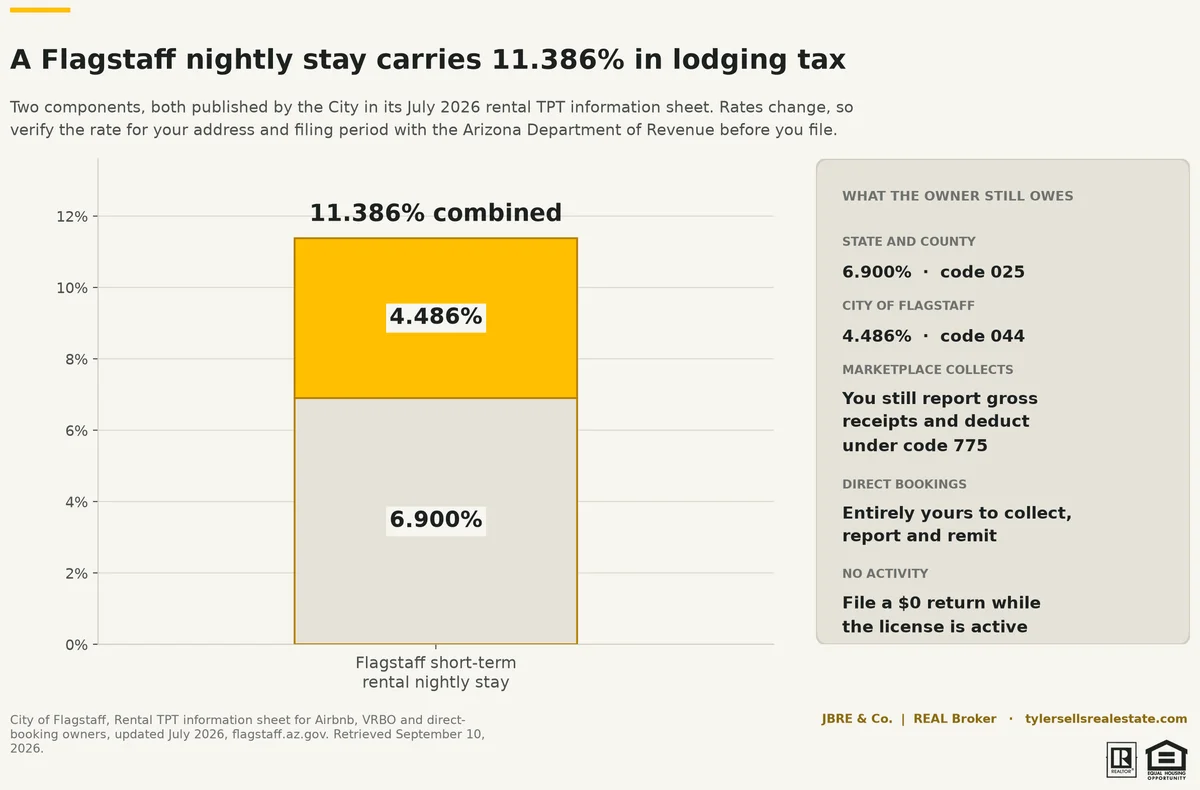
What a Flagstaff nightly rental owes in lodging tax
If you clear both gates and operate below 30 days, the tax stack is not optional and it is not small.
The City's own July 2026 rental TPT information sheet lists two components for a Flagstaff short-term rental: State and County transient lodging under business code 025 at 6.90%, and City of Flagstaff lodging under business code 044 at 4.486% (City of Flagstaff Short-Term Rentals TPT Information Sheet, updated July 2026). Combined, that is 11.386% on the nightly stay.
The same sheet is specific about what owners still owe even when a marketplace collects. You report gross receipts on the TPT return and deduct qualifying marketplace receipts using deduction code 775. You file $0 returns for periods with no activity while the license is active. Direct bookings taken outside a marketplace are entirely yours to collect, report, and remit, and taxable receipts can include cleaning fees and other booking-related charges.
Rates change. Verify the rate for your address and filing period against the Arizona Department of Revenue rate table before you file. That is the City's own instruction on the same sheet.
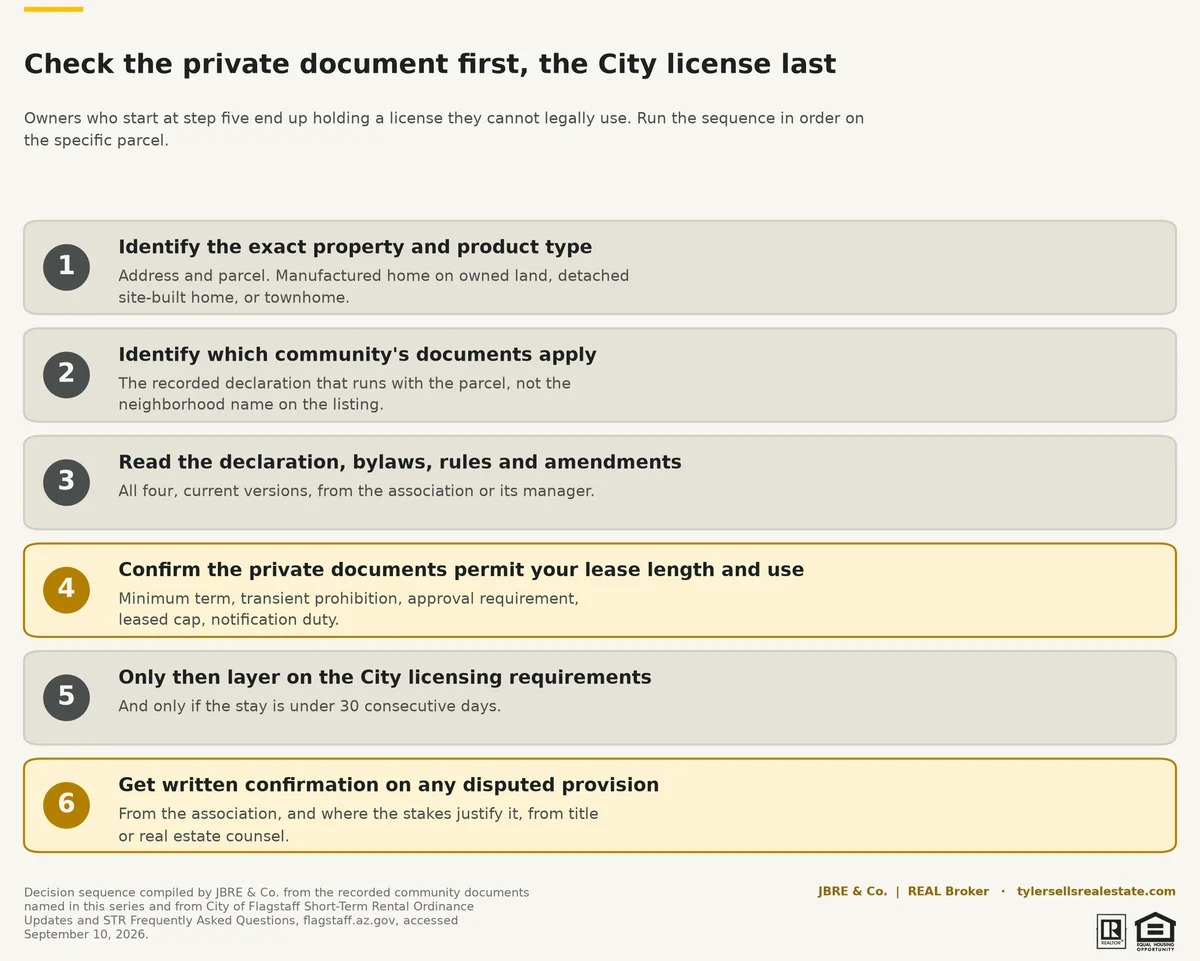
The six-step sequence for checking Railroad Springs rental rules
Run this in order. Skipping to step five is how owners end up with a license they cannot legally use.
Identify the exact property and product type. Address and parcel, and whether it is a manufactured home on owned land, a detached site-built home, or a townhome. The product type usually tells you which association you are dealing with.
Identify which community's governing documents apply to that address. Not the neighborhood name. The recorded declaration that runs with the parcel.
Read the applicable declaration, bylaws, rules, and amendments. All four, current versions, from the association or its manager. A neighborhood-wide assumption is not a substitute for a document.
Determine whether the private documents permit a lease of the length and use you intend. Minimum term, transient prohibition, approval requirement, leased cap, notification duty.
Only then layer on the City's licensing and operating requirements, and only if the stay is under 30 consecutive days.
For any disputed provision, get written confirmation from the association, and where the stakes justify it, from title or real estate counsel, before you treat the rule as settled.
Questions Railroad Springs owners ask
Can the City override my HOA if the HOA says no? No. The City licenses, it does not authorize you against a private covenant. Its FAQ says that if HOA rules allow rentals of less than 30 days, short-term rentals are likely allowed, and to check the HOA rules, because the City does not enforce them (City of Flagstaff STR FAQ).
Can my HOA override the state and just ban all rentals? The declaration is what controls. A member may rent unless the declaration prohibits it, and must follow the declaration's rental time period restrictions (A.R.S. 33-1806.01). Arizona also limits what an association may demand about a tenant, caps the disclosure fee at $25 per new tenancy, and bars charging a rental property differently from an owner-occupied one.
A listing says short-term rental allowed. Is that enough? No. It is a data field someone filled in. Verify against the recorded declaration and the current association rules for that specific parcel.
Does a 29-day stay get me around a 12-month minimum? No. A 29-day stay is below the City's 30-day line, which puts you further inside the short-term rental program, not outside the covenant. A 12-month minimum lease term forecloses it.
Where do I get the documents? From the association or its management company. For Railroad Springs 66 that is Peaks HOA Management Company at 928-556-1461 (Peaks HOA Management). For the Townhomes at Railroad Springs that is Vision Community Management at 928-286-3080 (Vision Community Management). Request the declaration, bylaws, current rules, and all amendments, and request them in writing.
How does the rest of the Flagstaff market factor in? Rental strategy is one input into value, not the whole picture. Published citywide figures disagree with each other, so read them separately rather than averaged: Redfin puts the Flagstaff median sale price at $700,619 for the three months ending June 2026, down 4.0% year over year (Redfin), while Zillow reports a $674,367 median sale price through July 31, 2026 (Zillow). For neighborhood-level context, see the Railroad Springs market report.
Talk to a Railroad Springs agent before you rely on a rule
If the rental question is the reason you are buying, selling, or refinancing in Railroad Springs, get the governing documents in front of you before the inspection period closes. Lucas works Railroad Springs specifically, including which association covers which streets and what the current documents actually say.
Get an ordinance and document review on a specific address, or a straight read on what your home is worth given how it can and cannot be rented.
Lucas Cowan · REALTOR®, JBRE & Co., brokered by Real Broker 619-847-3811 · lucas@jbreandco.com
This article is general education about recorded community documents and municipal ordinances. It is not legal advice, and it makes no representation about rental income or investment outcomes. Equal Housing Opportunity.

Written by
Tyler Vaughan
Northern Arizona's top-rated real estate agent with 350+ five-star reviews. Specializing in Sedona, Flagstaff, and Northern AZ luxury properties.
Ready to Make Your Move?
Whether you are buying or selling in Northern Arizona, Tyler is here to help you navigate the market with confidence.