

Ask five people whether Railroad Springs train noise is a problem and you will get five answers, because the honest answer depends on which street you are standing on. The BNSF main line runs along the south edge of this west Flagstaff neighborhood, and the distance between your future front door and that corridor is the single biggest variable nobody puts in a listing photo.
This is a field guide, not a verdict. Below is where the line sits, what a JBRE & Co. agent actually heard standing in the neighborhood on September 4, 2026, what the published train counts for the Flagstaff corridor say, and a checklist for evaluating a specific address before you write an offer.
The short version:
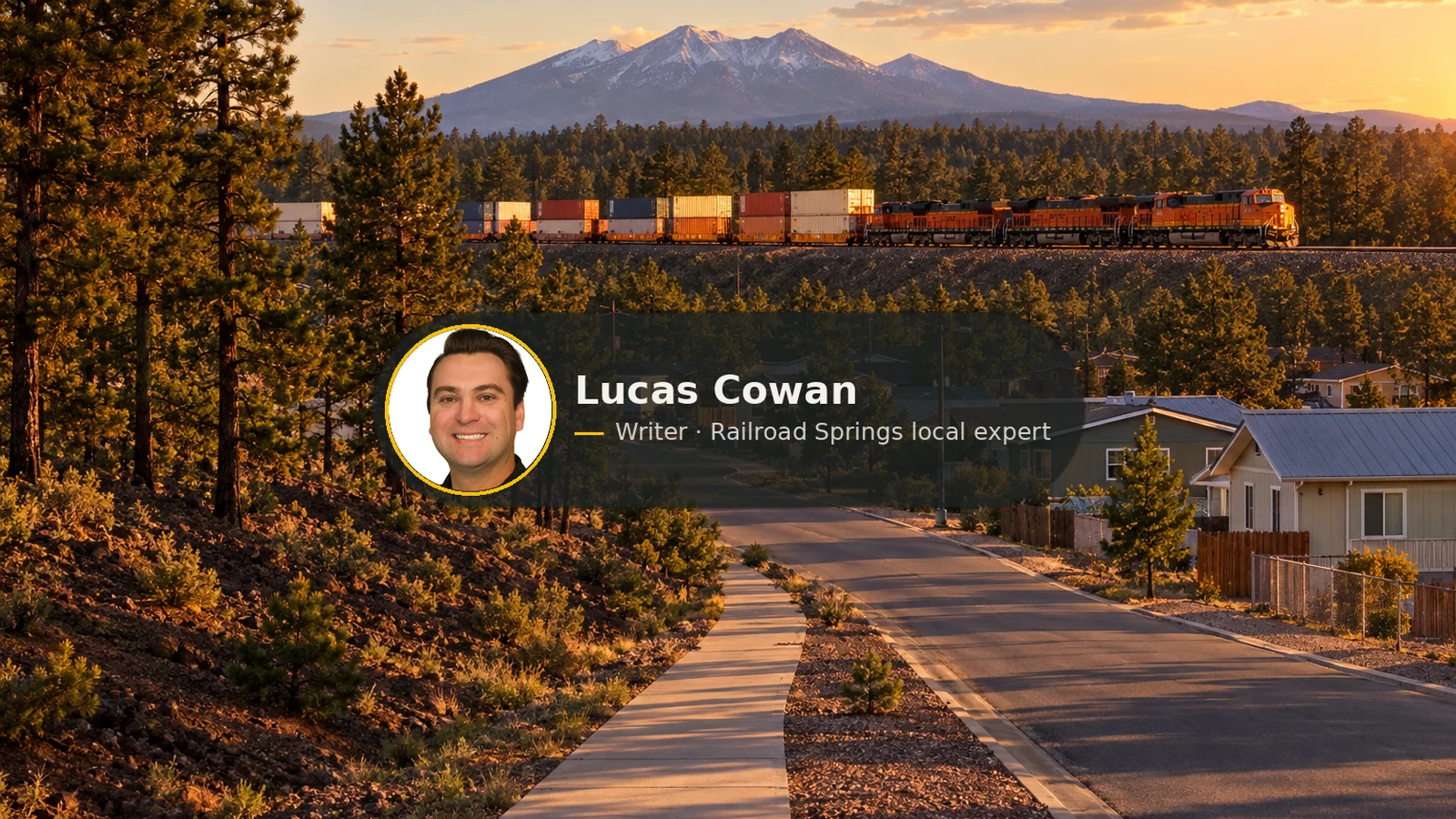
The BNSF corridor runs along the south edge of Railroad Springs. The neighborhood is named for it.
Published sources put Flagstaff corridor volume at roughly 100 trains a day, with one city planning document saying 100 to 120 depending on season.
Firsthand field observation on September 4, 2026 recorded roughly one train passing about every 15 minutes.
The Santa Fe Trail and Adirondack Ave area is the closest and loudest part of the neighborhood. When engines pass, the train is loud while you are outside.
From an Alaska Ave property the train is still audible, but over time it registers more like background white noise.
There is no decibel rating here for any street, and there will not be one. Go stand there, more than once, including at night.
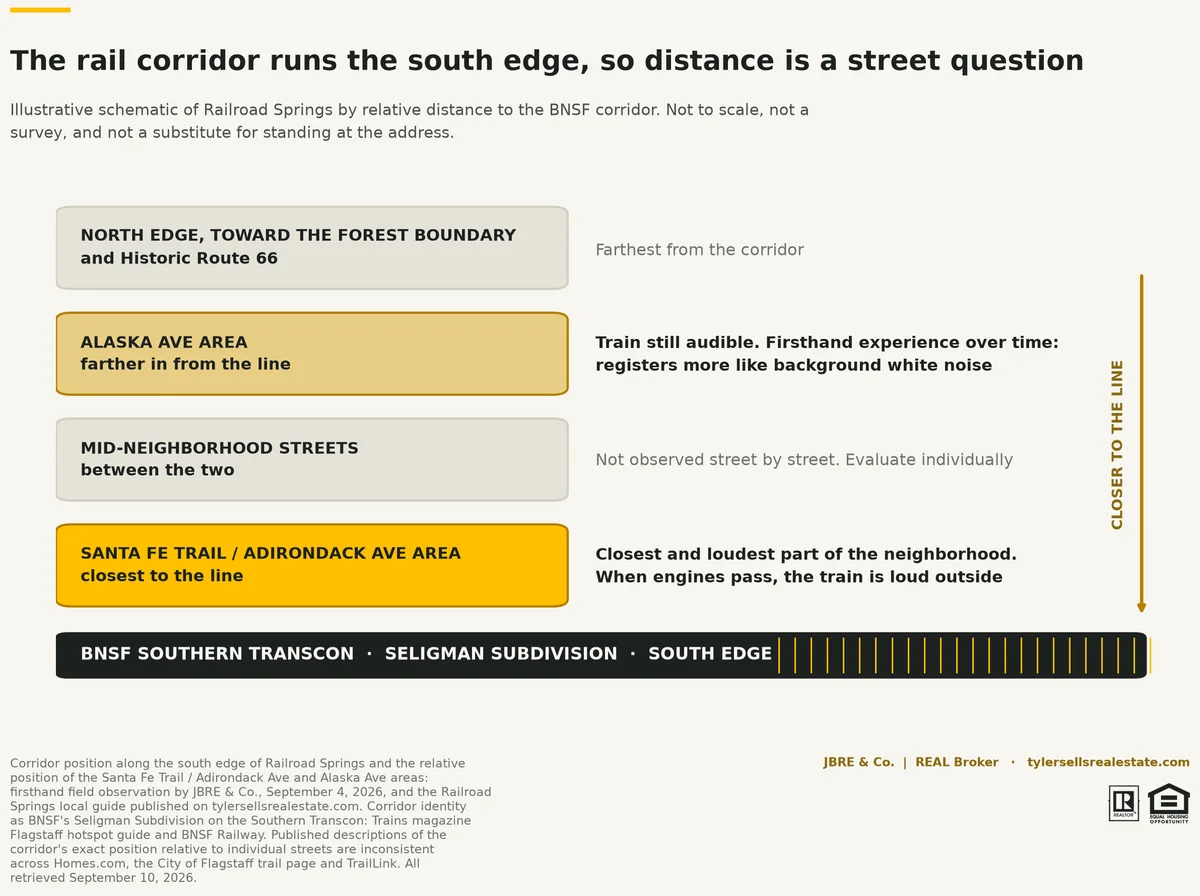
Where the BNSF line runs in Railroad Springs
Railroad Springs sits on Flagstaff's west side off Historic Route 66, near Woody Mountain Road, about three miles from downtown. The rail corridor through town is BNSF's Seligman Subdivision, part of the former Santa Fe "Transcon" route connecting West Coast ports to the Midwest, according to Trains magazine's Flagstaff hotspot guide and BNSF's own Flagstaff profile.
Here is where published descriptions get inconsistent, and it is worth knowing before you rely on any of them. The Homes.com neighborhood guide describes Railroad Springs as "located just south of the Burlington Northern Sante Fe Railroad." The City of Flagstaff trail page says the Railroad Springs Trail "follows the west side of Railroad Springs Boulevard, between Route 66 and the BNSF railroad tracks." TrailLink puts the tracks "just north of Adirondack Boulevard" and notes the connecting Tunnel Springs Trail begins "just south of the tracks."
Those descriptions do not line up cleanly with each other. What is consistent across all of them, and consistent with firsthand observation, is that the corridor borders the neighborhood on one side rather than running through its middle, and that the southern streets sit closest to it. That is the fact that matters for your offer. The fact that four published sources describe the geometry four slightly different ways is exactly why you should verify with your own ears at the address rather than from a map.
For the rest of the neighborhood picture, including lot ownership and housing stock, start with the Railroad Springs homes for sale guide.
What one agent heard standing in Railroad Springs
The following are firsthand field observations by JBRE & Co. in Railroad Springs on September 4, 2026. They are observations, not measurements, and they are reported here exactly as recorded.
The Santa Fe Trail and Adirondack Ave area is the closest and loudest part of the neighborhood to the line. When engines pass, the train is loud while you are outside. There is no softer way to phrase that, and softening it would not help anyone buying here.
From an Alaska Ave property, farther in from the corridor, the train is still audible. The firsthand experience there is that over time the sound registers more like background white noise rather than an event that interrupts what you are doing.
Both of those are true at the same time. That is the whole point of this article. "Is Railroad Springs loud" is the wrong question. "Is this address, on this street, acceptable to me" is the right one.
How often do trains pass? Observation versus published counts
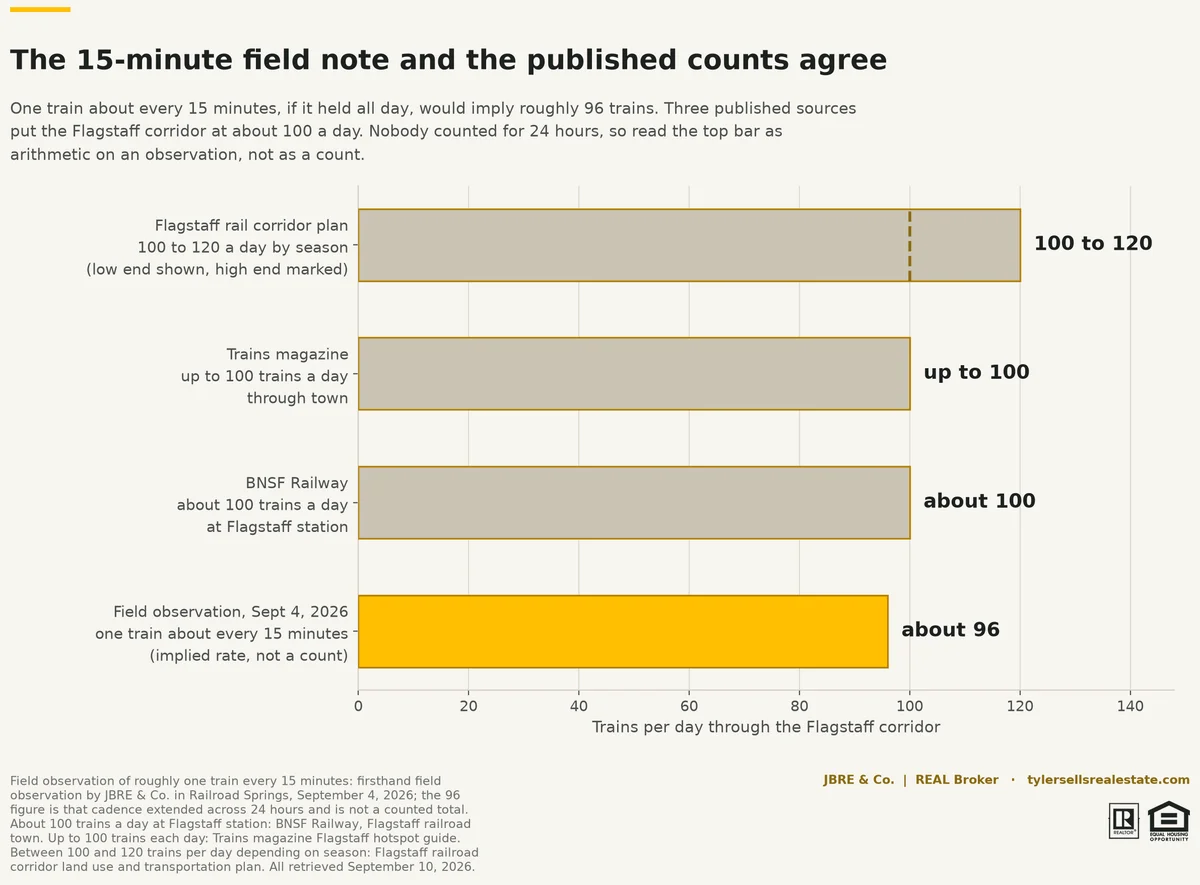
The September 4, 2026 field observation recorded roughly one train passing about every 15 minutes. Sustained around the clock, that cadence would imply something near 96 trains in a day, but nobody stood there for 24 hours, so treat that as arithmetic on an observation and not as a count.
Published sources for the corridor land in a similar range. BNSF says the Flagstaff station sits on the Southern Transcon and "sees about 100 trains, mainly intermodal, a day" (BNSF Railway). Trains magazine says "up to 100 trains blast through town each day, including intermodal, unit grain, and manifests" (Trains). The Flagstaff Railroad Corridor land use and transportation plan states "between 100 and 120 trains per day travel the rails depending on the season" (Rail Corridor Master Plan, City of Flagstaff planning document hosted by ChooseFlagstaff).
There is one more data point with an odd pedigree. When the city argued for horn relief, it said residents near the tracks "had been subjected to horns from the trains on BNSF's Chicago-Los Angeles route that went off every 15 minutes on average" (Tucson.com coverage of the Arizona appeals court ruling). That is the city's own characterization from that litigation, not a measurement taken in Railroad Springs, but the cadence it describes is the same one the September 2026 field observation recorded.
So the field observation and the published record are not in conflict. They point at the same rough picture: this is a busy freight corridor, and trains are frequent enough that you should plan on hearing them rather than hoping you will not.
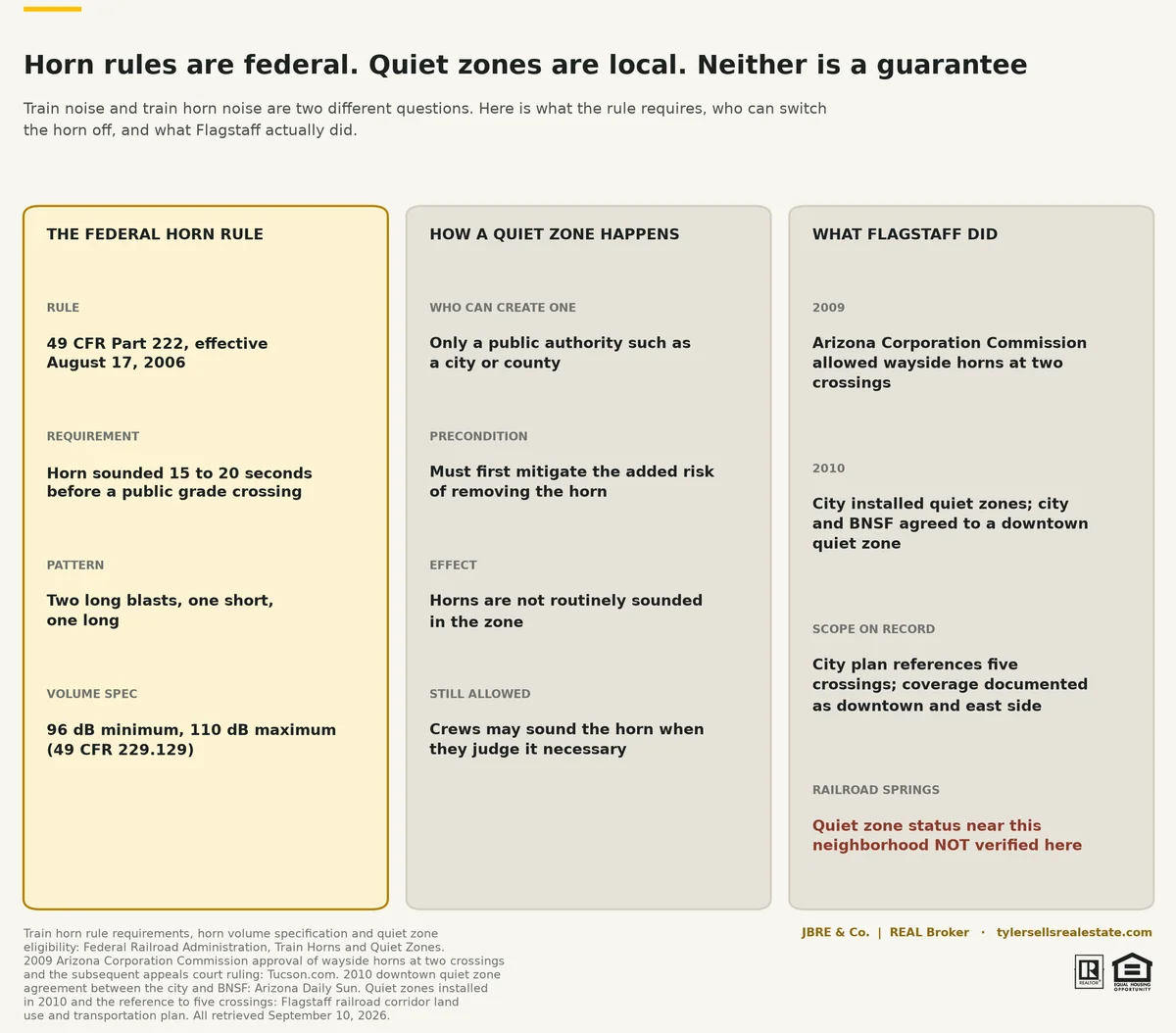
Horns are federal, quiet zones are local
Train noise and train horn noise are two different things, and buyers conflate them constantly.
Under the Federal Railroad Administration's Train Horn Rule, 49 CFR Part 222, effective August 17, 2006, "locomotive engineers are required to sound train horns at least 15 seconds and no more than 20 seconds before reaching a public highway-rail grade crossing," in a standardized pattern of two long blasts, one short, one long. A related regulation, 49 CFR 229.129, "requires that train horns operate at a maximum volume of 110 decibels and a minimum volume of 96 decibels" (Federal Railroad Administration).
The same rule created quiet zones. Only a public authority such as a city or county can establish one, and it must first mitigate the added risk of removing the horn (FRA).
Flagstaff did exactly that. The Arizona Corporation Commission gave the city permission in 2009 to install wayside horns at two crossings as part of a quiet zone, and the horns became operational the following year, a decision BNSF challenged and the Arizona appeals court upheld (Tucson.com). The Arizona Daily Sun reports that "in 2010, the city and BNSF agreed to establish a quiet zone in downtown, meaning train conductors are not required to blow their horns every time the train crosses the at-grade crossings," while conductors can still use horns when they judge a situation dangerous (Arizona Daily Sun). The city's rail corridor plan confirms "the City of Flagstaff installed quiet zones in 2010" and references five crossings (Rail Corridor Master Plan).
What that means for a Railroad Springs buyer: the quiet zone work documented in those sources is described as downtown and east side, and we have not verified quiet zone status for any crossing adjacent to Railroad Springs. Do not assume horns are off near your address, and do not assume they are on. Ask, and listen.
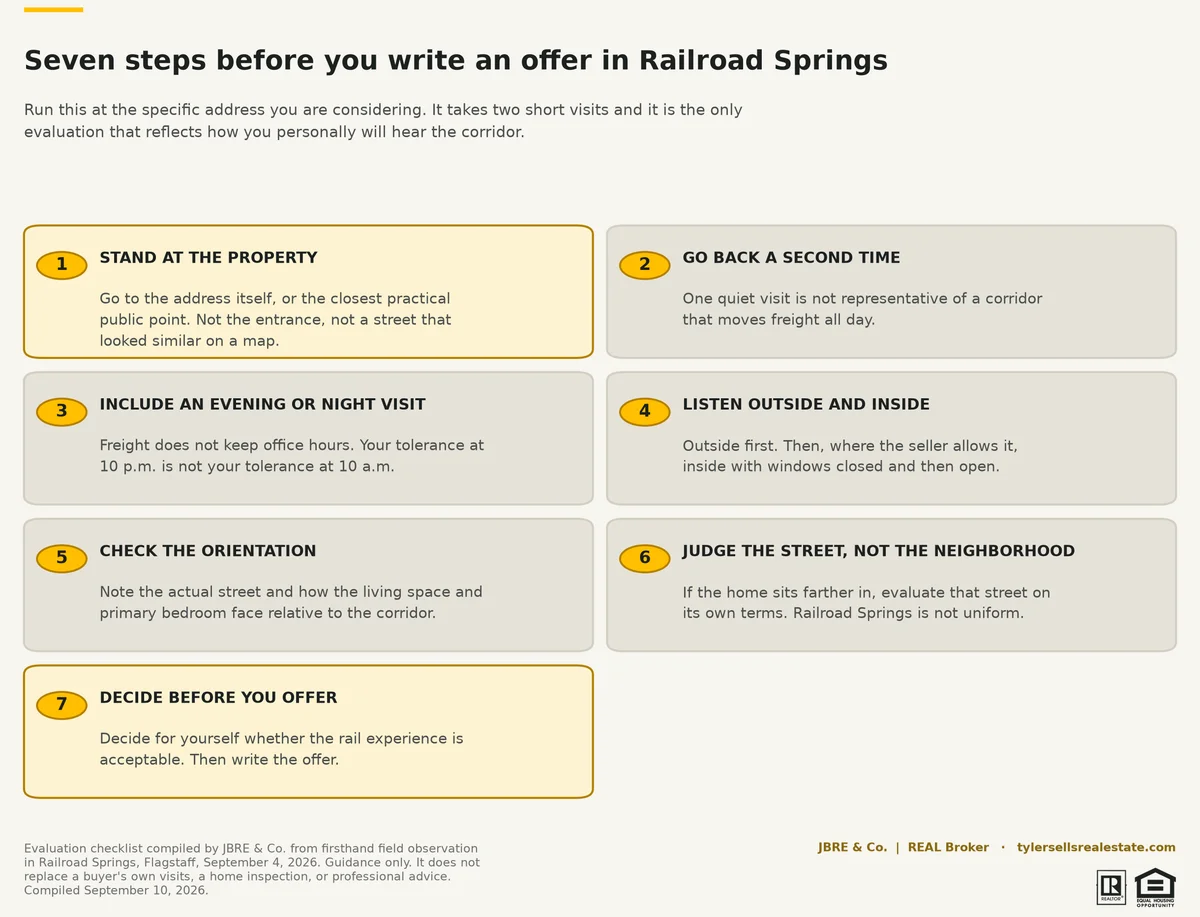
How to evaluate Railroad Springs train noise at a specific address
This is the part that actually protects you. Run it before the offer, not during inspection.
Stand at the specific property, or at the closest practical public point to it. Not the entrance, not a nearby street that looked similar on a map.
Visit more than once. One quiet visit is not representative of a corridor that moves freight all day.
Include an evening or nighttime visit. Freight does not keep office hours, and your tolerance at 10 p.m. is different from your tolerance at 10 a.m.
Listen from outside, and where the seller allows it, from inside the home with the windows closed and then open.
Pay attention to the actual street and how the house is oriented relative to the corridor.
If the property sits farther in from the tracks, evaluate that street on its own terms rather than assuming the experience is identical everywhere in Railroad Springs.
Then decide for yourself whether the rail experience is acceptable to you, before you write the offer.
If you are weighing this against price and inventory, the Railroad Springs market report shows what the neighborhood has actually been trading at, and this breakdown of one manufactured home sale shows how a specific Railroad Springs closing came together.
What changes the experience house to house in Railroad Springs
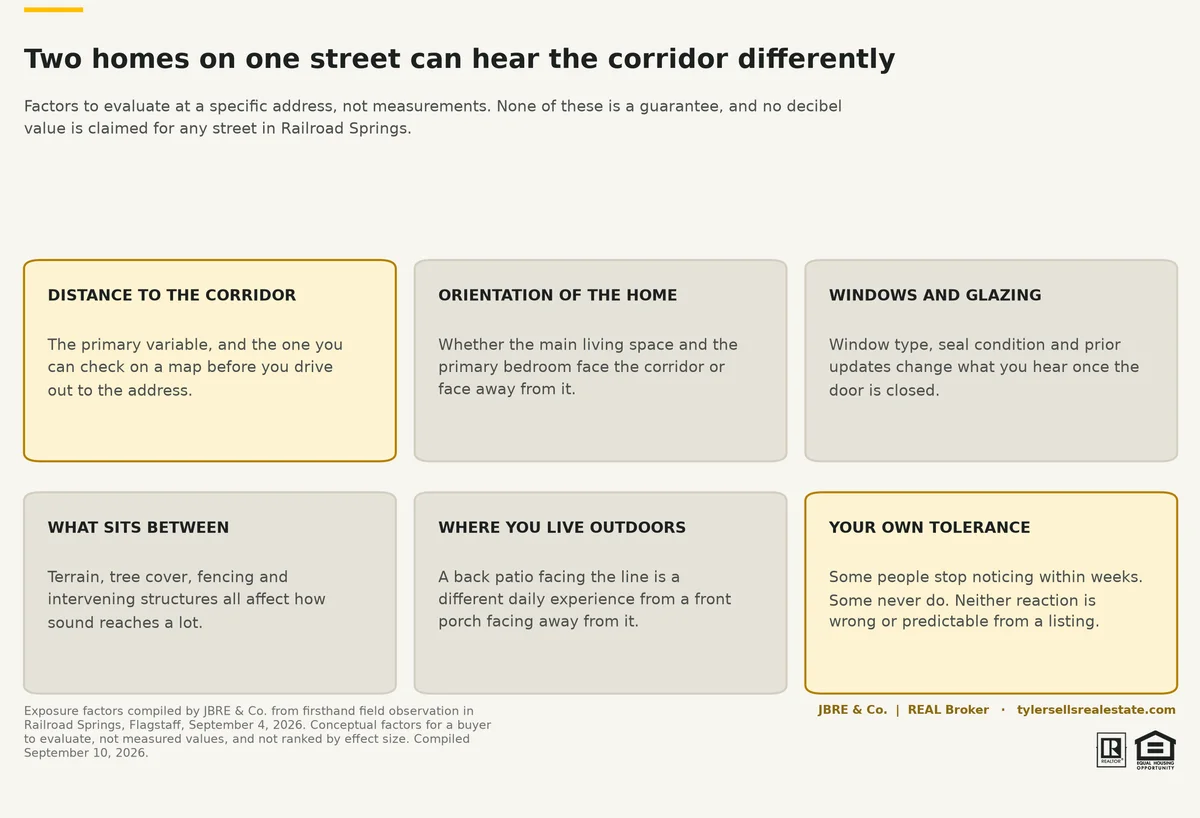
Two homes on the same street can register the corridor very differently. These are factors to evaluate, not measurements, and none of them is a guarantee.
Distance to the corridor. The primary variable, and the one you can see on a map before you drive out.
Orientation. Whether the main living space and the primary bedroom face the corridor or face away from it.
Windows and glazing. Window type, seal condition, and whether the home has been updated change what you hear indoors.
What sits between. Terrain, tree cover, fencing, and intervening structures all affect how sound reaches a lot.
Where you spend time outdoors. A back patio facing the line is a different daily experience from a front porch facing away from it.
Your own tolerance. Some people stop noticing within weeks. Some never do. Neither reaction is wrong, and neither is predictable from a listing.
What this guide does not claim
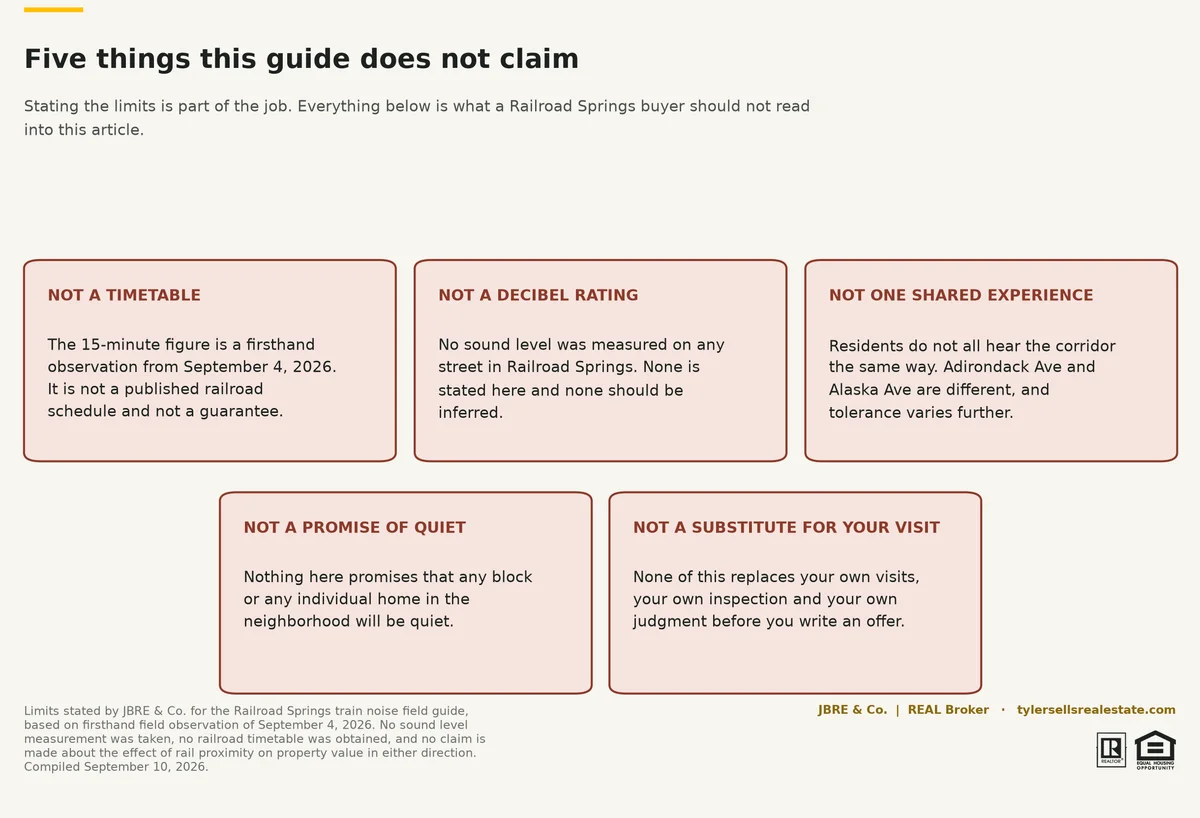
Stating the limits is part of the job.
The 15-minute figure is a firsthand field observation from September 4, 2026. It is not a published railroad timetable and not a guarantee of frequency on any given day.
There is no decibel rating in this article for any street in Railroad Springs. None was measured, and none should be inferred.
Not every resident experiences the corridor the same way. The Alaska Ave experience and the Adirondack Ave experience are different, and individual tolerance varies further.
Nothing here promises that any block or any home will be quiet.
None of this replaces your own visits, your own inspection, and your own judgment.
This article also makes no claim in either direction about whether proximity to the rail line raises or lowers value in Railroad Springs. We have no verified evidence for that, and asserting it without evidence would be inventing a statistic.
What the seller disclosure covers, and what it does not
Arizona sellers complete a Residential Seller's Property Disclosure Statement. In its environmental section the form asks whether the seller is aware if the property is subject to any present or proposed effects of, among other items, "Airport noise, Traffic noise, Rail line noise, Neighborhood noise, Landfill, Toxic waste disposal, Odors, Nuisances, Sand/gravel operations, Other," with a space to explain (Arizona Association of REALTORS® Seller Advisory).
Read that line carefully when it arrives. It is a disclosure of what the seller is aware of, which is useful, and it is not a substitute for your own evaluation. Two sellers on the same street can answer that question honestly and differently. Treat the SPDS as one input, then go verify.
What the national portals leave out about Railroad Springs
Portal pages for this neighborhood are quiet about the thing the neighborhood is named after. Zillow's Railroad Springs page reports a typical home value of $494,697, up 3.5% year over year, data through September 30, 2025, and says nothing about trains, the railroad, or noise beyond the neighborhood's name (Zillow). Redfin's Railroad Springs page likewise carries market metrics with no mention of trains or noise (Redfin).
Homes.com is the exception, and it is candid: "Located just south of the Burlington Northern Sante Fe Railroad, Railroad Springs earns its name from the sounds of passing trains that frequently fill this suburban neighborhood," quoting a local agent saying "people definitely notice the noise, but they get used to it" (Homes.com).
Neither the silence nor the reassurance tells you what you need. What tells you is thirty minutes on the specific street, twice, once after dark.
If the home you are considering is one of the older manufactured or early-2000s builds here, pair this with how to think about selling an older Flagstaff home, because condition and updates drive the indoor sound experience as much as distance does.
Thinking about buying in Railroad Springs?
Lucas Cowan works Railroad Springs specifically. He will walk the street with you, tell you straight which part of the neighborhood you are standing in relative to the corridor, and build you a shortlist worth your weekend instead of a feed dump.
Lucas Cowan · REALTOR®, JBRE & Co., brokered by Real Broker 619-847-3811 · lucas@jbreandco.com
Equal Housing Opportunity.

Written by
Tyler Vaughan
Northern Arizona's top-rated real estate agent with 350+ five-star reviews. Specializing in Sedona, Flagstaff, and Northern AZ luxury properties.
Ready to Make Your Move?
Whether you are buying or selling in Northern Arizona, Tyler is here to help you navigate the market with confidence.