

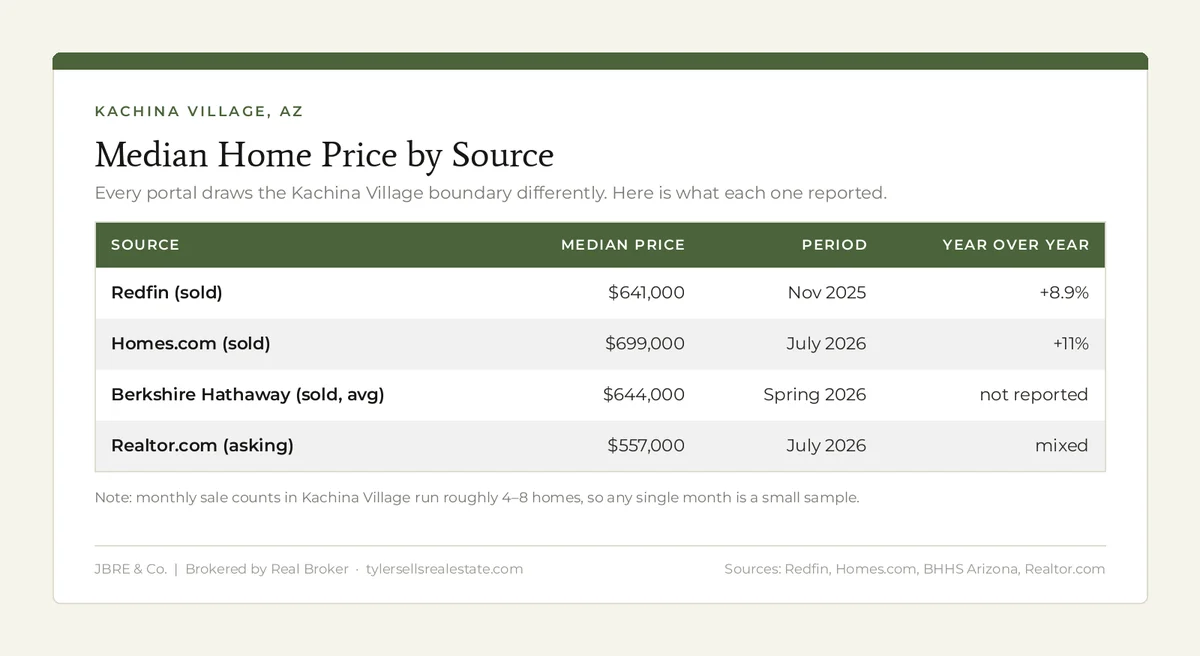
If you own a home in Kachina Village, you've probably had the same experience I have: you go looking for real numbers on your own neighborhood and you find almost nothing useful. One website says the median home price is $557,000. Another says $699,000. A third quietly folds the gated golf estates next door into the same number and tells you Kachina Village is a million-dollar market.
They're all technically pulling from something real. They're just measuring different neighborhoods and calling it the same place.
So here's a straight recap of the Kachina Village real estate market from 2024 through July 2026 — what actually sold, what it took to sell it, and what the last two and a half years mean for you as a buyer or seller. No hype, no cherry-picking.
First, the one thing that explains every confusing number
Kachina Village, AZ is not one housing market. It's two, sitting side by side.
The Kachina Village core is the community most people picture: roughly 1,400 homes served by the Kachina Village Improvement District, a mix of 1970s–1990s cabins, A-frames, manufactured homes, and site-built ranch homes on forested lots off the trail-named streets — Hotevilla, Tishepi, Shonto, Awatobi.
The luxury enclaves next door — Forest Highlands and The Canyon at Forest Highlands — are gated golf communities where the median sale price has been cited around $2.5 million (Stacker's Flagstaff neighborhood analysis).
Here's the catch: several major real estate portals draw their "Kachina Village" boundary wide enough to include those estates. So when a single $2.4M golf-course home closes in a month where only three or four other homes sold, the neighborhood "median" jumps — and it looks like Kachina Village home prices exploded. They didn't. The mix changed.
Every number below is labeled so you know which market you're looking at. This matters more here than in almost any other Flagstaff-area neighborhood.
Kachina Village home prices, 2024 to 2026
The honest headline: Kachina Village home values held up better than the broader Flagstaff market over this stretch, and the neighborhood is still one of the fastest-moving markets in the state.
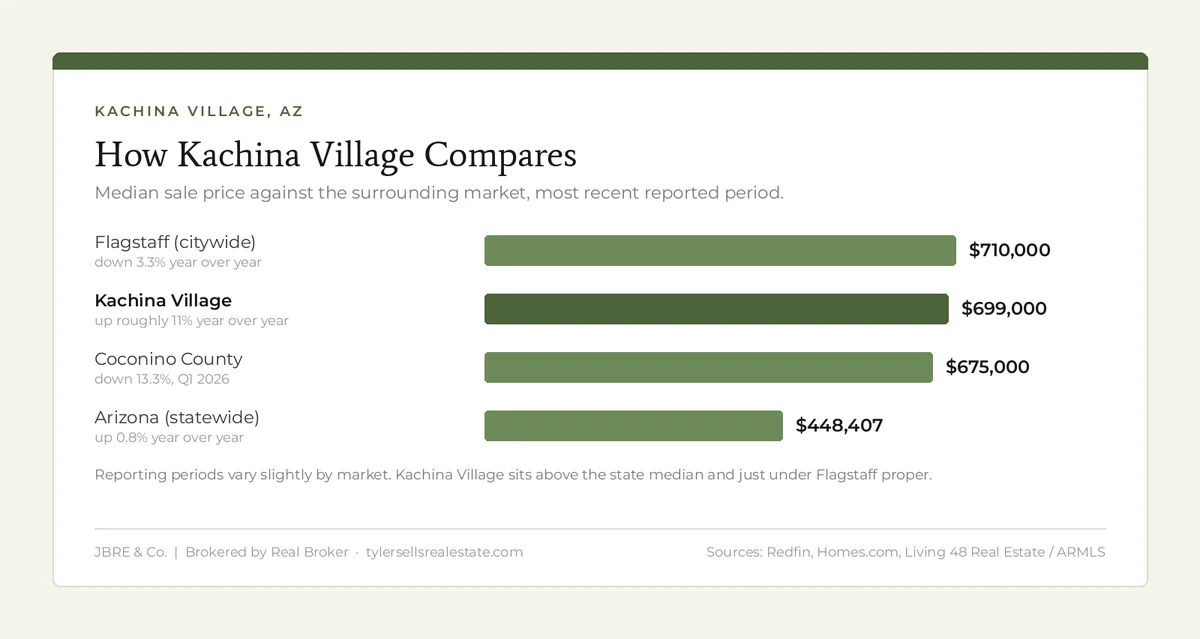
Now compare that to the neighborhoods around it:
Flagstaff citywide: median sale price about $710,000, down 3.3% year over year for the three months ending May 2026, with 200 homes sold in May versus 217 the year before (Redfin Flagstaff). Zillow's Flagstaff home value index sat at $665,540, essentially flat at -0.5% (Zillow).
Coconino County: a genuinely choppy two years. ARMLS put the county median at $725,000 (+3.6%) in Q2 2025 (ARMLS quarterly summary), while a Q1 2026 local recap showed $675,000, down 13.3% year over year — even as closed sales rose 18.3% (Living 48 Real Estate).
Arizona statewide: median $448,407, up just 0.8%, with 67 median days on market in May 2026 (Redfin Arizona).
Translation for a homeowner: Kachina Village sits roughly $250,000 above the Arizona statewide median and slightly below Flagstaff proper — and unlike the county, it hasn't posted a real price retreat in this window. You are paying a premium for pines, elevation, and a 10-minute commute, but you are still buying below city-limit pricing.
What actually sold: real Kachina Village comps
Medians are averages of a small pile of sales. Individual closings tell you more. These are real recorded sales in and around Kachina Village:
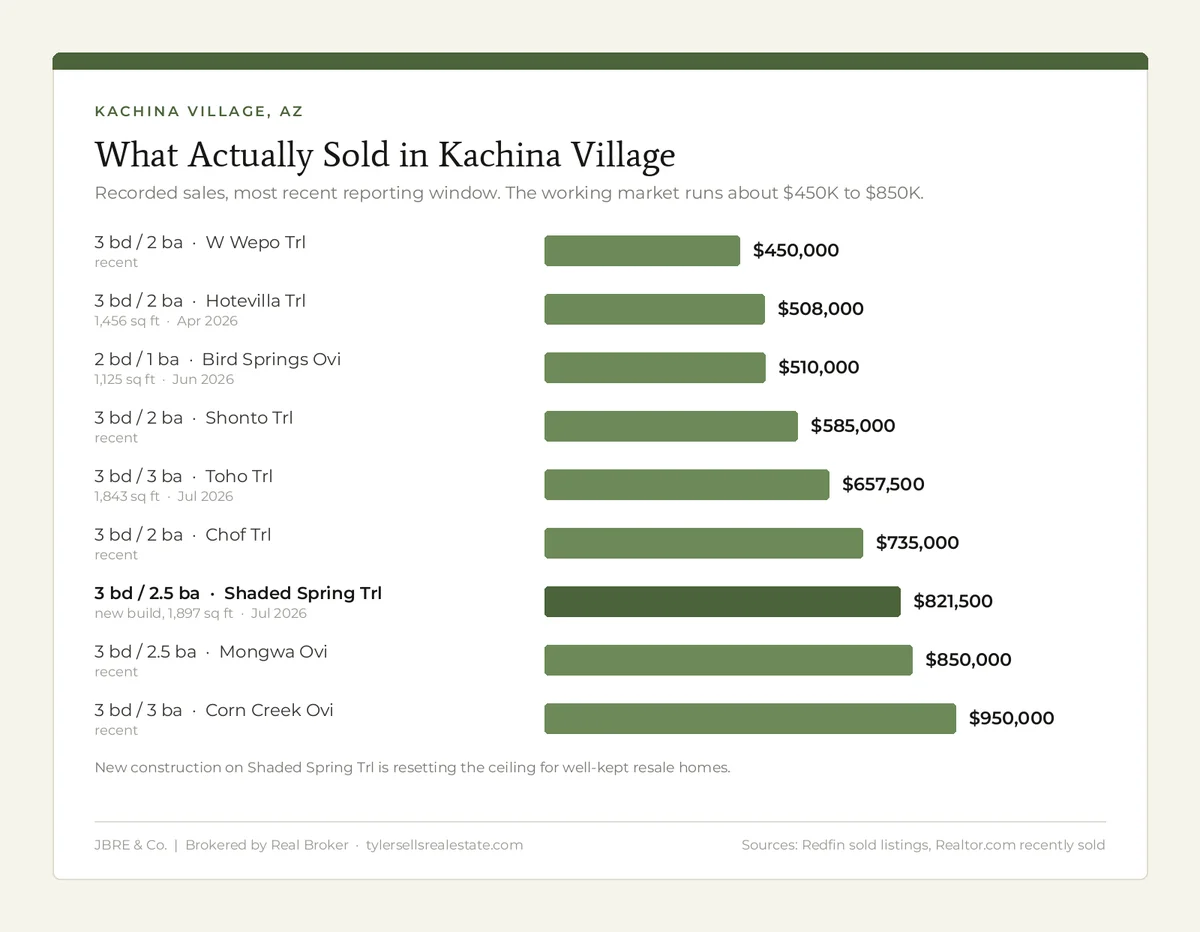
The pattern that matters: the working heart of this market runs roughly $450,000 to $850,000. Below that, you're usually looking at a small cabin, a manufactured home, or a project. Above roughly $1M, you've generally crossed into new construction or the gated enclaves. Redfin logged about 38 house sales in the trailing six months and 62 in the trailing twelve — real activity, but a small enough sample that any single month's percentage swing should be taken with a grain of salt.
Speed and competition: the number that surprises people
In its statewide market report, Redfin ranked Kachina Village the #1 most competitive housing market in Arizona by its Compete Score — ahead of Pinetop Country Club, El Mirage, and Doney Park (Redfin Arizona housing market).
That's not a typo, and it's not because Kachina Village is expensive. It's because supply is tiny and demand for forested homes under Flagstaff pricing is constant.
Days on market: Redfin recorded a median of 12 days in its most recent reported Kachina Village month, versus 74 days a year earlier. Realtor.com shows 49 days. Homes.com shows a much longer average. That spread is what a small, mixed-inventory market looks like — a well-priced $550K home under the pines can go in under two weeks, while an overpriced or hard-to-finance property can sit for months.
Sale-to-list ratio: roughly 96% to 99% across sources, meaning most sellers are netting close to asking, with modest negotiation.
Compare to Flagstaff citywide at 31 median days on market and about 98% of list (Redfin Flagstaff).
Kachina Village homes for sale right now
As of late July 2026, active inventory is genuinely thin — 17 to 26 homes depending on whose boundary you use:
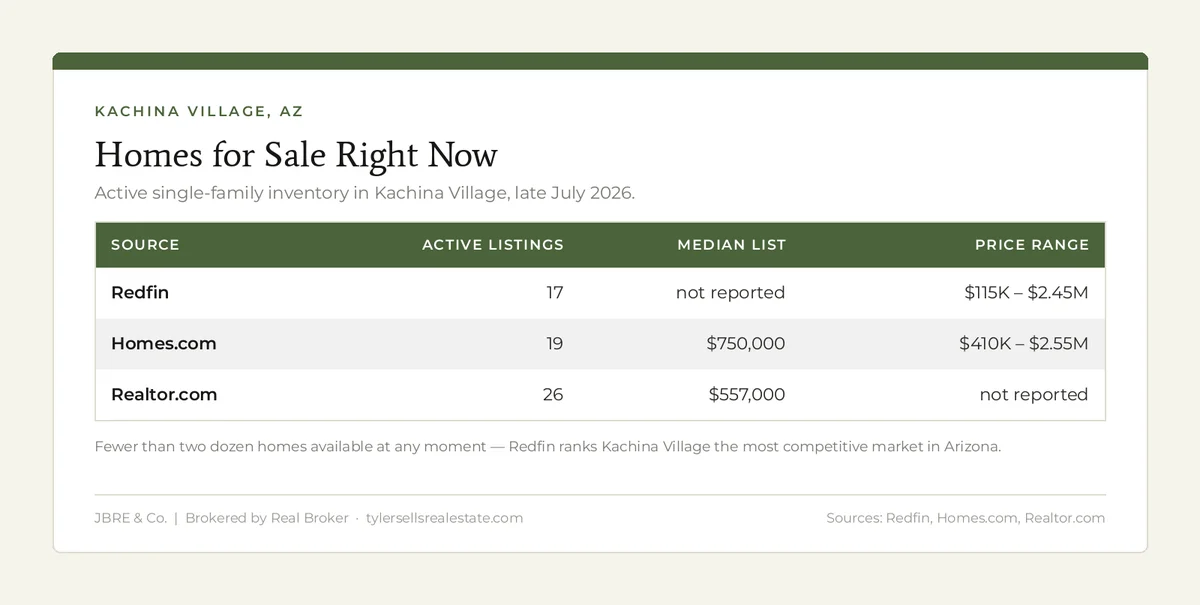
For perspective, Coconino County was running about 5.7 to 5.9 months of supply across 2025–2026 (Living 48, ARMLS) — a fairly balanced market. Kachina Village, with fewer than two dozen homes available at any moment, behaves much tighter than the county average it's technically part of.
New construction is changing the top of the market
Two developments are quietly resetting the ceiling. The Highlands at Tovar Springs and Kachina Village Highlands are delivering modern site-built homes in the $820,000 to roughly $1,025,000 range on Shaded Spring and Flower Spring Trails, with floor plans up to about 3,234 square feet (Homes.com new construction).
That's a meaningful development for existing owners. When a brand-new 1,897 sq ft home closes at $821,500 down the street, it gives well-maintained resale homes in the $600Ks and $700Ks a much stronger comparison point than they had in 2024.
Land is the thinnest segment of all
Only two vacant-lot sales were recorded in Kachina Village in the trailing six months: $250,000 for a 0.52-acre parcel on Jadito Trail (July 23, 2026) and $812,500 for a sub-quarter-acre lot on Shaded Spring Trail (April 13, 2026) — the latter almost certainly a premium building lot inside the new-construction enclave rather than raw dirt. At the time of writing, a single active land listing sat at $322,000 for 0.58 acres (Redfin land listings). Two sales is not a trend — but it does tell you buildable Kachina lots are scarce and priced accordingly.
The mortgage rate backdrop, 2024–2026
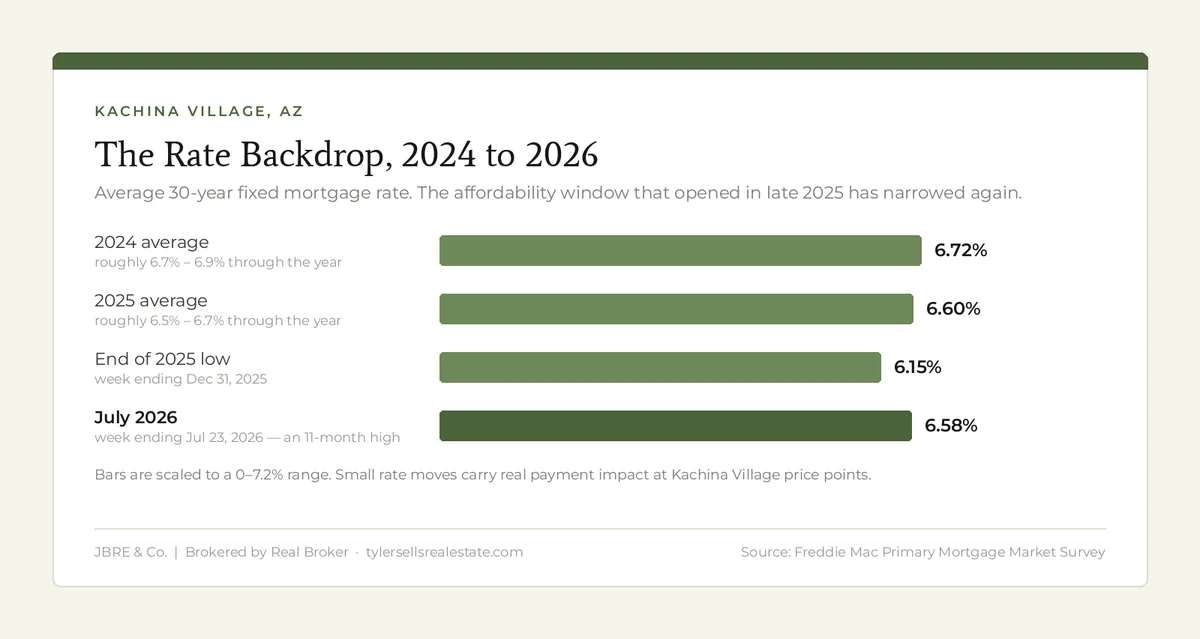
None of the above happened in a vacuum. The 30-year fixed rate averaged roughly 6.7%–6.9% through 2024 and 6.5%–6.7% through 2025, dipped to about 6.15% at the very end of 2025, then climbed back to 6.58% for the week ending July 23, 2026 — the highest in about eleven months (Freddie Mac PMMS, Bankrate rate history, Fox Business).
What that means practically: the affordability window that opened in late 2025 and early 2026 has narrowed again. Buyers who were pre-approved in January 2026 have real payment pressure now, which is exactly why correct pricing has separated the 12-day sales from the 90-day sales in this neighborhood.
Four Kachina Village specifics that affect value
These are the things national portals will never tell you, and they move the needle on price here.
1. You have municipal water and sewer — not septic and a well.
This is the single most common misconception about Kachina Village. The Kachina Village Improvement District operates four deep aquifer wells, three pumping stations, about 50 miles of water line, and roughly 40 miles of gravity sewer serving around 1,400 homes, with treated effluent going to the Kachina Village Wetlands in a zero-discharge system (KVID history, Brown and Caldwell case study). The plant is rated at 0.309 million gallons per day and runs near half capacity, which is why new development can connect without forcing a system rebuild (KVID FAQ). KVID raised rates recently — its first increase in twelve years — to fund aging infrastructure.
If you're comparing Kachina Village vs. Mountainaire, this is the biggest structural difference: parts of Mountainaire do rely on individual on-site septic systems (Coconino County community assessment). For a buyer, utilities you don't have to inspect, maintain, or replace are worth real money.
2. Short-term rental rules tightened, and they apply here.
Kachina Village is unincorporated, so Coconino County's vacation-rental ordinance governs it — not the City of Flagstaff's rules. Since late 2023, operating a short-term rental requires an annual $250 county permit, an Arizona TPT license, at least $500,000 in liability coverage, and written notice to adjacent neighbors, with fines starting at $1,000 for unpermitted operation (Coconino County STR information, county STR FAQ). In December 2025, supervisors added an owner-occupancy requirement for any accessory dwelling unit receiving a certificate of occupancy on or after January 1, 2026 that will be used as a short-term rental (Coconino County board coverage). If you're buying a home with an existing rental history, verify the permit transfers and the ADU status before you write the offer.
3. Wildfire risk is now an insurance-pricing issue, not a theoretical one.
Arizona saw a 61% cumulative increase in home insurance rates from 2019 to 2024 — the largest of any state — driven heavily by wildfire exposure, with Northern Arizona hit harder than the state average (KNAU). Current Flagstaff-area estimates run roughly $2,000–$2,800 per year in the standard market and $3,200–$6,000 for forest-adjacent homes carrying a fire surcharge (AskDoss).
This became very concrete this summer. The Pocket Fire, which started June 19, 2026, grew past 27,000 acres, and put Kachina Village and Forest Highlands into pre-evacuation "SET" status on June 27–28 before downgrading to "READY" by July 1–2 (KNAU, AZCentral). Stage 2 fire restrictions took effect across Kachina Village zones on June 30, 2026. My advice to every buyer here: get an actual insurance quote during your inspection period, not after. And to every seller: documented defensible space and a clean roof are now selling features.
4. Forest Service adjacency cuts both ways.
Being wrapped by the Coconino National Forest is the reason people fall in love with this neighborhood. It also means federal management decisions land in your backyard — a year-round camping and campfire restriction now covers National Forest land immediately around Kachina Village and Pumphouse Wash from May 2025 through April 2035 (U.S. Forest Service order). Net effect for residents: less dispersed camping pressure at the edges of the neighborhood.
What this means if you're buying in Kachina Village
Be ready before you tour. In the most competitive market in Arizona with fewer than 25 homes available, "let me think about it over the weekend" is how buyers lose the good ones. Full pre-approval, proof of funds, and a clear must-have list, in advance.
Underwrite the whole payment. Principal and interest at roughly 6.6%, plus a forest-adjacent insurance premium, plus KVID utilities. The mortgage payment is not the cost of ownership.
Know which sub-market you're shopping. A $500,000 cabin and a $900,000 new build are not the same asset with different price tags. They have different maintenance profiles, financing paths, and resale audiences.
Look hardest at the honest middle. The $450,000–$700,000 band is where this neighborhood's real value lives, and it's the band with the most competition.
What this means if you're selling in Kachina Village
Do not price off a portal estimate. If the automated value on your home is being influenced by golf-course estates a mile away, you will list too high, sit, and then negotiate from weakness. Price off actual Kachina Village closings on comparable homes.
The first ten days are the whole game. With a median as low as 12 days in some months and sale-to-list ratios in the 96–99% range, correctly priced homes here get their best offer early. Overpriced homes get a price reduction and a longer story.
New construction is your friend, if you prepare. Buyers now have $820K+ new builds to compare against. Make sure your home reads as move-in ready — roof, deck, defensible space, mechanicals, clean crawlspace — so the comparison flatters you.
Have your documentation ready. KVID account, any STR permit history, insurance history, and wildfire mitigation work. Every one of those removes a buyer objection before it becomes a price concession.
Frequently asked questions about the Kachina Village market
Is Kachina Village a good place to buy a home near Flagstaff?
For buyers who want ponderosa pine forest, cooler summers, and a 7–10 mile commute to downtown Flagstaff and NAU without paying city-limit prices, it's one of the strongest options in Northern Arizona. It's car-dependent with no real commercial district of its own, and it carries forest-adjacent insurance costs.
What is the average home price in Kachina Village, AZ?
Depending on the source and the boundary used, recent medians have run from about $557,000 (asking) to $699,000 (sold) as of mid-2026, with the typical working range for a standard single-family home falling around $450,000 to $850,000.
Are Kachina Village home values going up or down?
Through mid-2026, Kachina Village medians were up in the high single digits to low double digits year over year on small sample sizes, while Flagstaff citywide was down about 3% and Coconino County posted mixed readings. Call it resilient and tight, not booming.
Does Kachina Village have city water and sewer?
Yes. Water and sewer are provided by the Kachina Village Improvement District, not by private wells and septic systems. That's a meaningful difference from parts of neighboring Mountainaire.
Can I use a Kachina Village home as a short-term rental?
Yes, subject to Coconino County's vacation-rental ordinance — a county permit, an Arizona TPT license, minimum liability insurance, and neighbor notification. Newer ADUs used as short-term rentals also face an owner-occupancy requirement. Confirm current requirements with the county before you buy on that assumption.
A note on the numbers in this report
Kachina Village records only a handful of sales in a typical month, and every major real estate portal draws its boundary a little differently — some of them include the Forest Highlands luxury enclaves, which pulls medians sharply upward. Figures here are a snapshot as of late July 2026, sourced and dated so you can check them yourself, and they will change. For a true apples-to-apples read on your specific street, home type, and lot, you need a human looking at MLS closings, not an algorithm.
Want the number for your actual house?
I track this neighborhood closely — every closing, every price change, every new listing on the trails. If you want a real valuation on your Kachina Village home, or a straight answer on what your budget buys here right now, reach out.
Information deemed reliable but not guaranteed. Market data is compiled from public sources including Redfin, Realtor.com, Homes.com, Zillow, ARMLS, Freddie Mac, and Coconino County, and reflects a point-in-time snapshot as of July 2026. Small-market statistics are volatile and boundary definitions vary by source. This report is not an appraisal and is not intended as financial, insurance, tax, or legal advice. Verify all utility, insurance, permitting, and short-term rental requirements directly with the applicable provider or agency before relying on them.

Written by
Tyler Vaughan
Northern Arizona's top-rated real estate agent with 350+ five-star reviews. Specializing in Sedona, Flagstaff, and Northern AZ luxury properties.
Ready to Make Your Move?
Whether you are buying or selling in Northern Arizona, Tyler is here to help you navigate the market with confidence.