

For the first time since the pandemic-era investor rush, Flagstaff's short-term rental market is contracting. Active STR listings across Airbnb, Vrbo, and Booking.com are down 13.6% year-over-year, and the City of Flagstaff's own 2026 fee analysis anticipates only 1,100 properties will renew their license on July 1 — a projected 60% drop from the roughly 2,741 rentals currently operating. If you own a home in Kachina Village and you've been renting it out short-term, the math on that decision just changed. If you're a Kachina owner watching the STR ordinance headlines and wondering whether to sell or hold, this is the honest read.
What you'll learn in this article:
How much the Flagstaff STR market has actually shrunk in the last twelve months, and how the city's July 1 ordinance accelerates the decline
What it now costs annually to legally operate a Kachina Village STR, line by line
Why the Kachina submarket specifically is exposed — 130 active listings, $268/night ADR, 46% occupancy
The three seller profiles most likely to list their Kachina home in the next 12 months
What all of this means for Kachina Village home values through 2027
Flagstaff's short-term rental supply has peaked
Between 2016 and 2025, the Flagstaff STR market grew roughly 500% — from 536 active listings to 3,171 at last year's peak, per StaySTRA data. Investors saw a resort market with year-round demand (Grand Canyon in summer, Snowbowl in winter, NAU parents in between), and Arizona's state preemption law under SB 1350 blocked cities from banning short-term rentals outright. The supply-side response was predictable and enormous.
That trend has now reversed. AirDNA's May 2026 MarketMinder data shows 2,741 active Flagstaff STR listings — down 13.6% year-over-year. This is the first material supply decline the market has recorded since the 2020-2022 investor surge. Occupancy has softened alongside it, dropping to a trailing 12-month average of 54% per AirDNA, with AirROI reporting 42.4% for the Airbnb-only sample.
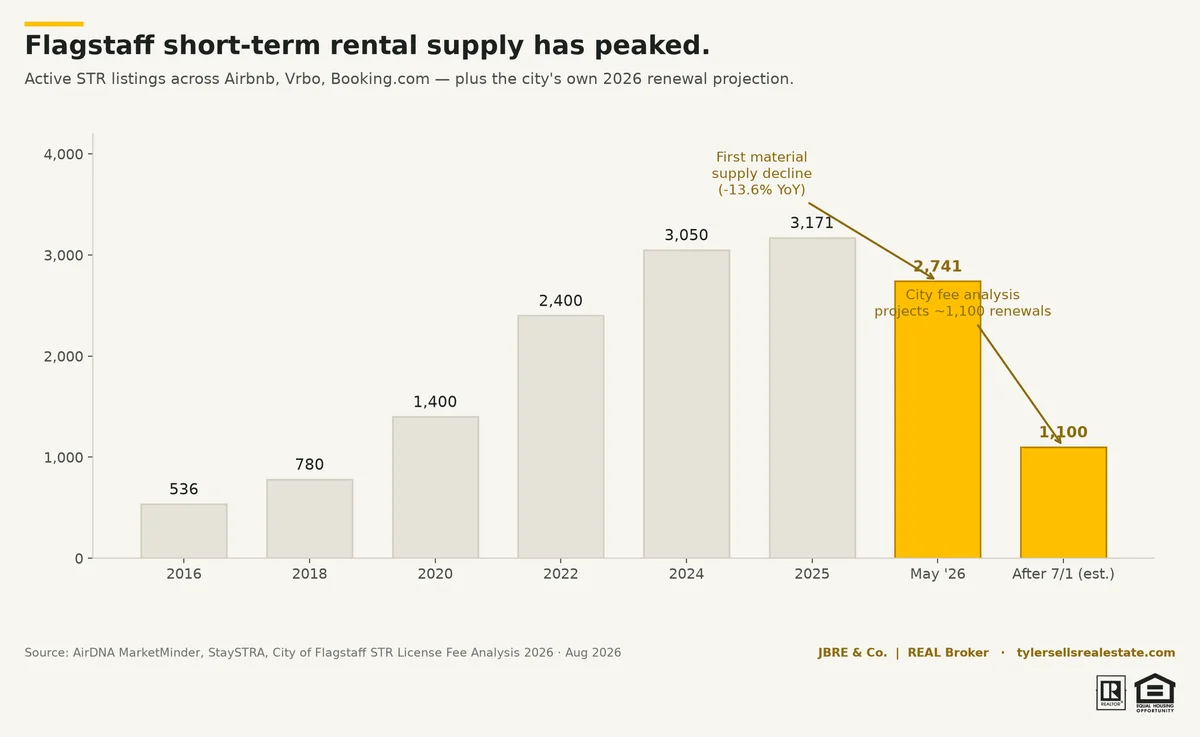
The July 1, 2026 ordinance is about to accelerate this. Two data points tell the story: 2,741 active listings today, and roughly 1,100 licenses the city expects to renew going forward. If that projection holds, more than 60% of the properties currently on Airbnb, Vrbo, and Booking are operating outside the framework Flagstaff is now enforcing.
What changed with Ordinance 2026-11
The Flagstaff City Council passed Ordinance 2026-11 on May 19, 2026, updating Chapter 3-12 of the city code effective July 1. Four changes matter for anyone operating a short-term rental in Flagstaff or Kachina Village:
1. The annual license fee jumped from $185 to $250. That's the state maximum. The city is explicit that the increase is to recover the full administrative and enforcement cost of the STR program.
2. Liability insurance is now a hard requirement. Every STR operator must carry a minimum of $500,000 in liability coverage before offering or renting the property. Standard homeowner's policies do not cover STR activity. This is a specialty-insurer product, and premiums vary widely.
3. Civil fines were restructured into three tiers. Violations now carry $500, $1,000, or $3,500 penalties depending on severity, per the city's ordinance summary. A continuing violation counts as a separate offense on each successive day.
4. Enforcement has real teeth for the first time. The city runs a 24/7 STR complaint hotline (928-714-7951), platforms are increasingly asked to display license numbers, and compliance failures now produce daily fines rather than warning letters.
Coconino County, which covers the unincorporated area around Flagstaff, has run its own parallel STR permit process since 2023 with a $250 annual fee. Owners have to confirm which jurisdiction their property sits in — Kachina Village addresses fall inside the city or the county depending on the specific parcel.
What it now costs to operate a Kachina Village STR
Here is the annual cost stack for a typical Kachina Village short-term rental, using the AirROI submarket data that places the average Kachina STR at $3,506 in monthly revenue — roughly $42,000 per year gross.
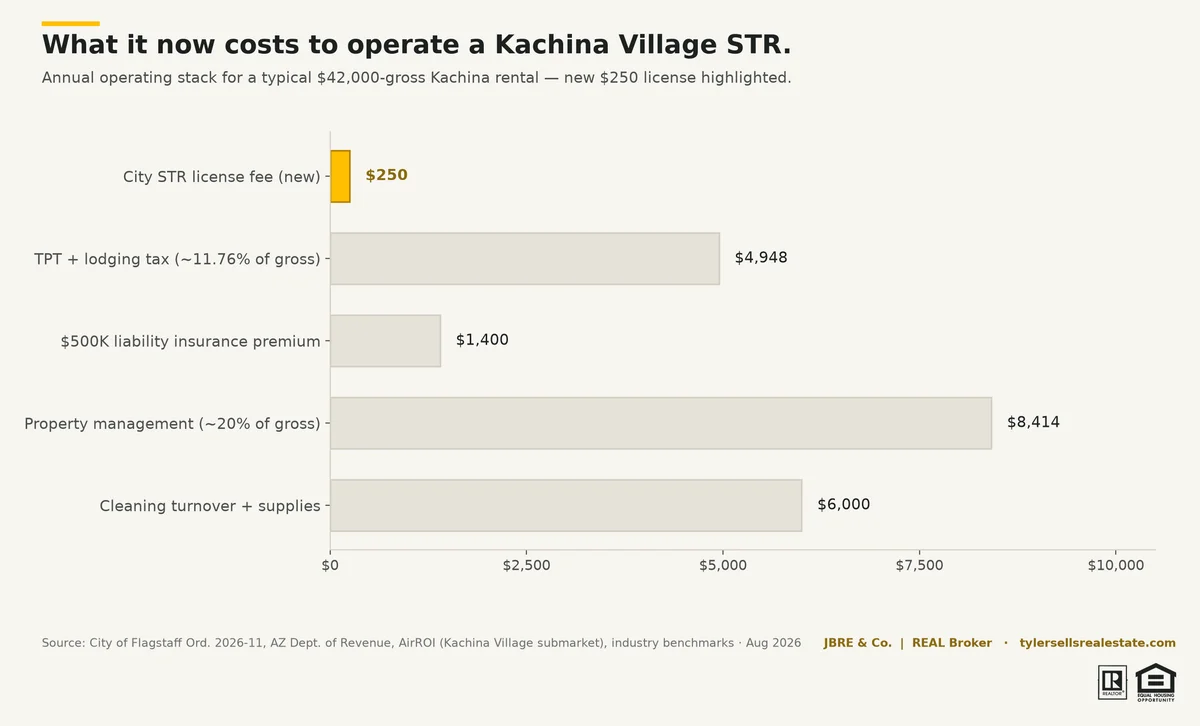
Before mortgage, property tax, HOA dues, utilities, and repairs, a compliant Kachina STR now runs roughly $21,000 per year in operating costs — about half of gross revenue. Add a $500,000 mortgage at current rates and property taxes, and the net picture for a passive investor gets thin fast.
This is why the delisting trend is real. The properties that keep operating under the new ordinance will be the ones with strong locations, professional management, and owners who are actually running a business. The properties that leave the market are the light-touch investors who bought during the 2020-2022 rush assuming 65%+ occupancy at $300+ ADR — and are now facing 46% occupancy at $268 ADR with a compliance stack they didn't underwrite for.
What this looks like in Kachina Village specifically
AirROI's Kachina Village submarket data is precise: 130 active Airbnb listings, $268.79 average daily rate, 46% occupancy, $3,506 in average monthly revenue. Cross-referencing Airbnb's own search returns, the mix is roughly 97% entire cabins and homes, 3% private rooms — nightly rates cluster in the $200-$400 range, with larger 4+ bedroom chalets reaching $400 and up.
For context, Kachina Village's residential market itself is holding value. Sotheby's Q2 2026 market data puts the median sale price at $513,000 across 20 closings, with average days on market at 69. Homes.com's trailing 12-month figure is $699,000, reflecting a mix skewed toward larger properties. Either way, Kachina is a working, liquid residential market.
The tension: STR economics are compressing at the same time residential values are stable. That's the setup for a supply pulse. If a subset of Kachina owners decide to convert their rental cabin back to a primary or list it outright, that inventory hits a market with median days on market at 69 and buyers who are still active. The exit is real — but it will get more crowded the longer owners wait.
The three seller profiles most exposed
Not every Kachina STR owner is a distressed seller. But three specific profiles account for most of the delisting trend I'm watching in this submarket:
The 2021-2022 investor. Bought the cabin at peak, financed at 3-4% pre-hike, underwrote to 65% occupancy at $310 ADR. Today's market delivers 46% occupancy at $268 ADR — a nearly 40% revenue miss against the underwriting model. Refinance math doesn't work, and the new $250 license plus $500,000 insurance policy is real dollars against a shrinking margin.
The out-of-state owner. Lives in Phoenix, Los Angeles, or Denver. Bought Kachina as a lifestyle-adjacent investment. The 2026 ordinance requires a 24/7 local emergency contact who can respond within one hour — for out-of-state owners, that means hiring a Flagstaff-based property manager, which adds ~20% of gross revenue to the cost stack. That change alone can flip the property from cash-flow positive to negative.
The passive landlord. Bought a Kachina property as a long-term hold, tried STR income as a supplement, never really wanted the operational load. Neighbor notifications, TPT filings, insurance minimums, license renewals, and compliance risk are more work than the yield now justifies. This owner is often the easiest to list — the STR side was always a hedge, not a plan.
What this means for Kachina Village home values through 2027
Two forces are moving in opposite directions.
Downward pressure: if the city's 1,100-license projection holds and a meaningful share of the non-renewing owners choose to sell rather than convert to long-term rental or personal use, Kachina could see 15-30 additional single-family listings enter the market over the next 12-18 months. On a submarket that typically closes ~20-30 homes per quarter per Sotheby's data, that's a material supply pulse.
Upward pressure: the STRs that stay licensed become the only compliant supply. Nightly rates on the compliant subset should rise because demand doesn't disappear when supply contracts — AirDNA's 2026 midyear outlook already shows this pattern nationally, with ADR up 2.8% and occupancy holding despite tighter supply. That supports residential values too, because a functioning STR is worth more than one that can't legally operate.
The most likely outcome for Kachina Village through 2027: flat-to-modestly-appreciating primary residential values, with a wider spread between compliant STR-capable properties and non-compliant ones. Owners with clean licenses, real insurance, and clear operating histories will command a premium. Everyone else will be a discretionary seller in a market with slightly more inventory than it's used to.
The one insight for Kachina owners
If you own a Kachina Village home and you've been running it as a short-term rental, the July 1 ordinance forces a real decision. Renewing under the new framework is doable — the $250 fee is not the barrier — but only if the underlying property still cash-flows against realistic occupancy, realistic ADR, realistic management costs, and the new insurance floor. If the numbers don't work with a manager who can respond in an hour and a policy that actually covers guest liability, the property isn't an STR anymore. It's either a long-term rental, a primary, or a listing.
For most passive owners, listing is going to look better in the next 12 months than in any of the 12 months after that.
Thinking about selling your Kachina Village home in the next year?
I work Kachina Village specifically — pricing, comps, and the STR-vs-residential math that decides whether you list this fall or hold through the ordinance cycle. Get a straight read on what your property is actually worth to a buyer today and what the exit door looks like over the next 12 months.
Tyler Vaughan · Realtor, JBRE & Co., brokered by Real Broker 928-622-0130 · tyler@jbreandco.com · Schedule a conversation
Equal Housing Opportunity.

Written by
Tyler Vaughan
Northern Arizona's top-rated real estate agent with 350+ five-star reviews. Specializing in Sedona, Flagstaff, and Northern AZ luxury properties.
Ready to Make Your Move?
Whether you are buying or selling in Northern Arizona, Tyler is here to help you navigate the market with confidence.