

If you're looking at Hospital Hill Flagstaff homes for sale, you've probably also seen the area called NoHo — and you've probably noticed the listings don't agree on where it starts or ends. That's not sloppy marketing. It's an honest reflection of a part of Flagstaff that was never planned as a single neighborhood. It accumulated: an 1880s railroad-era grid at the bottom, a hospital dropped on the hill above it in 1936, postwar ranches filling in behind that, and new construction still going in today.
That layering is why one block trades like a protected historic asset and the block behind it trades like a 1970s tract home. It's also why this is one of the few Flagstaff neighborhoods where the address determines which set of rules you buy into — and most buyers don't find that out until they're under contract.
Here's the honest version.
The short version:
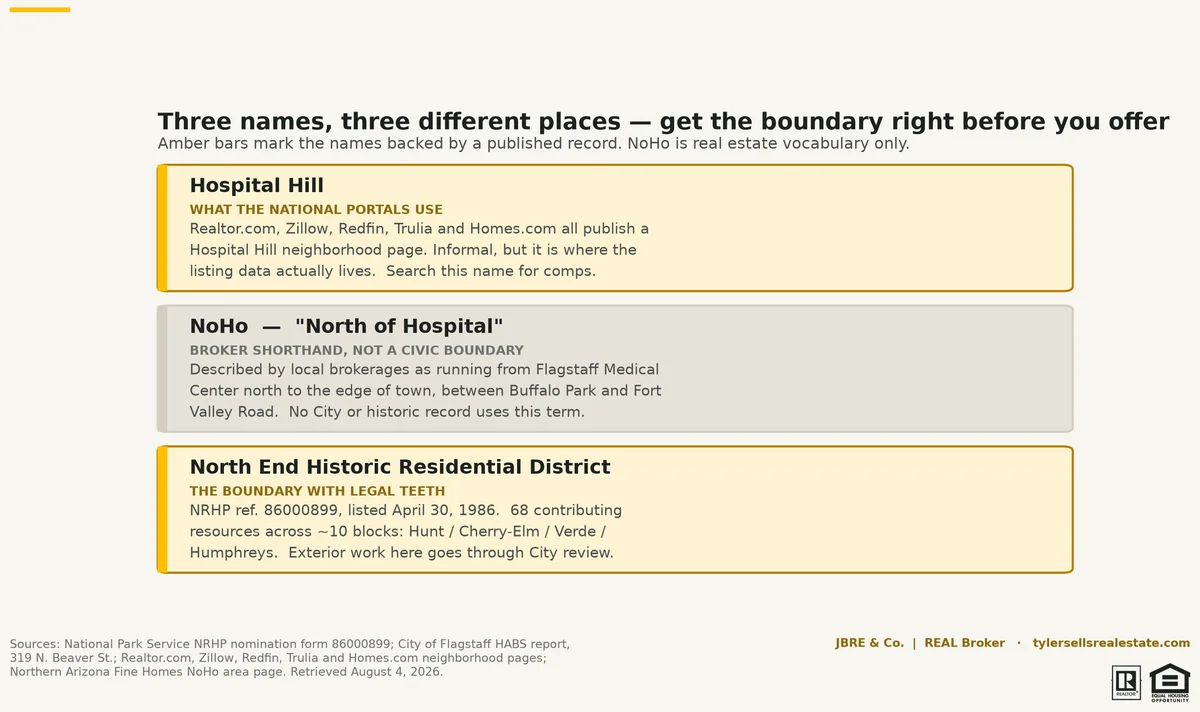
Three different names get used for overlapping ground: Hospital Hill (what the portals use), NoHo (agent shorthand for "North of Hospital"), and the North End Historic Residential District (a real, federally listed 10-block boundary). They are not the same thing.
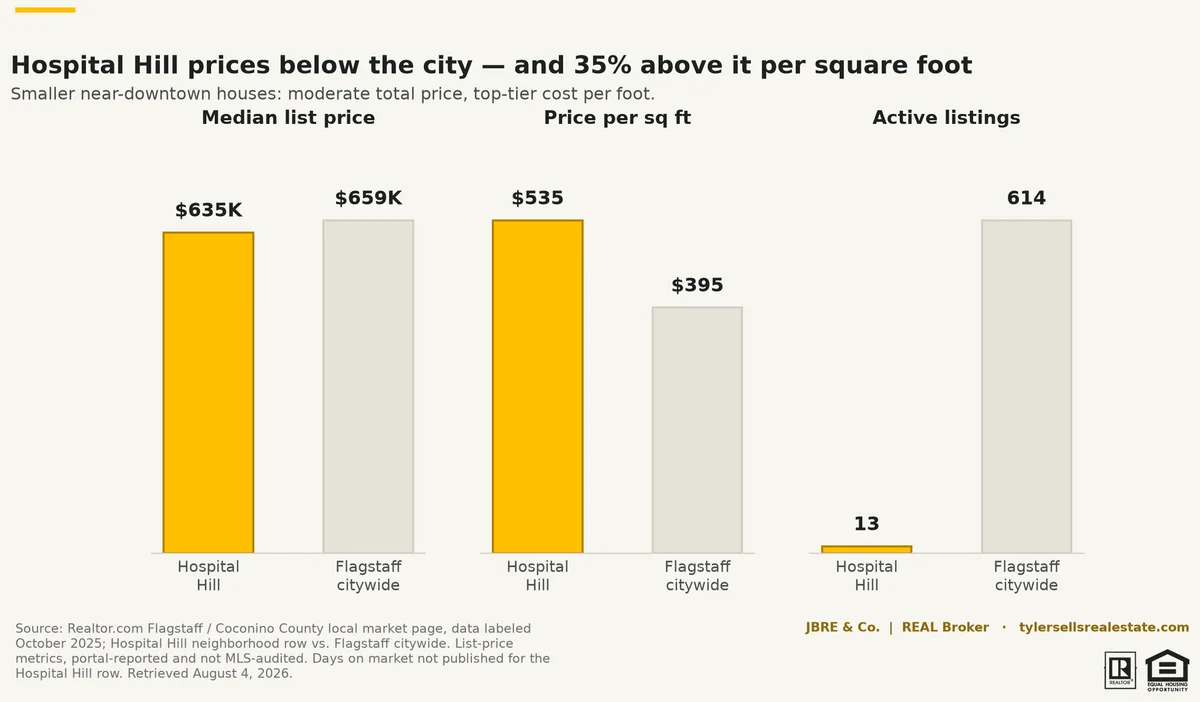
Hospital Hill's median list price was $635,000 at $535/sq ft — a 35% premium per foot over Flagstaff citywide's $395, on Realtor.com data labeled October 2025.
Build years in the area's active listings run 1956 to 2025. This is a mixed-vintage market, not a uniformly historic one.
If your target home sits inside the North End Historic District boundary, exterior work goes through City review. One block outside, it doesn't.
The new-hospital plan is paused, not underway — Northern Arizona Healthcare said so publicly in February 2026.
Hospital Hill, NoHo, or North End? Getting the name right first
This matters more than it sounds, because the name you search determines the data you see.
Hospital Hill is the name the national portals standardized on. Realtor.com, Zillow, Redfin, Trulia, and Homes.com all publish a Hospital Hill neighborhood page. If you want listing data, this is the label the data lives under.
NoHo is broker shorthand for North of Hospital. Northern Arizona Fine Homes, which maintains a NoHo area page, defines it as running from Flagstaff Medical Center north to the edge of town, between Buffalo Park and Fort Valley Road. It's useful local vocabulary. It is not a City-designated neighborhood and it doesn't appear in any civic or historic record — it's a real estate term, and you should treat it as one.
The North End Historic Residential District is the one with legal teeth. It was listed on the National Register of Historic Places on April 30, 1986 under reference number 86000899, with 68 contributing resources across roughly 10 blocks bounded by Hunt Street on the north, Cherry and Elm Streets on the south, Verde Street on the east, and Humphreys Street on the west (National Park Service nomination form, City of Flagstaff HABS report). Its period of significance runs from the early 1880s through 1935.
Notice that Realtor.com lists "Hospital Hill" and "North End" as two separate neighborhood rows on its Flagstaff market page. The publisher treats them as different places, because they are. The historic district sits near downtown; the broader Hospital Hill/NoHo market area runs north and uphill from it, and most of the homes trading in it are not historic and not regulated.
Anyone telling you every home in NoHo is a protected historic property is wrong. Anyone telling you none of them are is also wrong. The boundary is the answer, and it's checkable.
How this part of Flagstaff got built the way it did
The near-downtown grid came first. Flagstaff's original townsite and its early residential additions were platted in the 1880s, and the North End district's first building wave produced vernacular Queen Anne houses roughly between 1882 and 1900 — hipped roofs with cross gables, irregular rooflines, asymmetrical massing, notably plainer than the high-style Queen Annes you'd see in a larger city. A second boom ran 1909 to 1917 and delivered the Craftsman bungalows the district is best known for: low-pitched gable roofs, exposed rafter tails, deep open eaves, full-width porches. Western or Builders Colonial and Neo-Colonial "classic box" houses show up in the district too, per the City's own documentation.
Then the hospital arrived. Dr. Charles Sechrist opened a 25-bed hospital on the hill above the grid on January 4, 1936, and the community took ownership of it in 1955 (Arizona Daily Star historical feature). That facility is now Flagstaff Medical Center at 1200 North Beaver Street, operated by Northern Arizona Healthcare, and it is the only state-designated Level I Trauma Center north of Phoenix (NAH 2026 fact sheet).
A regional trauma center generates a specific kind of housing demand — nurses, techs, physicians, travelers on contract, all of whom value being minutes from the door. That demand is what filled in the ground above and behind the historic grid with postwar and mid-century houses, and it's what keeps the newer end of the area competitive today.
Why the houses on one street don't match the next
Practically, you're shopping three different products under one neighborhood label.
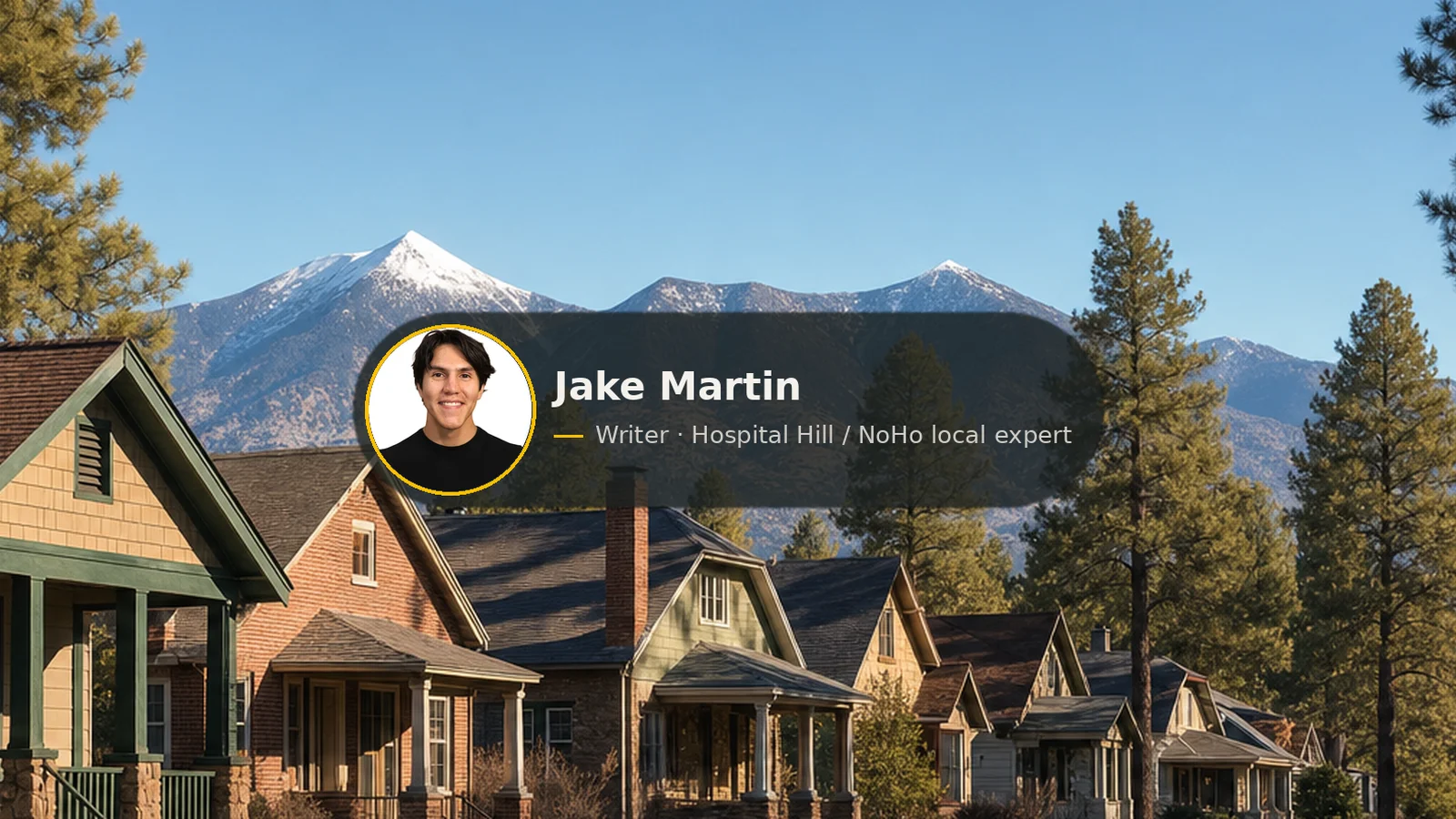
The historic core. Late-1800s Queen Anne and 1910s-20s Craftsman, close to downtown, inside or adjacent to the North End district boundary. Smaller footprints, mature street trees, original detail, and real constraints on what you can change outside.
The postwar and mid-century belt. The oldest confirmed build year in the area's current active listings is a 1956 house on West Navajo Road; there's a 1963 on West Meade Lane, a 1967 on North Rim Drive, and a 1973 on North Turquoise Drive. Bigger lots, simpler houses, and — importantly — the City treats post-World War II production housing as generally exempt from the cultural resource review requirement, though custom or architect-of-note postwar homes can still trigger it once they cross 50 years old (City of Flagstaff Heritage Preservation Maps).
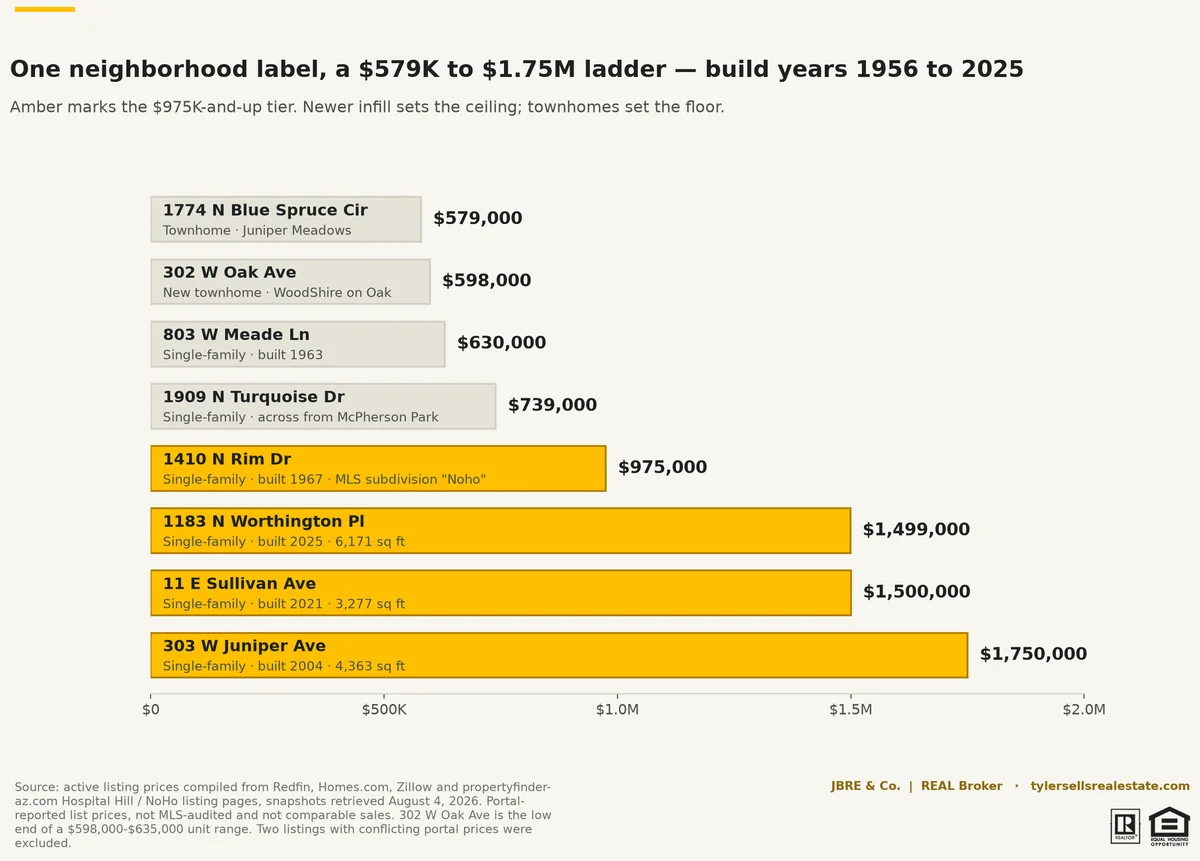
Infill and new construction. A 2004 six-bedroom on West Juniper Avenue, a 2021 build on East Sullivan Avenue, a 2025 build on North Worthington Place, plus new townhome product like WoodShire on Oak. These are the price ceiling of the area and they carry none of the renovation friction.
Build years in the current listing pool span 1956 through 2025. Treat "Hospital Hill" as a location, not a housing type.
What Hospital Hill homes actually cost
On Realtor.com's Flagstaff local market page, using data labeled October 2025, the Hospital Hill neighborhood row showed a median list price of $635,000 at $535 per square foot with 13 active listings, against a Flagstaff citywide $658,950 at $395 per square foot with 614 active listings and 76 days on market (Realtor.com Flagstaff market data).
Read that carefully, because the headline number is misleading. The median price is slightly below citywide. The price per square foot is 35% above it. That gap is the whole story of this neighborhood: you are paying a location premium on smaller houses. Older near-downtown homes are compact, so the total price looks moderate while the per-foot cost is among the highest in the city.
For wider context on the same ZIP, Realtor.com's 86001 page showed a median listing price of $746,402, 53 days on market, and 279 active listings through May 2026, with homes selling at about 98% of asking in June 2026 (Realtor.com 86001 market page). Those are different snapshots seven months apart — don't stack them into one comparison.
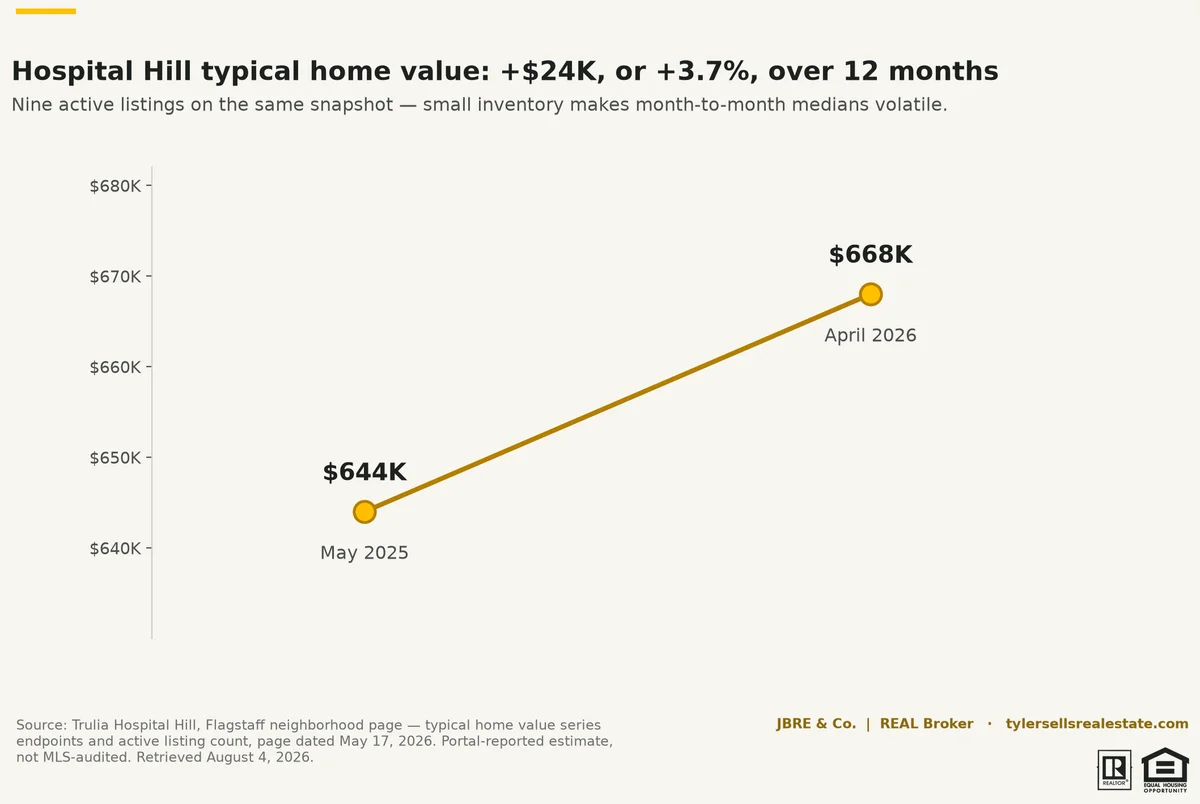
On the trend side, Trulia's Hospital Hill page showed a typical home value moving from about $644,000 in May 2025 to $668,000 in April 2026 with 9 active listings as of a page dated May 17, 2026 (Trulia Hospital Hill). Modest appreciation, thin supply.
One honest caveat on the data. All of the above is portal-reported, not MLS-audited, and Hospital Hill's sold-side samples are tiny — Redfin's neighborhood pages have published a Hospital Hill median as low as $490,000 and as high as $715,000 in different snapshots, each based on a single closed sale. A one-transaction median is not a market. For anything you're actually pricing off of, pull current MLS comps.
The one thing I'd check before you write an offer
Find out whether the parcel sits inside the North End Historic District boundary. Not "in the general area." Inside the line.
If it does — or if the structure is simply over 50 years old at the time of application — City of Flagstaff review comes into play. Under the Flagstaff Zoning Code, any exterior alteration, restoration, reconstruction, removal, or demolition of a structure within a historic overlay or district requires review, and a Cultural Resource Study is required for properties on the local, state, or National Register, for undeveloped land, and for any structure over 50 years old (Flagstaff Zoning Code 10-30.30). Ordinary maintenance with no design change, and interior-only work, are exempt.
The process runs through the Heritage Preservation Commission, which meets monthly on the third Wednesday at 4 p.m. You file with the Community Development Division — site plan, elevations, photos, materials board — and a $65 application fee applies. Smaller conforming projects can get administrative Consent Approval from the Historic Preservation Officer; larger or contested projects go to the HPC for a Certificate of Appropriateness, a Certificate of No Effect, or a Certificate of Economic Hardship (City of Flagstaff Heritage Preservation).
This changes two things at once, and buyers usually only think about the first:
Your renovation timeline and scope. Window replacement, siding, a porch rebuild, an addition, a detached garage — all of it becomes a design-review conversation instead of a permit.
Your comps. A contributing property inside the district and a similar-looking house one block outside it are not comparable assets. Different buyer pool, different constraint set, different pricing behavior. If your appraisal pulls across that line, you have a problem worth catching early.
My family's background is construction, and this is the part where I earn my keep on a NoHo deal: getting the boundary confirmed, getting the scope of your intended work in front of the right City staffer, and building the review timeline into the contract instead of discovering it after the inspection period closes.
Can you build an ADU or run a short-term rental here?
Both are usually possible. Both have specifics.
ADUs. Flagstaff allows accessory dwelling units on lots with one existing single-family dwelling as a matter of right under Arizona HB 2720, with a maximum of two per lot — no more than one detached, plus one attached or interior. Detached ADUs need five feet from rear and interior side property lines, or zero if the lot abuts a public alley, which the older grid streets here often do. Maximum occupancy is two persons per ADU, and an ADU can't be sold separately from the main house. If it's used as a short-term rental, the owner has to live on site. Size limits are expressed as a percentage of the primary dwelling with a hard square-foot cap, and the published summaries don't agree cleanly — verify against the current text of Flagstaff Zoning Code 10-40.60 before you design anything.
Short-term rentals. Arizona law (A.R.S. § 9-500.39) prevents Flagstaff from banning STRs, so the City regulates instead. Ordinance 2026-11 updated the rules in 2026: the annual license fee rises to the state maximum of $250, operators must carry $500,000 in liability insurance (satisfied automatically by booking through a marketplace that provides equivalent coverage), guests must be screened against the National Sex Offender Public Website within 24 hours of each stay, and smoke alarms, CO detectors, fire extinguishers, and clear egress are mandatory. Most new requirements kick in at your next license renewal (City of Flagstaff STR ordinance updates). You'll also need a state TPT license.
If the house is inside the historic district, note that the STR rules and the historic-review rules are separate systems — the City doesn't publish an STR restriction tied to historic status, but exterior work you'd want to do to make a property rentable still goes through preservation review.
What living in NoHo is actually like
Sidewalks connect. Alleys still function. The ponderosas are the mature kind that took eighty years to get that way, and they're the reason the older streets feel like a canopy in July.
Downtown is a walk rather than a drive from the lower blocks. Buffalo Park at 2400 North Gemini Road gives you a 2.2-mile loop trail with exercise stations, plus a ramada and permanent restrooms, and the Oldham Trail #1 climbs 5.5 miles toward Mount Elden from the park's north end (City of Flagstaff Parks, USDA Forest Service). McPherson Park sits at 1650 North Turquoise Drive in the middle of the newer NoHo streets. Thorpe Park west of downtown adds ball fields, disc golf, and a bark park. The Flagstaff Urban Trail System connects most of it without a car.
Your neighbors skew hospital and university — nurses, techs, physicians, NAU faculty and staff. The neighborhood has a shift-change rhythm because of it: quiet at odd hours, busy at 6:45 a.m. and 6:45 p.m.
The honest tradeoff is sirens. You're near a Level I trauma center that serves everything north of Phoenix, and ambulances run at night. Some people stop hearing it in a month. Some never do. Spend an evening on the block before you decide which you are.
At roughly 7,000 feet, the sky compensates. Flagstaff became the world's first International Dark Sky City on October 24, 2001, having adopted the world's first outdoor lighting ordinance back in 1958 (City of Flagstaff Dark Sky, DarkSky International). The City reports being named DarkSky International's Dark Sky Place of the Year in 2025. Walk out on a clear December night and you'll understand why the ordinance has survived seven decades.
Schools: verify, don't assume
Flagstaff Unified School District's Board adopted new attendance boundaries on November 5, 2025, affecting middle and high school assignments — elementary boundaries were unchanged — effective for the 2026-27 school year (FUSD school boundary maps).
Because of that change, do not rely on any static school list in any real estate article, including this one. Run the specific address through FUSD's official online school locator before you make a decision that depends on the answer. I'm not going to name a school here and risk being wrong about your address.
Is Flagstaff Medical Center moving?
Not right now. Voters previously rejected Proposition 480, an NAH plan to build a new hospital near Fort Tuthill. As of February 10, 2026, Northern Arizona Healthcare paused its effort to build a new Flagstaff Medical Center, citing declining reimbursement rates and rising costs, and said it is not moving forward with three previously studied sites and is not currently considering others. Board conversations about capacity continue, and renovating the existing Hospital Hill campus remains on the table (KNAU, February 10, 2026).
In the meantime NAH has been renovating the existing Emergency Department in phases and building out its Summit Center on North Turquoise Drive with added operating rooms and a wound clinic (NAH Summit Center announcement).
What that means for you as a buyer: the "walk to work at the hospital" premium in this neighborhood is not on a countdown clock, and it's also not guaranteed forever. Anyone selling you either certainty is guessing. Buy the house and the location on their own merits.
How Hospital Hill compares to other Flagstaff neighborhoods
If the per-foot premium here is more than you want to carry, the comparison worth running is against Flagstaff's newer, lower-cost tiers — our Railroad Springs guide covers the west-side entry point, and Presidio in the Pines covers the newer east-side master plan. Neither gives you the 1910s Craftsman or the walk downtown. Both give you more square footage per dollar and none of the preservation review.
Nobody planned this neighborhood. That's exactly what makes it hard to replace.
Thinking about buying or selling in NoHo or Hospital Hill?
Jake works the North of Hospital and North End blocks specifically — where the historic district line actually falls, which houses carry review obligations, and how that changes both your renovation plan and your comps. Get a shortlist of what's genuinely worth seeing, or a straight read on what your home is worth on the right side of that boundary.
Jake Martin · REALTOR®, JBRE & Co., brokered by Real Broker (928) 707-0504 · jake@jbreandco.com
Equal Housing Opportunity. Market figures are portal-reported and dated as cited; they are not MLS-audited and are not a substitute for a current comparative market analysis.

Written by
Tyler Vaughan
Northern Arizona's top-rated real estate agent with 350+ five-star reviews. Specializing in Sedona, Flagstaff, and Northern AZ luxury properties.
Ready to Make Your Move?
Whether you are buying or selling in Northern Arizona, Tyler is here to help you navigate the market with confidence.