



Selling a rental property in Flagstaff is not the natural conclusion of this article. If you own a rental on NoHo, the North Hospital Hill blocks that Northern Arizona MLS calls Area 130, you own something with a tenant pool most Flagstaff rental markets do not have. This piece is arithmetic, not persuasion. It is written for the landlords on this hill, a large share of whom read their mail in Phoenix, Gilbert, or somewhere further out, and it exists so that a decision this size gets made deliberately instead of by default.
Here is what the next twenty minutes covers:
Why rental demand on this hill is structurally strong, and why that counts as an asset in any decision
Four signals that a rental has quietly stopped working, none of which is a bad year
The valuation number most long-held Arizona rentals get wrong, and the statute that causes it
What an exit actually costs on NoHo, priced against four documented Area 130 closings
Three ways out, compared honestly, with nobody ranked first
What to do if you are keeping it, which most readers will be
Nothing here is an appraisal, a valuation of any specific property, tax advice, or investment advice. Run the tax questions past a CPA and the portfolio questions past a financial adviser.
Why rental demand on NoHo is genuinely strong
Start with the strength, because it is the part owners underrate.
Northern Arizona Healthcare is the second largest employer in Coconino County, with 2,200 employees and 2.90% of total county employment in fiscal year 2024/2025, according to the county's annual comprehensive financial report filed with the Arizona Auditor General. Flagstaff Medical Center is that system's Flagstaff hospital, and by the system's own description it is the only Level 1 Trauma Center north of Phoenix. We do not publish a facility-level headcount, because no primary source we could verify gives one. The county figure is the honest number.
What sits at the top of this hill is therefore an institution, on rotating shifts, running around the clock, every month of the year.
A meaningful share of that workforce is on contracts measured in months rather than years. That is observable rather than anecdotal. On September 11, 2026, the clinical job board Vivian listed four active travel contracts at Flagstaff Medical Center, all night shift, 3x12 and 4x12 schedules, at $2,077 to $3,200 per week. Travel nurses are only one slice of it. Residents, visiting specialists, and families staying close to a patient through a long course of treatment all need the same thing: a furnished or semi-furnished place, near the hospital, for a defined stretch of time. Furnished Finder showed 321 furnished monthly rentals near Flagstaff the same day, and its Flagstaff corporate listings advertise on proximity to FMC directly.
Many of these tenants would rather walk than drive in January, which is a rational preference at 7,000 feet, and it is the reason walkable distance to the hospital campus prices differently here than square footage alone would suggest.
The NoHo tenant pool renews on somebody else's schedule
That produces something unusual. Most Flagstaff rental submarkets refill when the local economy refills them. NoHo refills on a rotation set by an institution.
Even in a slow year the hill has renters. Vacancy risk here is not zero, but it is structurally different from vacancy risk in a submarket dependent on discretionary in-migration. Count that as an asset on the ledger before you count anything else.
One thing we will not do is publish a rental percentage for the neighborhood. The rental share on this hill shifts street to street rather than neighborhood-wide. One block is almost entirely owner-occupied, with families who have held the same house for decades. The next block is nearly all rentals. No source we reviewed publishes a defensible neighborhood-level figure, so we are not estimating one. If you want the pattern on your specific street, that is a parcel-level question and it has a real answer, which is a different exercise than a headline statistic. Our Hospital Hill inventory analysis walks through how the block-by-block tenure patterns actually read.
Four signals a NoHo rental has stopped working
None of these is a bad year. Each is a trend that usually runs for a while before an owner notices, which is exactly why it is worth checking on purpose.
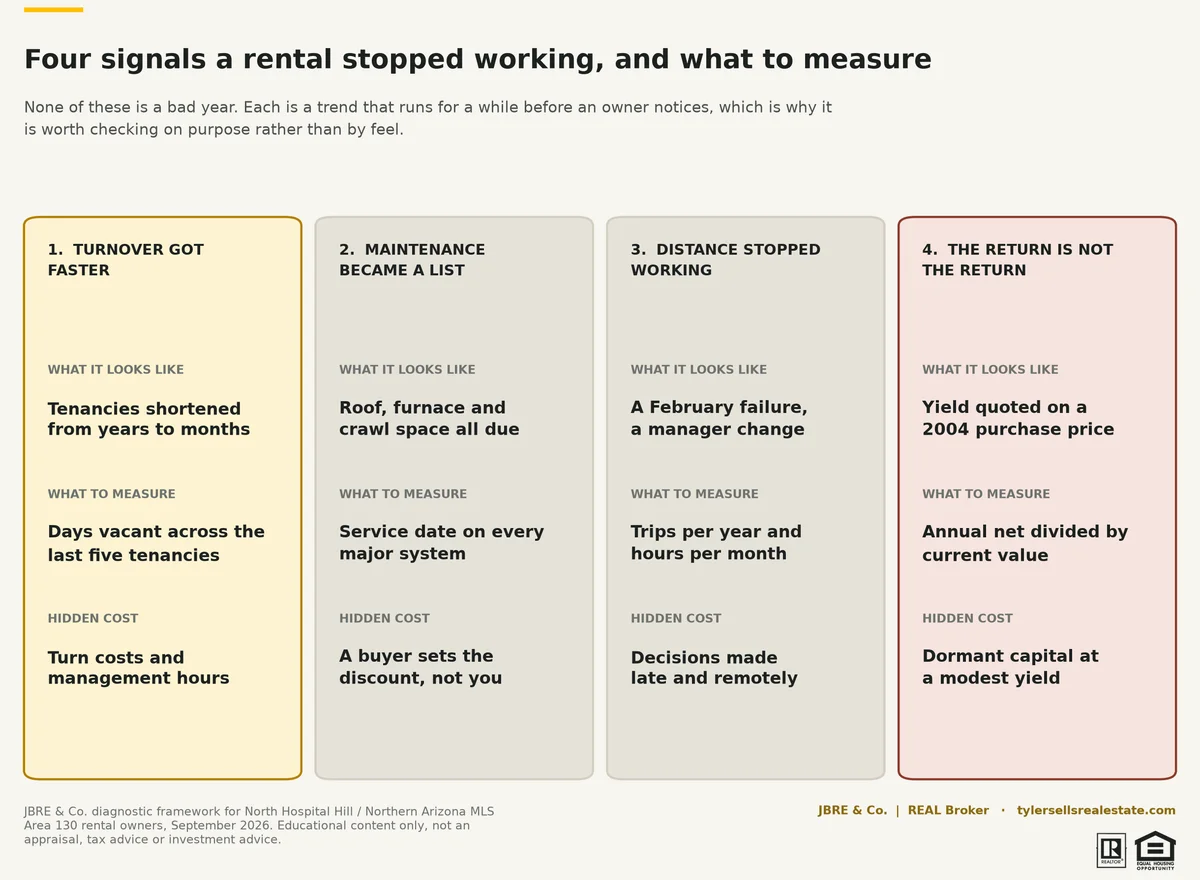
1. Turnover has quietly gotten faster. A rotating-staff tenant pool is a strength and a cost at the same time. If your tenancies have shortened from years to months, then vacancy weeks, turn costs, and management hours have all risen whether or not rent followed. Look at the last five tenancies, not the current one. The current one always looks fine.
2. Deferred maintenance became a list rather than an item. On housing of this era, postponed work does not stay the same size. A roof at the end of its service life, an undated furnace, a crawl space nobody has entered: each is manageable on its own schedule, and much larger when they arrive together, which eventually they do. The honest question is not whether the house needs work. It is whether you intend to be the person who does it, or whether you are handing that list to a buyer at a discount the buyer will set.
3. You are managing it from a distance you no longer want to manage from. This works until it does not, and it typically stops working when a system fails in February, a tenancy ends badly, or the property manager changes. Distance is not a problem until it is the entire problem.
4. The return you are getting is not the return you think. This is the important one, and it gets its own section.
The number most long-term NoHo landlords have wrong
Arizona is a two-value state, and that fact quietly distorts how long-term owners understand their own equity.
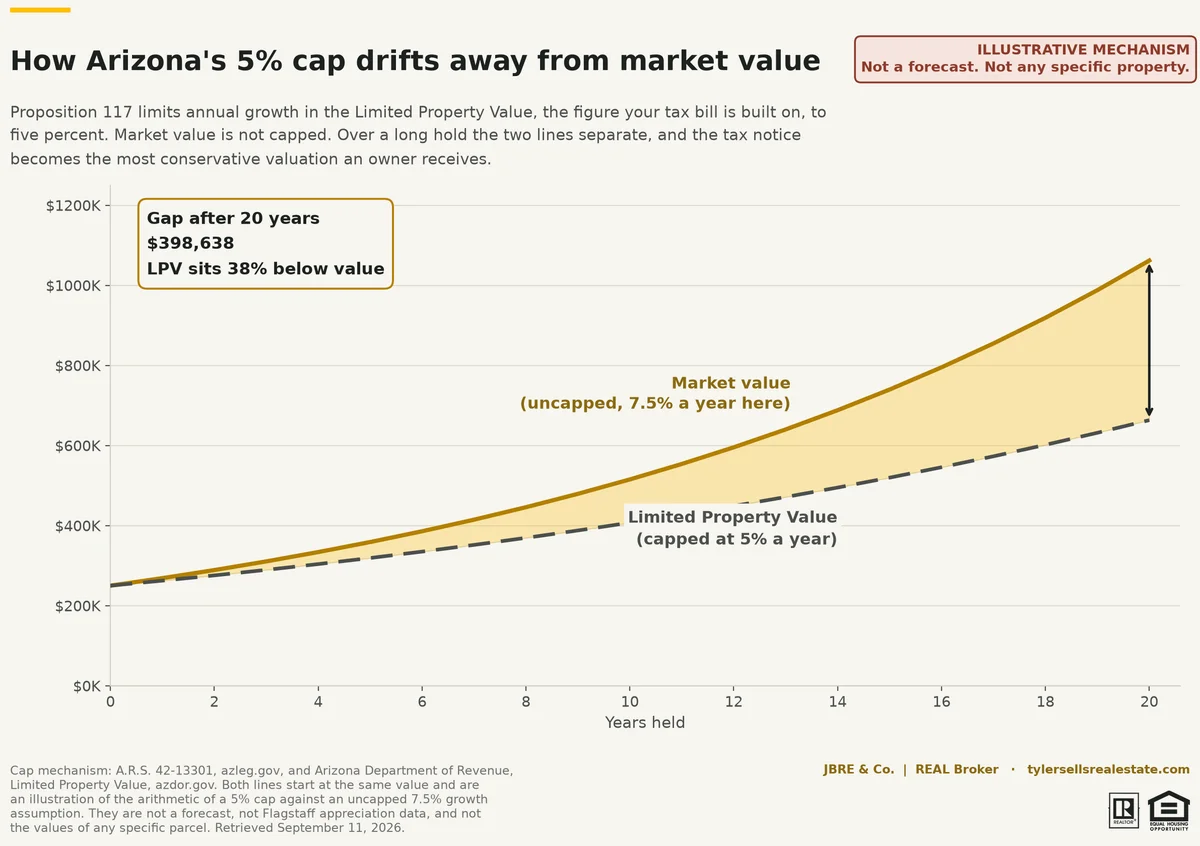
Under Proposition 117, approved by Arizona voters in 2012, the Limited Property Value that drives your tax bill can rise no more than five percent a year. The statute is blunt about it. A.R.S. 42-13301 reads: "The limited property value of property for property taxation purposes is the limited property value of the property in the preceding valuation year plus five per cent of that value." The Arizona Department of Revenue's own explainer confirms the origin: "Proposition 117 imposed a limitation of the LPV's annual growth to 5% beginning in tax year 2015."
Hold a rental fifteen or twenty years and a figure capped at five percent compounding drifts a long way below what the property is actually worth in a market that did not agree to be capped.
Now add the behavioral part. For most owners, the annual tax notice is the only valuation they ever receive. The Coconino County Assessor mails a Notice of Valuation between January 1 and March 1 each year, and it states the Full Cash Value, the Limited Property Value, and the classification. So the longer you have held, the more your instinct about your own equity is anchored to a number that was designed by statute to be conservative.
Limited Property Value and Full Cash Value are not the same number
The distinction is worth getting exactly right, because the two values do different jobs.
The Arizona Department of Revenue puts it plainly: "There are two values applicable to property in Arizona: full cash value and limited property value. Full cash value is synonymous with market value in most cases ... This means that full cash value fluctuates with the market from year to year. In contrast, limited property value is restrained by law, in that it can never exceed full cash value and can only increase by up to five percent over the prior year."
Three practical consequences for a NoHo landlord:
Real property is taxed on the LPV, per the same Department of Revenue publication. That is why your tax bill has felt manageable while local prices did not.
The LPV cannot be appealed. The county says so directly: Full Cash Value and classification are appealable, the Limited Property Value is not, "because it is a statutory calculation." The appeal window is 60 days from the postmark on the notice.
The cap follows the parcel, not the owner. Under A.R.S. 42-13302 the LPV is only re-established at a level comparable to similar property on enumerated events, such as a modification by construction, destruction, or demolition worth fifteen percent or more of full cash value, or a split or consolidation.
So the Full Cash Value line on your notice is the better indicator of where the market thinks your capital sits. It is still the assessor's estimate rather than an appraisal, and it is not a substitute for a broker price opinion or a comparative market analysis on your specific parcel. But as a starting denominator it beats the number you paid in 2004 by a wide margin.
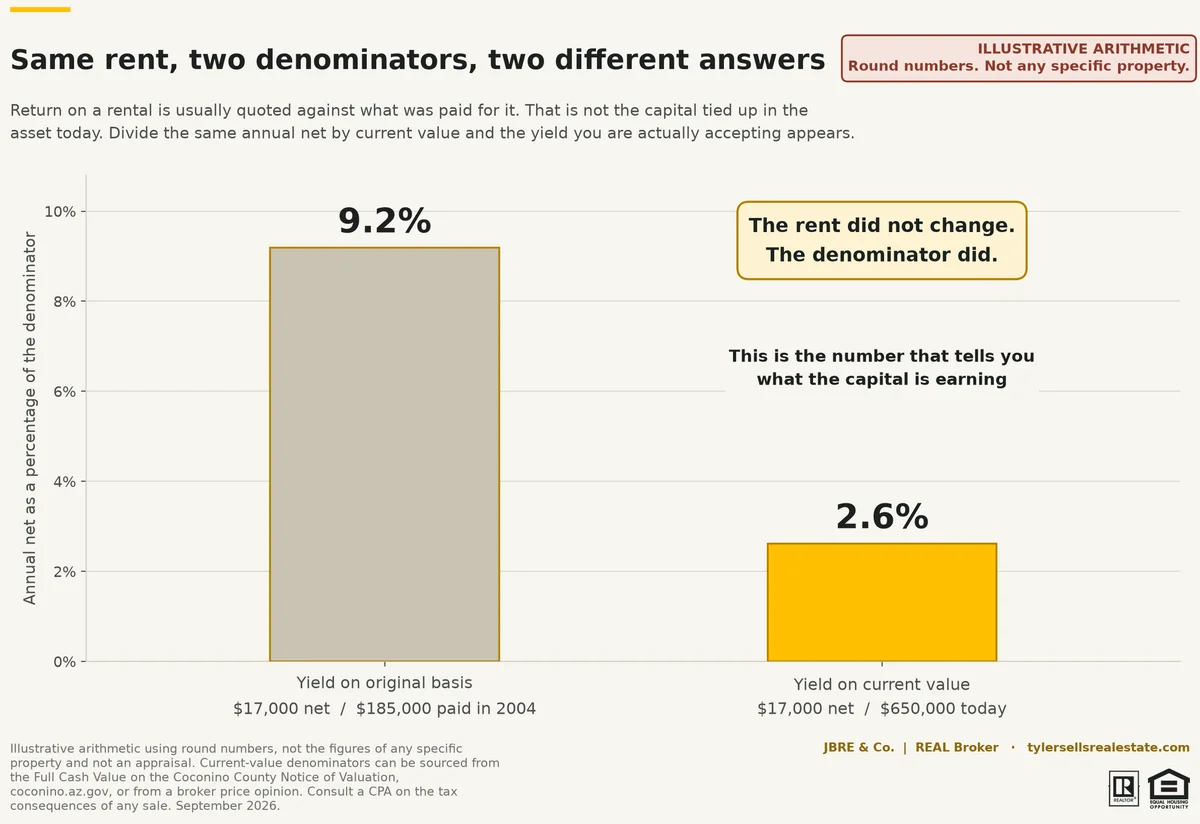
The arithmetic: yield on basis versus yield on current value
Return on a rental is usually calculated against what was paid for it. That is the wrong denominator for a hold decision, because what was paid for it is not the capital currently tied up in the asset.
Run the same annual net against current value instead. Same rent, same expenses, different denominator, and a very different answer about what your money is earning where it sits.
Some owners run this and are reassured. The property is carrying itself, the tenant pool is reliable, and the yield is acceptable against current value too. Some owners run it and discover they are holding a large amount of dormant capital for a modest yield, which is a legitimate thing to do on purpose and an expensive thing to do by accident.
Both are useful answers. Not running it is the only bad outcome.
What selling a rental property in Flagstaff costs on this hill
The first real decision is not price. It is condition: sell as-is, or put the house in retail condition first.
We have four documented Area 130 closings that bracket the question, drawn from Northern Arizona MLS and Coconino County records and deemed reliable but not guaranteed:
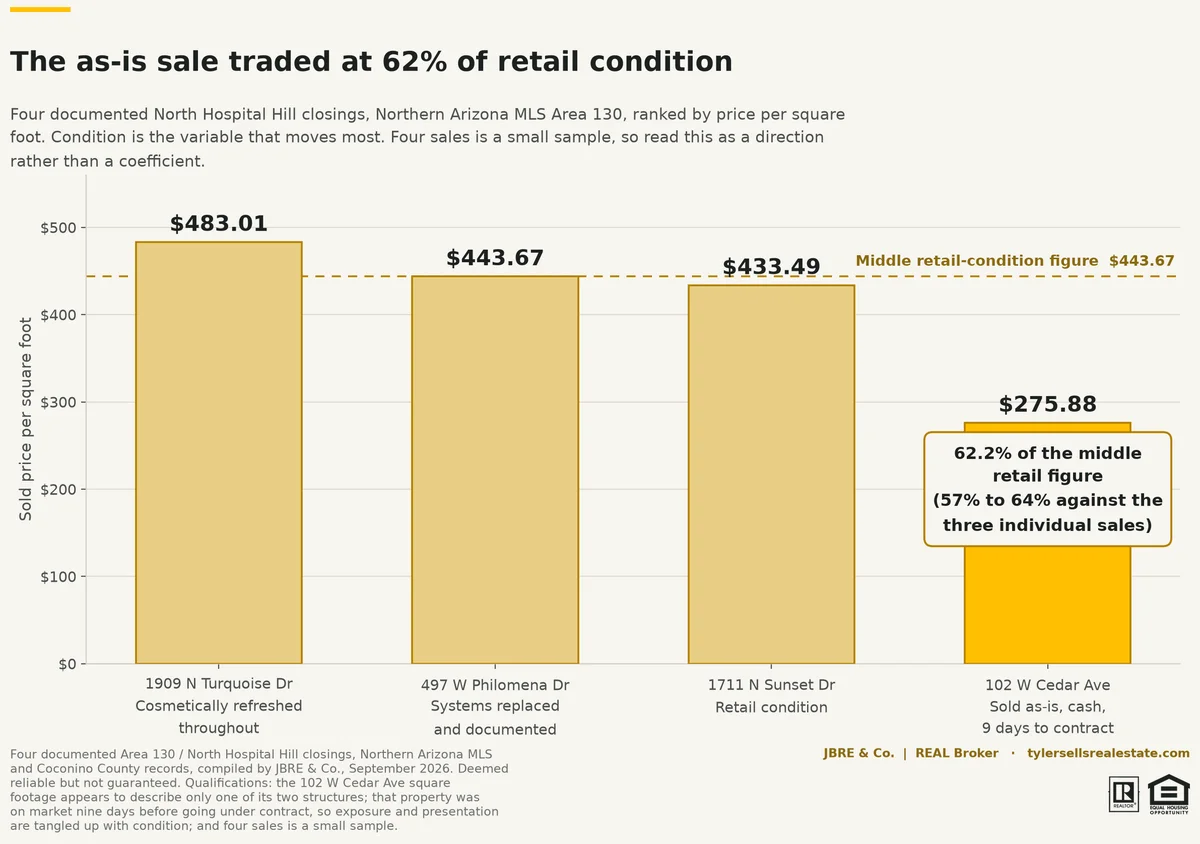
1909 N Turquoise Dr, cosmetically refreshed throughout: $483.01 per square foot
497 W Philomena Dr, systems replaced and documented: $443.67 per square foot
1711 N Sunset Dr, retail condition: $433.49 per square foot
102 W Cedar Ave, sold as-is for cash, nine days to contract: $275.88 per square foot
The as-is sale traded at 62.2% of the middle retail-condition figure, and between roughly 57% and 64% of the individual retail sales. That is the 60 to 65 percent range in plain arithmetic. On a 1,600 square foot house the gap between $443.67 and $275.88 a foot is about $268,000, which is not a rounding error.
Three qualifications have to be published alongside that, because the number is only useful if you can see its edges:
The as-is property also carried a square footage figure that appears to have described only one of its two structures, which would move its per-foot math.
It was on market nine days before going under contract, so presentation and exposure are tangled up with condition inside that single number.
Four sales is a small sample. This is a direction, not a coefficient.
The direction, though, is not in doubt. As-is is a legitimate way to sell and sometimes the right one. It is simply the most expensive way, and the discount is set by the buyer rather than by you. For the longer version of that argument on older Flagstaff stock generally, see our guide to selling an older home in Flagstaff.
Three exits from a NoHo rental, honestly compared
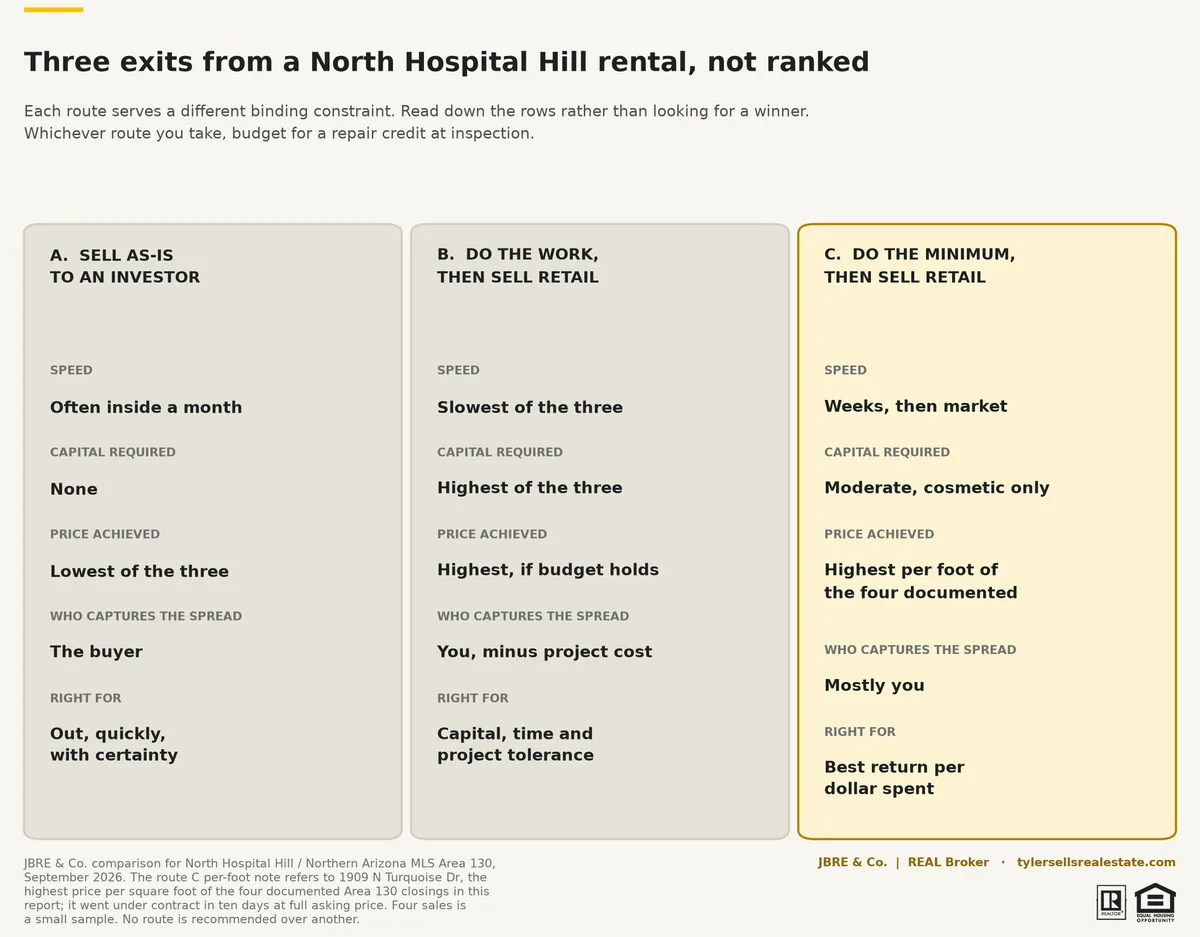
These are not ranked. They serve different priorities, and the right one depends on which constraint binds hardest for you.
A. Sell as-is to an investor. Fastest and cleanest. Cash, no repair negotiation, no financing contingency, frequently closed inside a month. You pay for that speed in price, and the buyer captures the as-is-to-retail spread documented above. This is the right answer for an owner whose priority is out, quickly, with certainty.
B. Do the work, then sell retail. Captures the spread, and the documented sales suggest the spread is large. It requires capital, time, and tolerance for running a project, possibly from out of town. Price the project with real contractor numbers before you commit, not estimates. A renovation budget built on estimates is how the spread gets spent twice.
C. Do the minimum, then sell retail. Often the best return per dollar spent. The Turquoise sale is the instructive one: paint, flooring, kitchen and baths, cosmetic work done completely, no new systems. It went under contract in ten days over the holidays at full asking price and posted the highest per-foot figure of the four. The lesson is that cosmetic work done thoroughly outperforms partial renovation, because partial reads to a buyer as a house mid-project, and buyers discount uncertainty harder than they discount age.
Expect a repair credit on NoHo's older housing stock
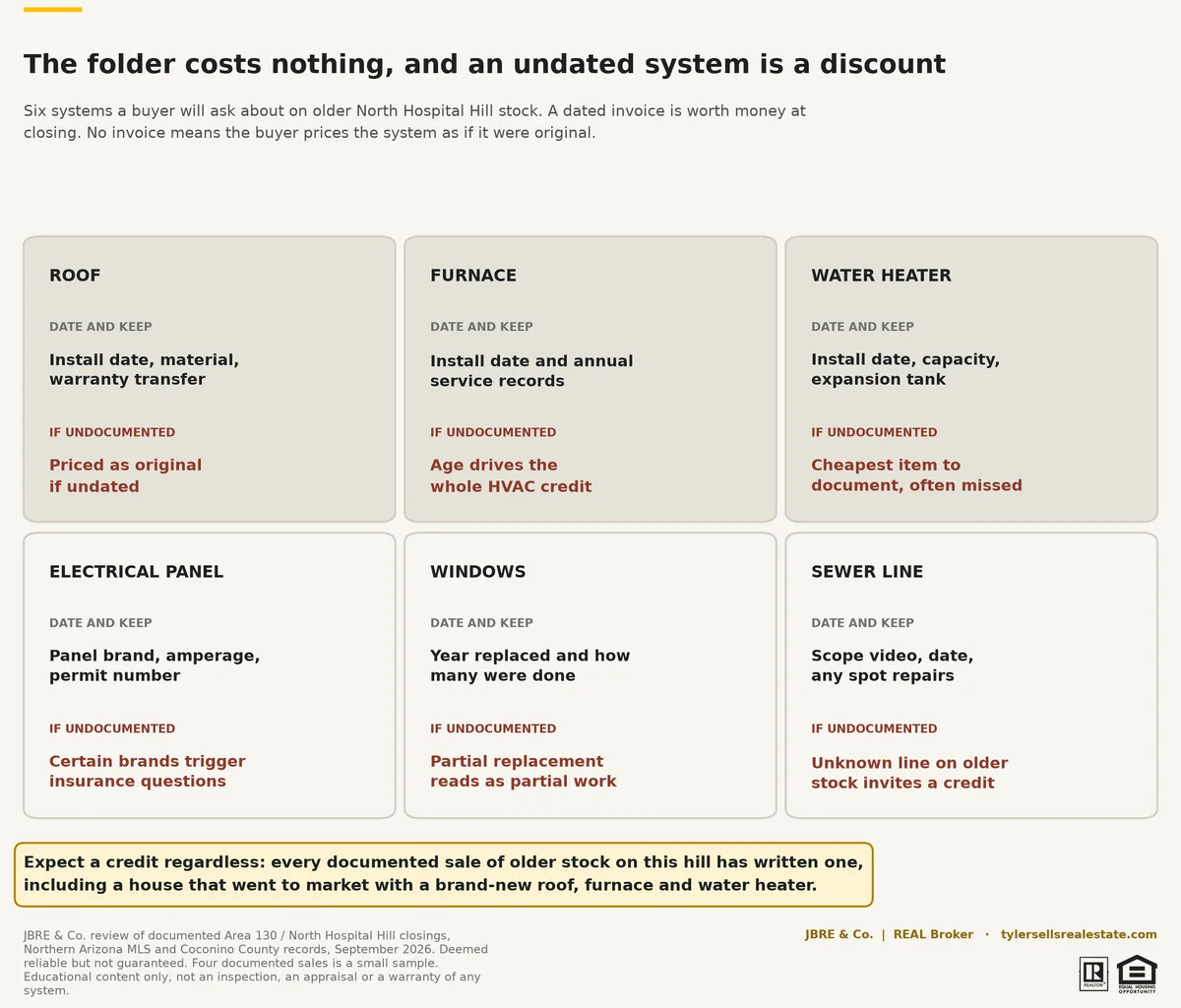
Whichever route you take, budget for a credit at inspection.
Every documented sale of older stock on this hill has written one. That includes a house that went to market with a brand-new roof, furnace, and water heater. That is not a negotiating failure. That is what a fifty or sixty year old building does when a licensed inspector spends three hours in it.
Treat the credit as a line item rather than a surprise. Our case study on the NoHo concessions structure at 1907 N Meadow Lark Drive shows what actually got written into a closed transaction on this hill, which is a more useful reference than any general rule about credits.
If you are not selling your NoHo rental, two things worth doing anyway
Most readers will not be selling, and that is a reasonable position. Rental demand here is real, and this hill has held value through markets that were unkind to other parts of Flagstaff. If the arithmetic says keep, keep.
Two things are still worth doing.
1. Run your net against current value once. Not against basis. Not against the LPV on your tax notice. Against what the capital is actually worth today, so you know the yield you are accepting. One hour, once.
2. Start the folder. Roof, furnace, water heater, electrical panel, windows, sewer line: every invoice with a date on it. On this hill a documented system is worth real money at sale, and an undocumented system is a discount waiting to be applied, because a buyer who cannot date your furnace will price it as if it were original. The folder costs nothing and it only gets more valuable the longer you hold.
Two rules on NoHo that change by address, not by neighborhood
Two things landlords here get wrong by assuming the neighborhood answer applies to their parcel.
Short-term rental rules. Flagstaff allows short-term rentals, but the City requires an annual Short Term Rental License, effective November 2023, at $250 a year, and Chapter 3-12 of the City Code has been amended since. Requirements can also turn on your specific parcel and any recorded restrictions on it. Verify the current requirement for your address on the City of Flagstaff short-term rental page before you advertise, and read our companion breakdown of how STR rules read at the community level for how much variation is normal.
School attendance areas. FUSD's Board of Education adopted new boundaries on November 5, 2025. Middle and high school attendance areas change for the 2026-2027 year; elementary boundaries do not. Confirm your address against the district's current boundary maps rather than a listing remark, since this matters to a share of your tenant pool.
NoHo rental owners: what to run before you decide
Nobody should sell a working asset because a market report suggested it. The point of running the numbers is not to reach a particular answer.
It is that a decision this size should be made deliberately rather than by default, and a surprising number of long-held rentals are held by default. If you run the arithmetic and the answer is keep, you now know why you are keeping it. That is worth the hour on its own.
If you want the neighborhood context around whatever you decide, start with what is currently for sale on Hospital Hill and NoHo.
Thinking about selling a rental property in Flagstaff, or deciding whether to hold?
Jake works NoHo and North Hospital Hill specifically: Area 130 comps, condition-tier pricing, and what a documented system is actually worth at closing. Get a straight read on what your rental would bring as-is versus in retail condition, and what the arithmetic looks like against current value rather than basis. No pitch, and no assumption that selling is the answer.
Jake Martin, REALTOR®, JBRE & Co., brokered by Real Broker 928-707-0504 · jake@jbreandco.com · @jake_martinaz
Equal Housing Opportunity.
Figures for North Hospital Hill / Northern Arizona MLS Area 130 are from Northern Arizona MLS and Coconino County records, deemed reliable but not guaranteed. Four documented sales is a small sample. Nothing in this article is an appraisal, a valuation of any specific property, tax advice, or investment advice; consult a CPA or a financial adviser before acting. No current owner, tenant, or property manager is named.

Written by
Tyler Vaughan
Northern Arizona's top-rated real estate agent with 350+ five-star reviews. Specializing in Sedona, Flagstaff, and Northern AZ luxury properties.
Ready to Make Your Move?
Whether you are buying or selling in Northern Arizona, Tyler is here to help you navigate the market with confidence.