

Selling an older home in Flagstaff is a different exercise than selling a newer one, and nowhere is that more true than North Hospital Hill. Most of the housing in NoHo went up between the 1940s and the late 1970s, which means the number a buyer is willing to write is driven less by square footage and more by the condition of six specific systems. This guide covers what those six items are, who reads them, and what a seller should do about them before the sign goes in the yard.
The short version:
Automated valuation estimates price size, beds, baths, and location. They cannot see a roof, a furnace, an electrical panel, or a crawl space.
Four different people read condition on the same house, and they read it for four different reasons.
Roofs, heat, electrical, windows, crawl spaces, and kitchens or baths are where the money moves in North Hospital Hill.
No air conditioning, a crawl space, and a pre-1978 lead disclosure are normal here. None of the three is a defect.
Every condition claim you cannot document is a discount waiting to be applied.
Arizona's inspection negotiation runs on a 10, 5, 5 clock by default, so preparation happens before you list, not after.
What "older home" means in North Hospital Hill
North Hospital Hill, the neighborhood most locals shorten to NoHo, sits on the rise north of Flagstaff Medical Center. It is largely a postwar and mid-century neighborhood: single-level ranch and split-level homes on established lots, with mature ponderosa canopy and streets that were platted long before current subdivision standards.
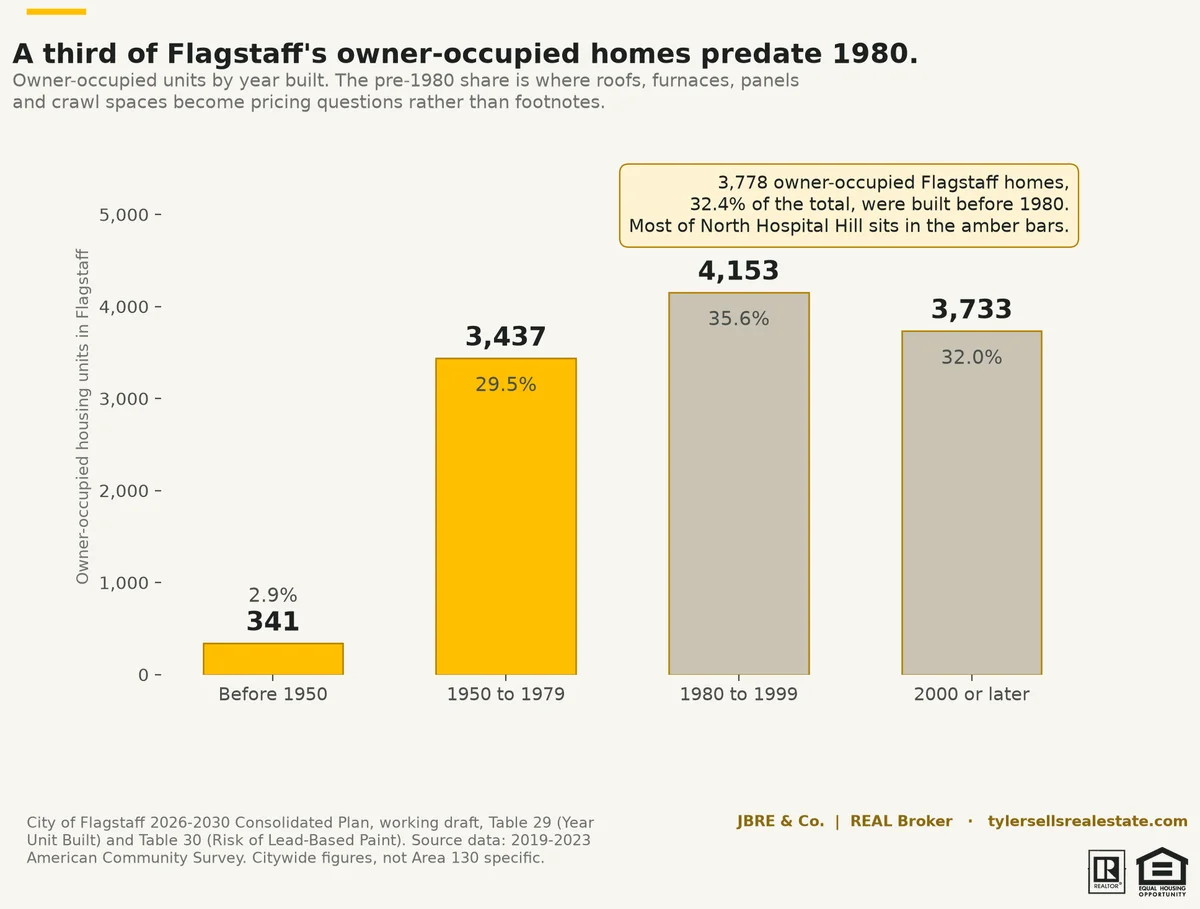
Citywide, the City of Flagstaff's 2026-2030 Consolidated Plan working draft puts 3,778 owner-occupied housing units, or 32.4% of the total, in the pre-1980 bracket, with another 3,437 units built between 1950 and 1979 (City of Flagstaff Consolidated Plan draft, Tables 29 and 30, using 2019-2023 American Community Survey data). Those are citywide figures rather than Area 130 specific, but they describe the pool NoHo sits inside. A large share of Flagstaff's owner-occupied stock is old enough that systems, not finishes, decide the price.
That matters because buyers in this price band are not comparing your house to new construction. They are comparing it to the other older home they toured last weekend, and the tiebreaker is almost always what they believe about the systems.
Why an automated estimate cannot price condition in NoHo
An automated valuation model works from public records and closed sales. It knows the year built, the recorded square footage, the bed and bath count, and the lot. It does not know whether the roof went on in 2009 or 2023. It does not know whether the furnace is a 1978 original or a 2021 replacement with a paid invoice in a folder.
On a 1990s tract home that gap is small, because the systems are close to the same age across the whole street. On a 1958 ranch in North Hospital Hill the gap between the best and worst example of the same floor plan can be very large, and the model splits the difference on both of them. That is why two nearly identical NoHo homes can carry very different offers, and why sellers who lead with documentation tend to land closer to ask.
The same logic drives condition tiers in other older Flagstaff neighborhoods. We broke that math down using sale data in our look at Upper Greenlaw home values and condition tiers.
Four people read condition, and they read it differently
Sellers tend to think of condition as one opinion. It is four.
The buyer reads surfaces, and reads them emotionally. Paint, floors, light, smell, and the state of the kitchen. This is the read that decides whether an offer gets written at all.
The buyer's agent reads the county record and the listing remarks. Year built, permit history, recorded square footage, and whether the remarks name specific years for specific work. Vague language gets discounted in the offer.
The inspector reads the punch list. Every deferred item, every improper repair, every missing safety element, in a report that will run dozens of pages and that the buyer will read line by line.
The appraiser and the insurer read risk. The appraiser is asking whether the price is supportable. The insurer is asking whether it will write the policy at all, and on what terms.
You can satisfy the buyer and still lose the deal at the insurer. Comfort is not the same as insurable.
Six condition items that move the number in North Hospital Hill
01 Roof
At 7,000 feet the shingle math changes. Ultraviolet levels rise by approximately 10% for every 1,000 meters of altitude (World Health Organization), and freeze-thaw cycling plus a snow load that averages about 101.7 inches a year at Flagstaff Pulliam Airport does the rest (NOAA Technical Memorandum NWS WR-273).
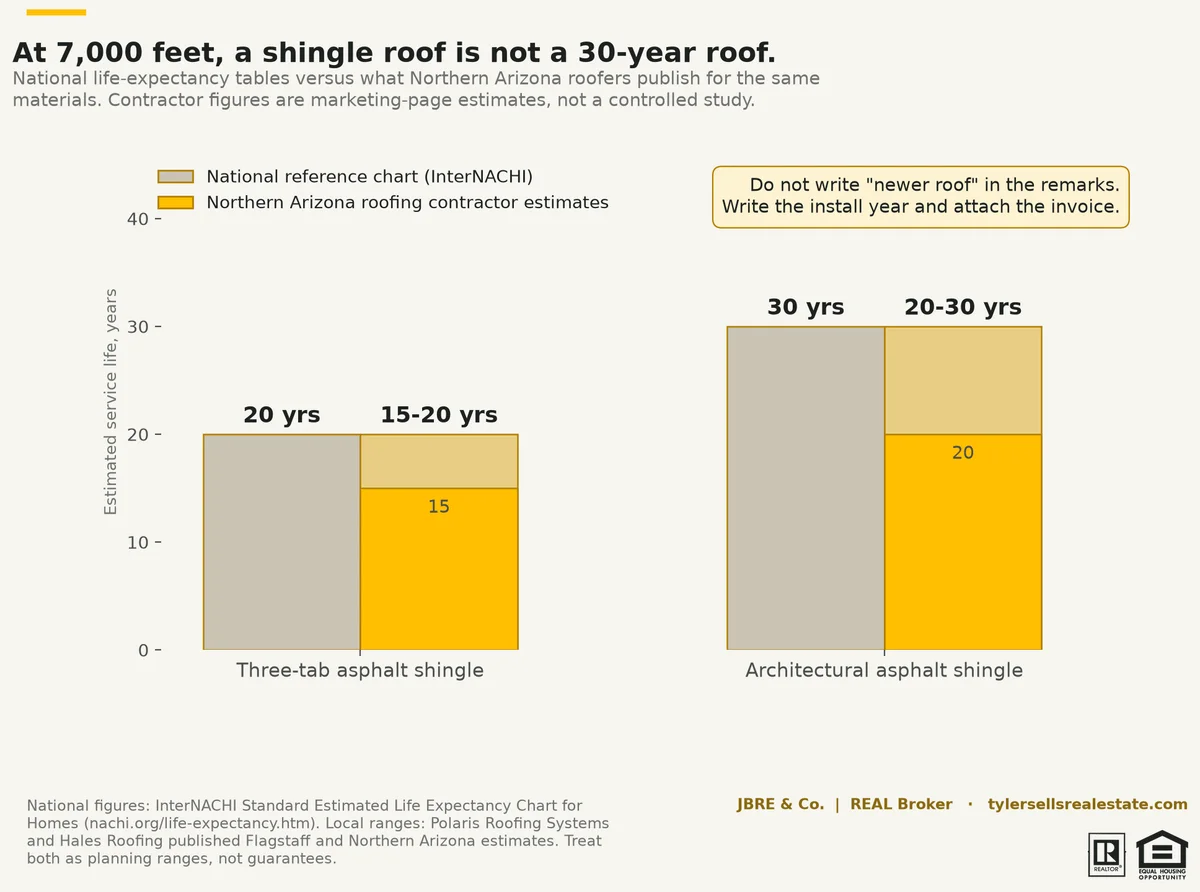
National reference tables put a three-tab asphalt shingle at about 20 years and an architectural shingle at about 30 (InterNACHI Standard Estimated Life Expectancy Chart). Northern Arizona roofing contractors publish shorter local ranges, with one Flagstaff company writing that shingles rated for 25 to 30 years at lower elevation "often deteriorate in just 15 to 20 years at high altitudes" (Polaris Roofing Systems) and another giving 20 to 30 years for Northern Arizona asphalt (Hales Roofing). Treat all of these as planning ranges rather than guarantees, since the contractor figures are marketing-page estimates, not a controlled study.
The practical instruction is short: do not write "newer roof" in the remarks. Write the install year and attach the invoice. Roof age also shows up on the insurance side, where industry commentary describes 15 to 20 years as the common pivot point for inspection requests and reduced-value endorsements (RoofPredict). There is no single national rule, so verify with the specific carrier rather than assuming.
02 Heat
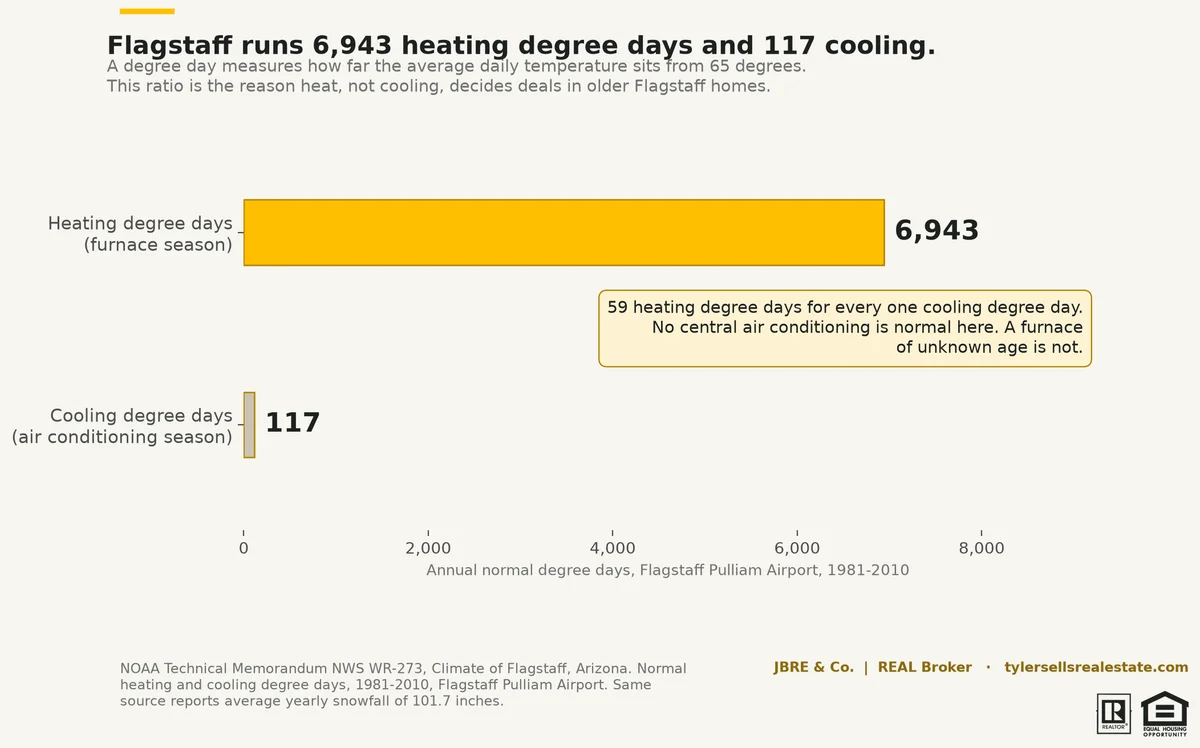
Flagstaff's annual normal is 6,943 heating degree days against 117 cooling degree days (NOAA Technical Memorandum NWS WR-273). That is roughly 59 heating degree days for every one cooling degree day. Heat is not a feature here. It is the whole mechanical story.
Most NoHo homes run gas forced air. A cracked heat exchanger is the single item most likely to end a transaction rather than get negotiated, because it is a combustion safety finding and because the fix is a furnace replacement, not a repair. National life-expectancy figures put a residential furnace at 15 to 25 years (InterNACHI). If yours is inside or past that window, know the year before a buyer's inspector tells you.
03 Electrical
Electrical is the category where buyers walk instead of negotiating. A roof is a number. A panel that a carrier will not insure is an unknown, and unknowns lose deals.
The items that draw attention in homes of this era are knob-and-tube wiring, aluminum branch circuit wiring, an undersized service, cloth-insulated wiring, and certain older panel equipment. Arizona electrical contractors write that Federal Pacific Stab-Lok and Zinsco panels were common in homes built in the 1950s through the 1970s and that many insurers now flag or decline them (Residential Electrical Services of Arizona), and that aluminum branch wiring is commonly accepted after an approved retrofit such as AlumiConn or COPALUM (Towery Electric). Those are contractor sources rather than insurer underwriting guidelines, so the correct move is to ask your own carrier and a licensed electrician about your specific panel rather than to rely on a general claim.
Ask the insurability question out loud, early, and in writing. Comfort is not the same as insurable.
04 Windows
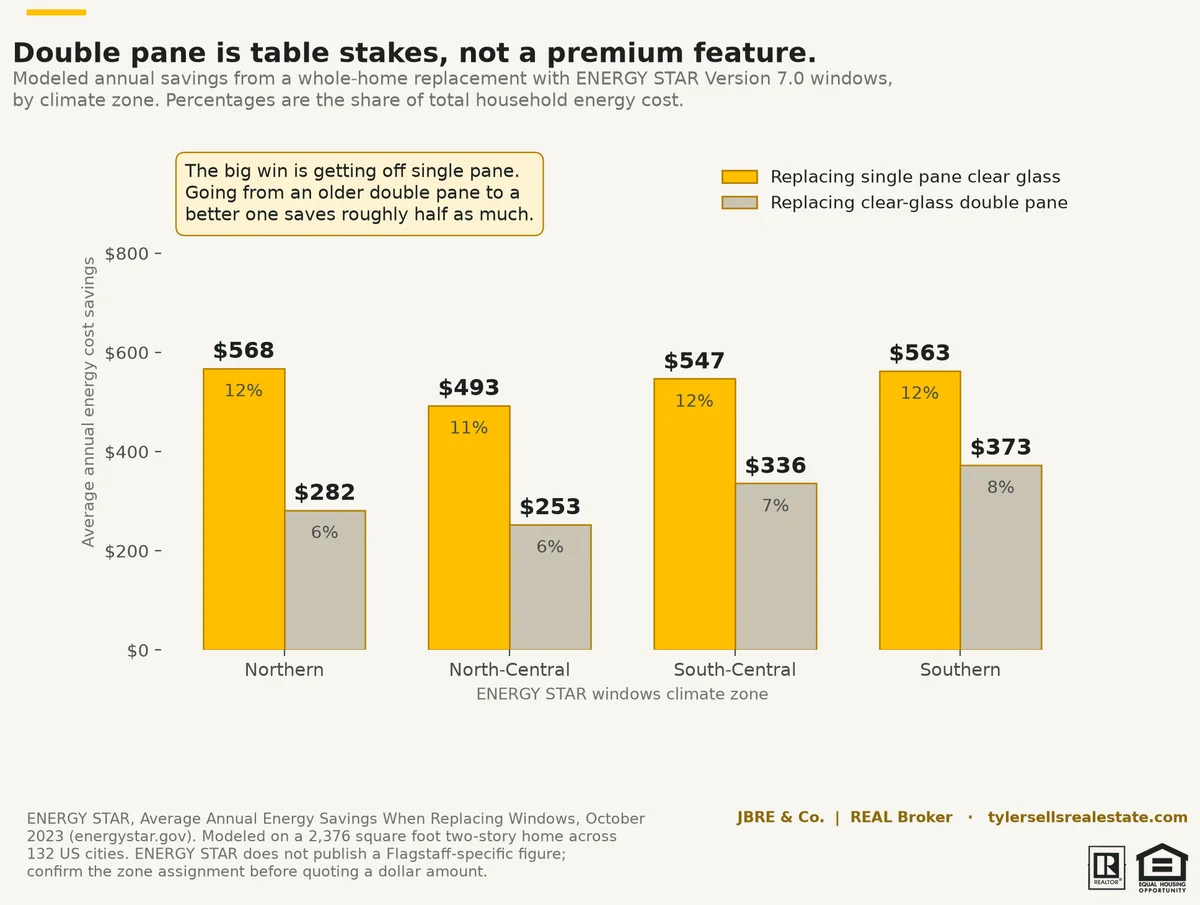
Double pane is table stakes in Flagstaff, not a premium feature. Sellers routinely expect a price bump for it and do not get one, because the buyer's baseline expectation at this elevation is already double pane.
Where the real money sits is going from single pane clear glass to a current unit. ENERGY STAR's modeled figures for a 2,376 square foot two-story home show annual savings of $568 in its Northern zone and $493 in North-Central when replacing single pane clear glass, against $282 and $253 for replacing an older clear-glass double pane (ENERGY STAR, Average Annual Energy Savings When Replacing Windows, October 2023). ENERGY STAR does not publish a Flagstaff-specific figure and its published methodology does not state Arizona's zone assignment, so do not quote a dollar amount as if it were local. The pattern is the point: the upgrade off single pane is worth roughly twice the upgrade between double panes.
05 Crawl space
This is the single largest gap between what sellers believe and what the report will say. Most sellers in North Hospital Hill have never been under the house. The inspector will be, and will photograph it.
What gets written up: standing water or staining, active or historic rodent activity, compromised or missing insulation, ducting that has separated, a vapor barrier that is torn or absent, and plumbing repairs made in a way that was never permitted. None of that is exotic in a house of this age. All of it is negotiable, and all of it is far cheaper to see yourself in advance than to see for the first time on page 34 of a report a buyer is already reading.
06 Kitchens and baths
Kitchens and baths are the most overweighted items in seller expectations. They are the most visible, so sellers assume they carry the price. In an older Flagstaff home they usually do not carry it alone.
An original 1960s kitchen paired with a documented new roof, a new furnace, and an updated panel will generally outperform a beautifully remodeled kitchen sitting above an undated furnace and a panel nobody wants to discuss. The finishes get the first offer. The systems decide whether that offer survives the inspection period.
What is normal in NoHo and is not a defect
Three things come up on nearly every North Hospital Hill transaction, and all three get mislabeled as problems.
No air conditioning. With 117 cooling degree days a year, central air is not the local standard, and its absence is not a condition deficiency. Evaporative cooling is common where cooling exists at all.
A crawl space. Slab construction is not the norm in this vintage. A crawl space is a design characteristic. What matters is what is in it.
Lead paint disclosure. Federal law requires sellers of housing built before 1978 to disclose known lead-based paint and hazards, provide the EPA pamphlet, and give the buyer a 10-day opportunity to conduct a lead assessment. The City of Flagstaff's Consolidated Plan draft estimates roughly 1,045 pre-1980 units, about 13% of that stock, are at lead-hazard risk with children under six present (City of Flagstaff). The disclosure is a normal step in a pre-1978 sale, not a red flag. We covered how it plays out in a specific transaction in what a 1937 home near Flagstaff Medical Center sold for.
Naming these three up front is a positioning advantage. If the listing explains them, the buyer stops treating them as discoveries.
The documentation principle
Take two identical roofs on two identical NoHo houses. One seller says "roof is newer." The other says "architectural shingle, installed August 2019, invoice attached, transferable workmanship warranty." The second roof is worth more, and it is the same roof.
That is the whole principle. Every condition claim you cannot document is a discount waiting to be applied, because an undocumented claim is indistinguishable from a hopeful one. The buyer's agent has no way to verify it, the inspector has no reason to assume it, and the appraiser cannot credit it.
The same rule applies to square footage, which is half of every price-per-foot argument you will have in this negotiation. Records, portals, and prior listings frequently disagree on older Flagstaff homes, and whoever brings the documented number controls the denominator. Settle it before you list, not while you are defending a price.
The Arizona inspection clock runs on 10, 5, and 5
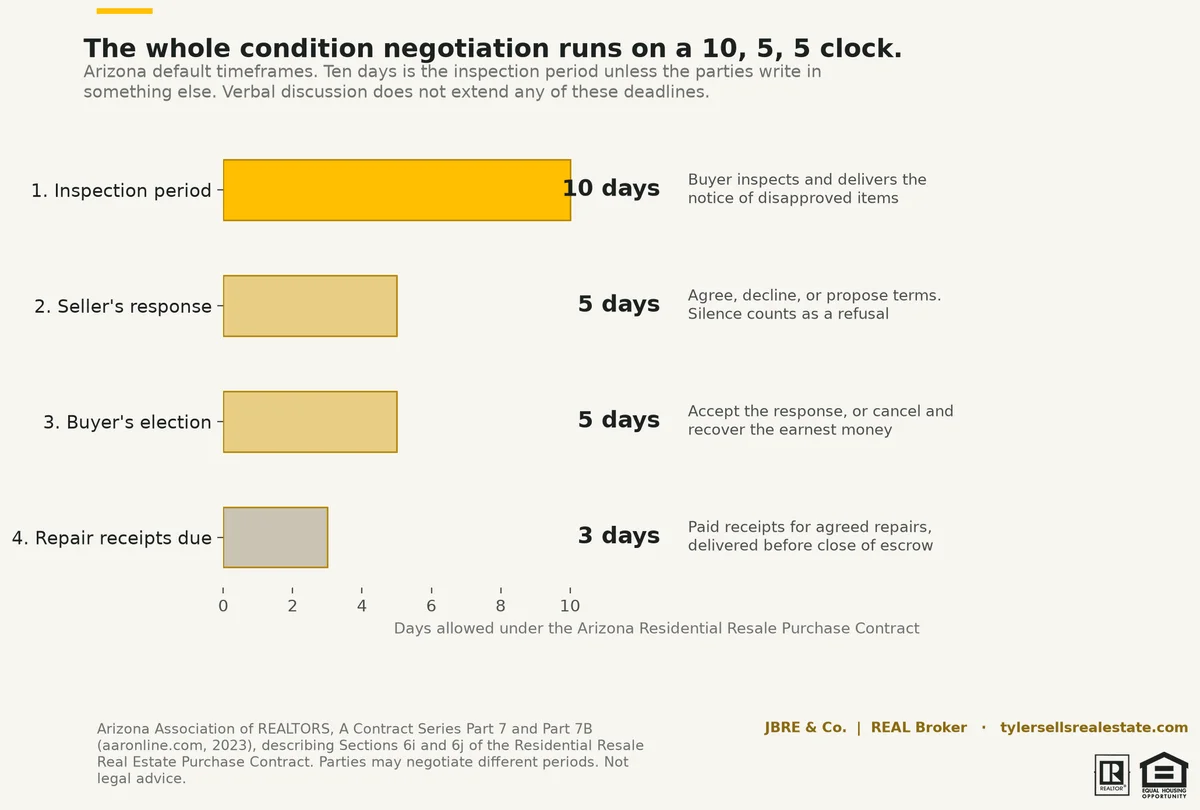
Preparation matters because the negotiation window is short and it is a default, not a courtesy. Under the Arizona Residential Resale Real Estate Purchase Contract, the buyer's inspection period is 10 days after contract acceptance unless the parties write in something else (Arizona Association of REALTORS, A Contract Series Part 7).
From there, the seller has five days to respond to the buyer's notice of disapproved items, and a failure to respond within that window counts as a refusal to correct anything. The buyer then has five days after the seller's response to cancel or move forward, and receipts for agreed repairs are due three days before close of escrow (Arizona Association of REALTORS, A Contract Series Part 7B). Verbal discussion does not extend any of these deadlines. Parties can negotiate different periods, and nothing here is legal advice.
Ten business days is not enough time to find a roofing invoice, get an electrician out, and settle a square footage dispute. That work belongs to the ninety days before listing.
What to do ninety days before you list in NoHo
Find the paperwork. Roof, furnace, water heater, panel, windows, sewer line, solar. Years and invoices. If a receipt is gone, the installer may still have the record.
Settle the square footage. Compare the county record against prior listings and any appraisal you have. Decide which number you will stand behind and why.
Look in the crawl space. Or send someone. Photograph it. You want to know what is down there before a stranger tells your buyer.
Have the panel looked at. By a licensed electrician, and ask the insurability question specifically.
Consider a pre-listing inspection. It converts surprises into disclosures, and a disclosed item priced into the list is far cheaper than the same item discovered in the inspection period.
Decide fix versus disclose and price. Both are legitimate. Choosing neither, and hoping, is the expensive option. In Arizona a home can be sold as-is, but known material facts still have to be disclosed, and the Seller's Property Disclosure Statement is the industry-standard tool for doing it.
One NoHo sale worth knowing about
A fully updated 1960s home on West Philomena Drive listed at $775,000 in May 2026 and closed at $760,000 on July 1, 2026 (Redfin). It had a new roof, a new furnace, a new water heater, remodeled baths, and owned solar. It was, by any reasonable standard, the prepared version of a NoHo house.
It still wrote a $12,000 repair credit plus $8,000 toward closing costs. That is the honest lesson: preparation does not eliminate the condition conversation in an older Flagstaff home. It moves the conversation from a price reduction to a credit, and from a cancellation to a closing. The full breakdown is in our write-up on seller concessions and that NoHo sale.
If you want the neighborhood context rather than the condition playbook, start with our guide to Hospital Hill and NoHo homes for sale.
Selling an older home in Flagstaff: talk to Jake
If you own a home in North Hospital Hill and you are thinking about a move in the next year, the highest-return work happens before the listing goes live. Jake Martin covers NoHo for JBRE & Co. and will walk your systems with you, tell you which of the six items actually matter on your house, and give you a straight answer on fix versus disclose and price.
Jake Martin JBRE & Co., brokered by Real Broker 928-707-0504 jake@jbreandco.com
Equal Housing Opportunity.
This article covers MLS Area 130, North Hospital Hill, which is not the same footprint as ZIP code 86001 as a whole. Figures are deemed reliable but not guaranteed. Nothing here is an appraisal, a home inspection, an insurance underwriting decision, or legal advice. Schools are named for location reference only. Flagstaff Unified School District adjusted attendance boundaries for the 2026-27 year, so confirm current boundaries directly with FUSD.

Written by
Tyler Vaughan
Northern Arizona's top-rated real estate agent with 350+ five-star reviews. Specializing in Sedona, Flagstaff, and Northern AZ luxury properties.
Ready to Make Your Move?
Whether you are buying or selling in Northern Arizona, Tyler is here to help you navigate the market with confidence.