

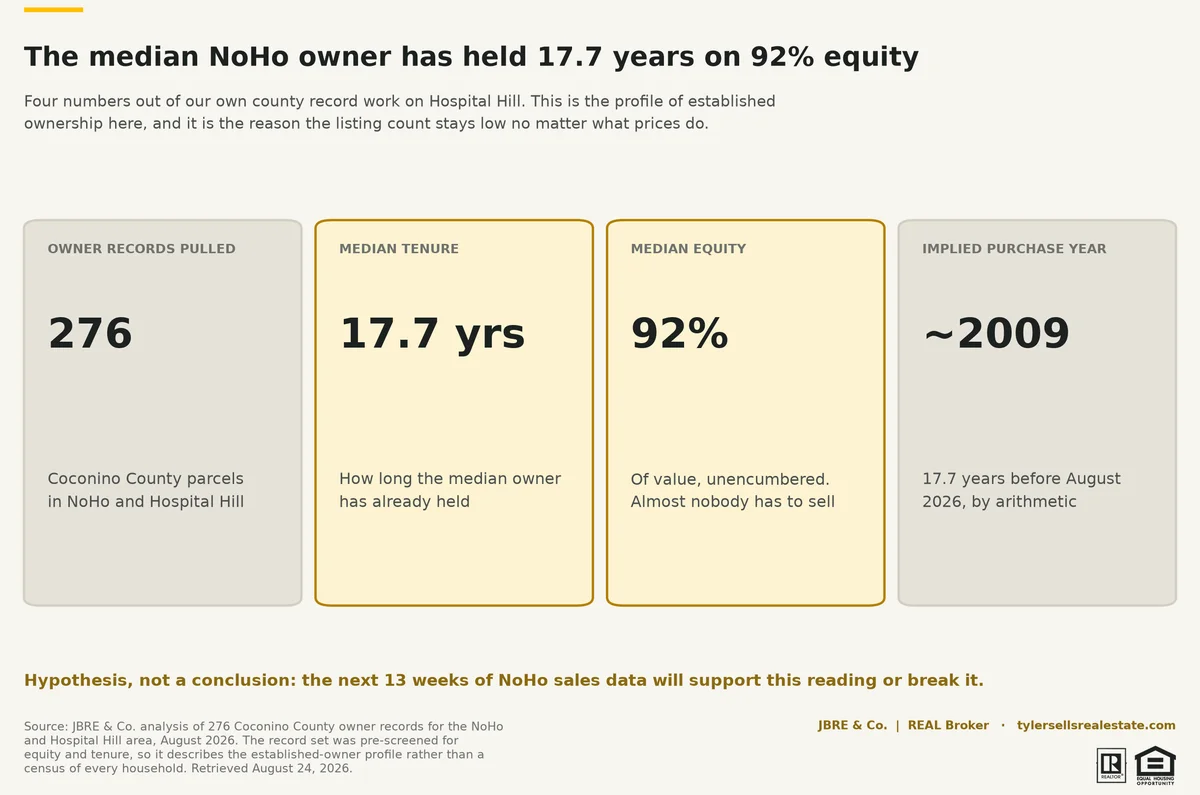
Hospital Hill Flagstaff inventory is thin, and the usual explanation is that it is a pricing problem. I do not think that is what is happening in NoHo. Across 276 owner records I pulled from Coconino County, the median owner has held for 17.7 years and sits on 92% equity. That is not a neighborhood waiting for a better number. That is a neighborhood where almost nobody needs to sell, and where the people who do sell are moving for reasons that have very little to do with the market.
This report lays out what I think is going on, the two structural mechanisms I believe are doing the work, and how I intend to find out whether I am wrong.
A note on what this is. This is a hypothesis, not a conclusion. I am publishing it before I have finished testing it because the reasoning is more useful to you in the open than in my notes, and because if it is wrong I would rather be corrected by someone who has owned on this hill for thirty years than keep repeating it.
The short version
Across 276 NoHo owner records: median 17.7 years owned and 92% equity. Source: JBRE & Co. analysis of 276 Coconino County owner records, August 2026.
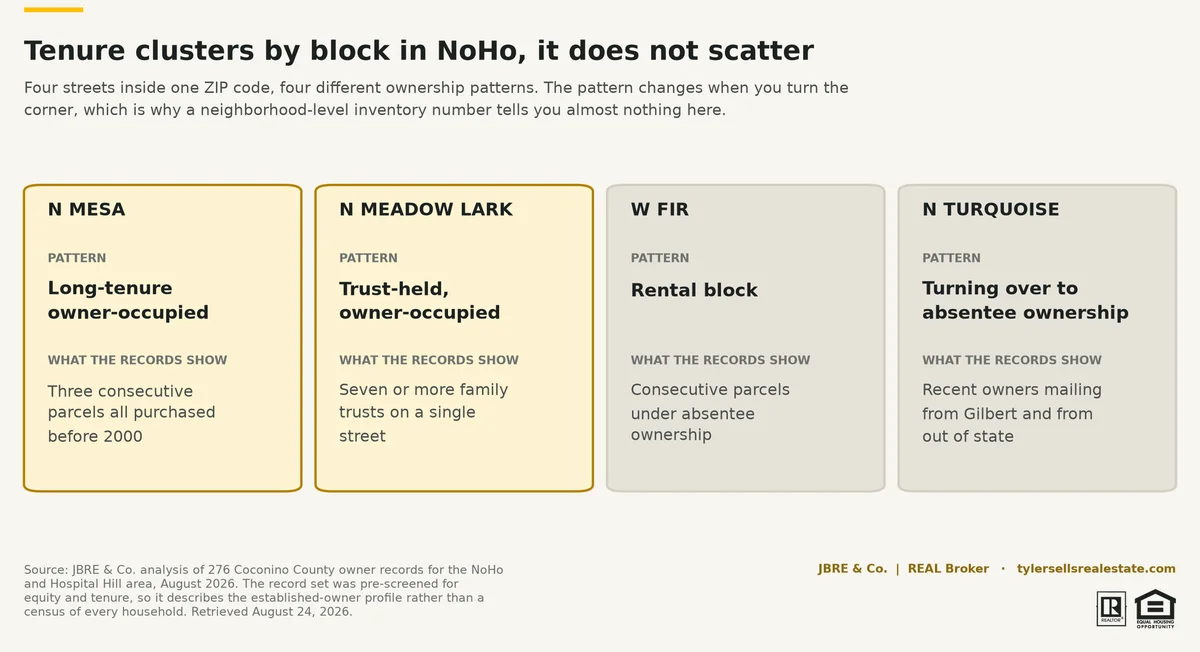
Tenure clusters by block rather than scattering. Whole streets share one ownership pattern, and the pattern changes when you turn the corner.
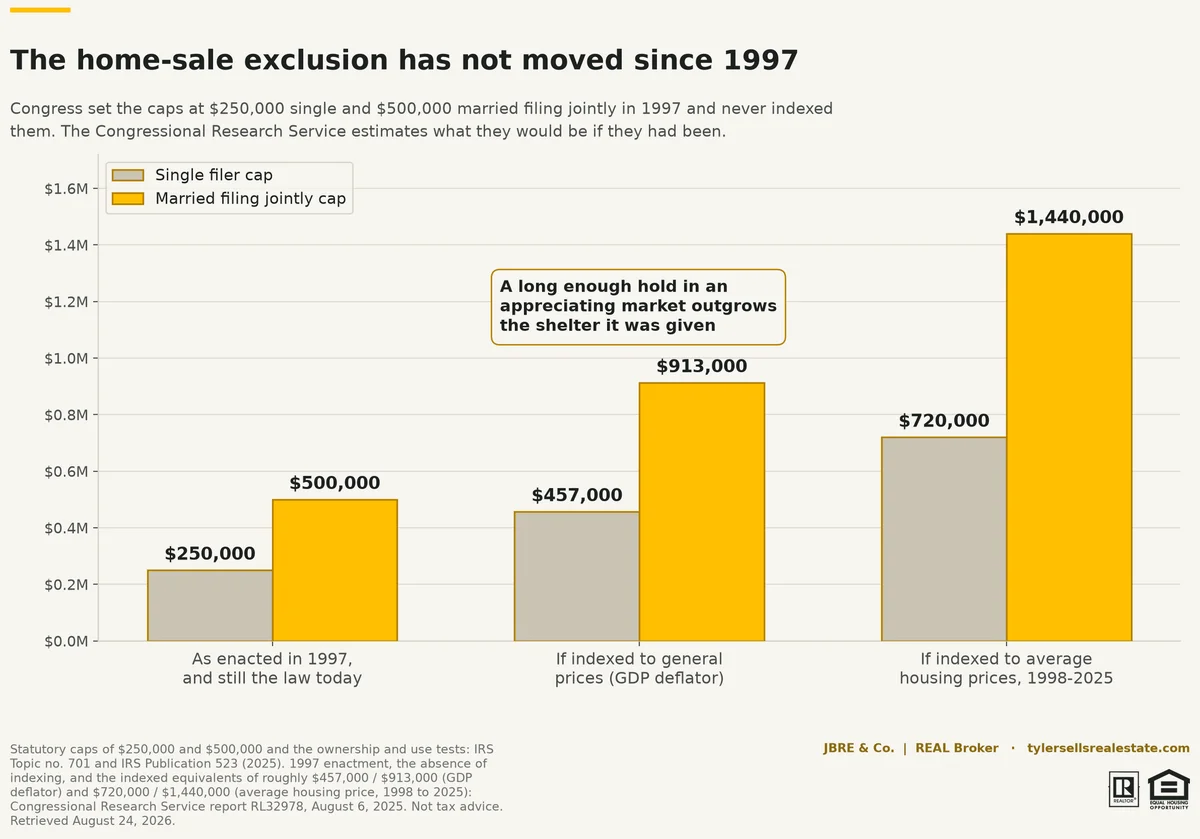
The federal home-sale exclusion has been $250,000 single and $500,000 married filing jointly since 1997, and it was never indexed. A long enough hold in an appreciating market eventually outgrows it.
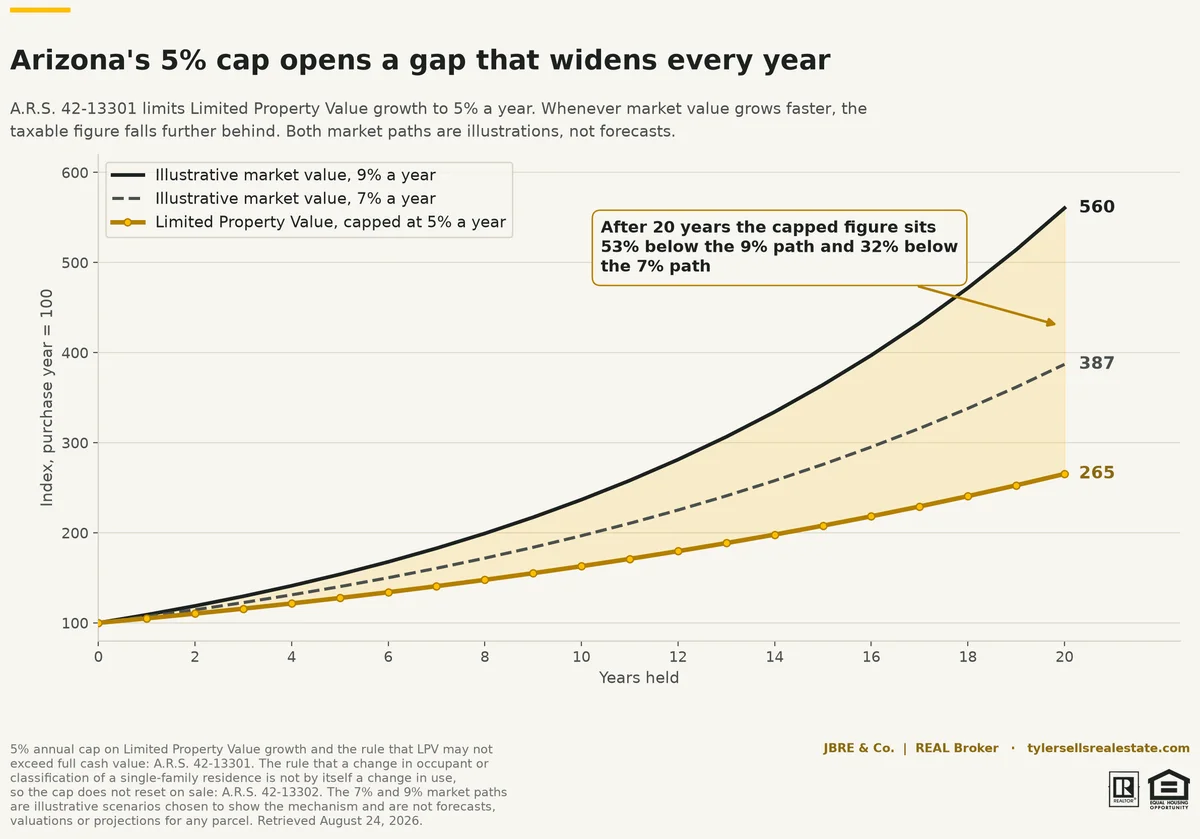
Arizona caps annual Limited Property Value growth at 5%, so the number a long-tenure owner sees on the county notice every year drifts further below market the longer they hold.
The hypothesis: NoHo inventory is constrained by tenure, not by price. If that is right, higher prices will not produce meaningfully more listings here.
It is a falsifiable claim, and the next 13 weeks of sales data will either support it or break it.
None of what follows is tax or legal advice. If any of it touches your situation, take it to your own CPA.
What the Hospital Hill Flagstaff inventory records actually show
I have spent the last several weeks pulling Coconino County records on NoHo properties one parcel at a time: assessor history, deeds, sale dates, ownership type. The pattern that came out of it was not the one I expected.
I expected tenure to be scattered. Some long holds, some recent buyers, distributed across the neighborhood the way you would assume. That is not what these blocks look like.
The median of the 276 records is a 17.7 year hold at 92% equity. Do the arithmetic on that median hold and it puts the typical NoHo owner's purchase somewhere around early 2009, before the recovery in Flagstaff prices, and it puts a meaningful share of these owners well before that.
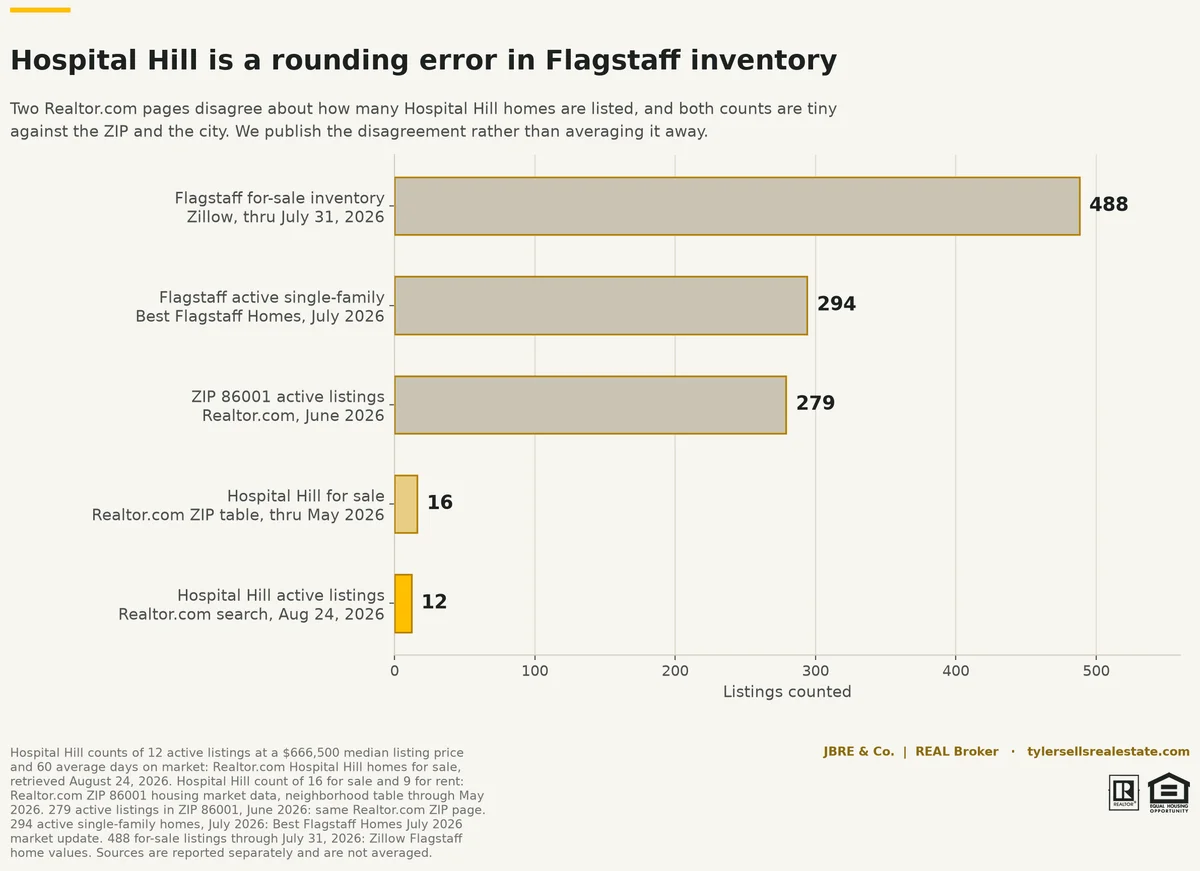
For scale on how little of that ever reaches the market: Realtor.com's ZIP-level market page counted 16 Hospital Hill homes for sale in its neighborhood table through May 2026, while its Hospital Hill search page counted 12 active listings with a $666,500 median listing price when I pulled it on August 24, 2026. Those two figures come from the same company and do not agree, which is normal for neighborhood-level portal data and is exactly why I do my own record work.
Either count is a rounding error against the 279 active listings Realtor.com reports for all of ZIP 86001 in June 2026, the 294 active single-family homes Best Flagstaff Homes counted citywide in July 2026, or the 488 for-sale listings Zillow reported for Flagstaff through July 31, 2026.
Tenure clusters by block in NoHo, not at random
This is the observation that changed how I read the neighborhood. Ownership pattern is a street-level property here, not a neighborhood-level one.
N Mesa: long-tenure owner-occupied. Three consecutive parcels all purchased before 2000.
N Meadow Lark: trust-held and owner-occupied. Seven or more family trusts on one street.
W Fir: a rental block. Consecutive parcels under absentee ownership.
N Turquoise: turning over to absentee ownership. Recent owners mailing from Gilbert and from out of state.
Source for all four: JBRE & Co. analysis of 276 Coconino County owner records, August 2026.
Four streets, four different inventory dynamics inside one ZIP code. And on the long-tenure blocks the holds are not fifteen or eighteen years. They are twenty-five and thirty, on houses bought when the price had four digits in front of the comma instead of six.
That is the observation. Everything after this is my attempt to explain it, and it is the part that can be wrong.
Why selling a long-held NoHo home is a different transaction
When you have owned a house for eighteen years in a market that did what this one did, selling stops being a move and becomes the liquidation of a position. Different decision, different math, and most of the math points toward staying.
There are three parts to it. Two of them are structural, and I can verify those against statute. The third is behavioral, and I only have my own conversations for it.
The federal exclusion has not moved since 1997
Section 121 lets a homeowner exclude up to $250,000 of gain filing single, or $500,000 married filing jointly, provided they owned the home at least 24 of the last 60 months and used it as a residence for at least 24 of the last 60 months, per IRS Topic no. 701 and IRS Publication 523.
Those two dollar figures were set by the Taxpayer Relief Act of 1997 and were never indexed. The Congressional Research Service puts it plainly in its August 6, 2025 report on the provision: "the dollar cap was not indexed for price changes." The same report estimates that if the caps had been raised with the change in average housing prices between 1998 and 2025, they would sit near $720,000 and $1,440,000 today, and near $457,000 and $913,000 if raised with the GDP deflator (CRS RL32978).
Sit with that. The shelter is the same size it was twenty-nine years ago. The gains it was built to shelter are not.
Work a real example from my own record review. One house on this hill sold in July 2026 for $805,000. The public record shows the prior owner bought it in 1998 for $156,000 and held it twenty-eight years. Set aside improvements and selling costs, which do reduce the taxable number, and the raw appreciation is roughly $649,000. Source: JBRE & Co. review of Coconino County records for that parcel, August 2026.
A married couple filing jointly clears the $500,000 exclusion on that math and still has real gain left over. A single filer is a long way past $250,000. And a long-tenure owner who rented the property out along the way is in a different conversation entirely, because Publication 523 treats depreciation allowed or allowable after May 6, 1997 as ineligible for the exclusion and recaptured separately, and the two-of-five-year residency test may not be met at all.
None of that makes selling a bad idea. It makes selling a decision with a tax consequence attached, and that is exactly the kind of decision people postpone. Talk to your own CPA about your numbers before you talk to any agent, including me.
The loan is part of the house now
A significant share of these owners financed or refinanced in a rate environment that no longer exists. Best Flagstaff Homes put rates in the upper 6% range in its July 2026 Flagstaff market update. That older loan is not portable. Selling ends it.
For an owner who is comfortable where they are, that is a recurring monthly reason to do nothing, and it renews every month without anyone having to make a decision.
The replacement problem
This is the one owners raise first, and it is the most honest of the three. Sell at the top of the NoHo range and you become a buyer in the same market that just paid you. Downsizing inside Flagstaff frequently does not free up what people expect it to, and the walk to Flagstaff Medical Center, the walk downtown, and the Buffalo Park trail access at the top of the hill do not exist at a discount somewhere else in town.
The equity is real. It is just hard to convert into something that feels like an upgrade without leaving Flagstaff.
The Arizona 5% cap quietly trains owners to underestimate
This is the piece I find most interesting, and it connects the tenure data to something I hear on the doors constantly.
Arizona limits how fast a property's Limited Property Value can grow. A.R.S. 42-13301 states that the LPV, which is the figure property taxes are actually calculated from, is the prior year's LPV "plus five per cent of that value," and may not exceed current full cash value.
In a market appreciating faster than 5%, the gap between that number and what a house would actually sell for widens every year. Compounded across twenty years, it is not a small gap.
Now consider what that means in practice. Once a year a long-tenure owner receives an official-looking document from the county with a value printed on it. It is a real number produced by a real government office, and it is far below what the house is worth. Nobody mails a corrected figure. They receive the same understated anchor, annually, for two decades.
So the owners with the most equity in NoHo are frequently the ones most likely to underestimate it. Not because they are not paying attention, but because the number arriving in their mailbox every year is structurally low, and it is the only number most of them ever receive.
That cap also does not work the way people assume when a house changes hands. A.R.S. 42-13302 is explicit that "a change in the occupant or classification of a single-family residence is not, by itself, a change in use." The cap follows the parcel. It does not reset to a buyer's purchase price the way valuation systems in some other states do.
If you take one practical thing from this report, take this: the value on your Arizona tax statement is not an estimate of what your house is worth, and it was never designed to be.
What the Hospital Hill tenure hypothesis predicts
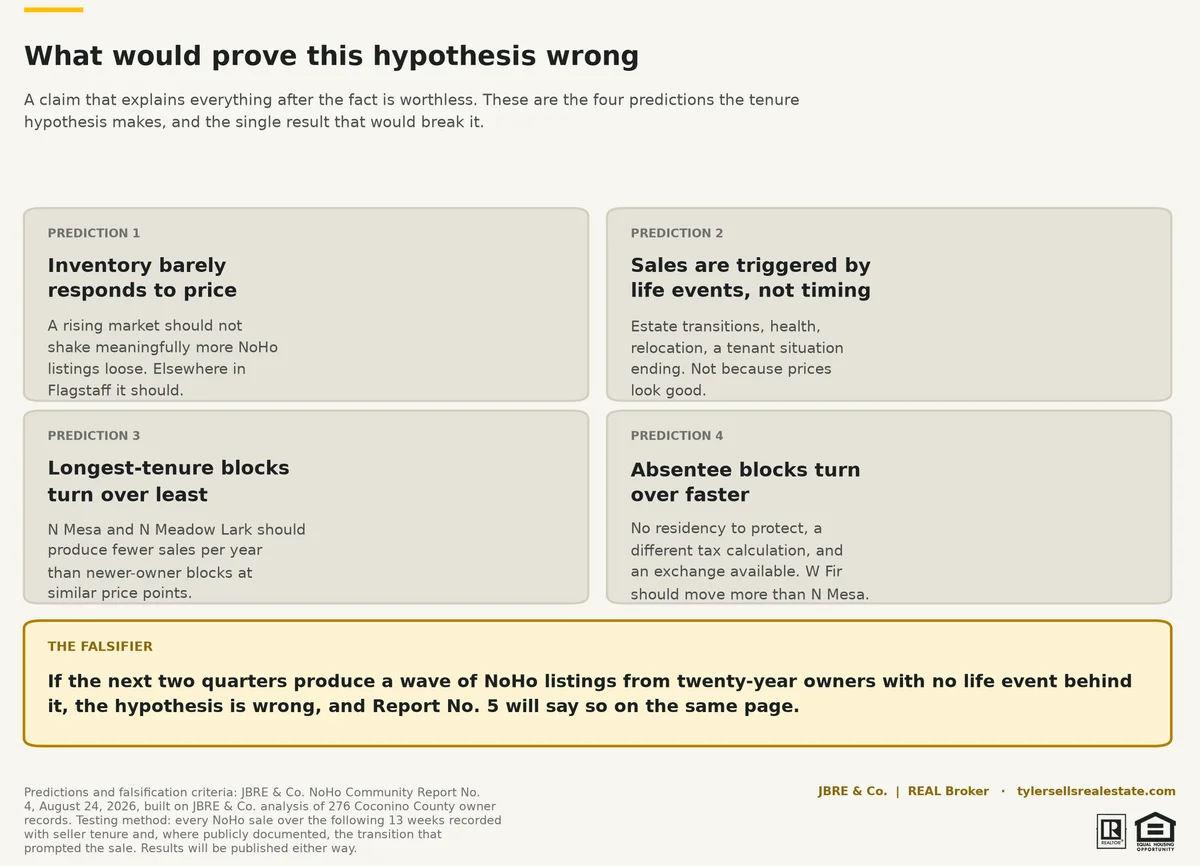
A hypothesis that explains everything after the fact is worthless. A useful one makes predictions that can fail. Here are mine.
Inventory should not respond much to price. If tenure is the binding constraint, a rising market will not shake meaningfully more listings loose in NoHo. Elsewhere in Flagstaff it should.
Sales should be triggered by life events, not market timing. Estate transitions, health, relocation, a tenant situation ending. Not "prices look good."
The longest-tenure blocks should turn over least, regardless of value. If N Mesa and N Meadow Lark produce fewer sales per year than blocks with newer owners at similar price points, that supports it.
Absentee-owned blocks should turn over faster. An owner who does not live in the property has no residency to protect, faces a different tax calculation, and can exchange into something else. W Fir should move more than N Mesa.
And the falsifier. If the next two quarters produce a wave of NoHo listings from twenty-year owners with no life event behind them, the hypothesis is wrong and I will say so on this page.
How I am testing it over the next 13 weeks
Every sale in this neighborhood gets written up in my sold archive whether or not it is my transaction. Starting with this report, each of those entries also records how long the seller had owned the property and, where it is publicly documented, what kind of transition prompted the sale. The write-up on seller concessions in a recent NoHo sale is the format.
Thirteen weeks is not a large sample. It is enough to see whether the shape is there.
I will publish the count either way. A report that only prints the results agreeing with it is not research, it is advertising.
One honest limitation on the data itself. The 276-record set was pre-screened for equity and tenure, so treat 17.7 years and 92% equity as the profile of established NoHo owners rather than a census of every household on the hill. It tells you what long-tenure ownership looks like here. It does not tell you what share of the neighborhood is long-tenure, and I am not going to pretend otherwise.
What this means if you own in NoHo
Three things, in the order I would think about them.
First, find out what it is actually worth, separately from your tax bill. Not because you should sell. Most of the people I talk to on this hill should not, and I tell them so. But the number matters for insurance coverage, for whether a remodel or an addition pencils, for refinancing decisions, and for any estate planning conversation. Being wrong about it in either direction costs money quietly. Our Hospital Hill and NoHo homes for sale guide is the running picture of what is actually listed and what it is asking.
Second, if you are anywhere near a transition, talk to a CPA before you talk to an agent. On a twenty-plus-year hold with a gain this size, the tax planning has more leverage than the list price does, and some of the useful options have to be set up in advance rather than discovered at closing. I am a REALTOR®, not a tax advisor, and this report is not tax advice. I would rather tell you to go get that advice early than watch it get expensive.
Third, keep the record. Improvements with years attached, permits, roof warranties. Documented condition is worth money at sale on this hill, and it also raises your basis, which matters more the longer you have owned. If your house predates the 1980s, selling an older home in Flagstaff covers what inspectors and appraisers actually flag here.
What this means if you are trying to buy in NoHo
Patience is the strategy, and the house you want may not come to market on a schedule that suits you.
It also means the listings that do appear deserve to be taken seriously the week they appear. In a neighborhood where the median hold in my record set is nearly eighteen years, a house coming available is not a routine event on that block. It may be the only one for a while. Realtor.com's Hospital Hill page put average days on market at 60 when I pulled it on August 24, 2026, which tells you the ones that sit are usually sitting for a reason, not for lack of demand.
If you want the background on why this pocket north of the hospital developed the way it did, why it is called Hospital Hill is the short history.
Hospital Hill and NoHo inventory questions, answered
What is the average length of ownership in NoHo? Across the 276 owner records I pulled, the median is 17.7 years with 92% equity, per JBRE & Co. analysis of Coconino County owner records, August 2026. That set was pre-screened for equity and tenure, so treat it as the profile of established owners here rather than a census.
Does Arizona reassess my property taxes when I sell? A.R.S. 42-13301 caps annual Limited Property Value growth at 5%, and A.R.S. 42-13302 states that a change in the occupant or classification of a single-family residence is not by itself a change in use. The cap is a feature of the parcel, not a benefit that resets to your purchase price the way it works in some other states. Ask a tax professional about your specific parcel.
Do I owe capital gains tax if I sell a home I have owned for twenty years? Possibly. Per IRS Topic no. 701, the federal exclusion is $250,000 single or $500,000 married filing jointly if you owned and used the home as a residence for two of the last five years. Gain above that is taxable, and Publication 523 brings depreciation recapture into it for any period the home was rented. This is a CPA conversation, not an agent conversation.
Why is my county valuation so much lower than what my neighbor's house sold for? Because the two numbers measure different things, and the 5% cap in A.R.S. 42-13301 means the gap widens the longer a property is held. Your tax valuation was never intended to be a market estimate.
Is now a good time to sell in NoHo? For most long-tenure owners on this hill, the honest answer is that it depends far more on what is happening in your life than on what is happening in the market. That is the whole point of this report.
How many homes are for sale on Hospital Hill right now? It depends which source you ask, which is itself the story. Realtor.com's neighborhood table showed 16 through May 2026 and its Hospital Hill search page showed 12 active on August 24, 2026. Redfin's Hospital Hill market page was still reporting December 2024 as its most recent month when I checked it, with one home sold. Small neighborhoods break portal dashboards.
The point of writing this down
Most neighborhood reports tell you what happened. This one is an argument about why, and arguments can be wrong.
If you have owned on this hill for twenty or thirty years and none of this describes your situation, I want to hear it. That is more useful to me than another county record. And if it does describe your situation, then you already know the part I cannot see from the outside, which is what would actually have to change for moving to make sense.
Either way, no pitch attached.
Thinking about buying or selling on Hospital Hill?
Jake works NoHo and Hospital Hill specifically: tenure, comps, condition, and the block-level detail that decides whether a deal pencils. Get a straight read on what your home is actually worth, separately from your tax notice, or a shortlist of the NoHo listings worth seeing this month.
Jake Martin · REALTOR®, JBRE & Co., brokered by Real Broker 928-707-0504 · jake@jbreandco.com
Equal Housing Opportunity.
This report is informational and is not tax, legal, or financial advice. Consult a qualified CPA or attorney about your own situation. Ownership, tenure, and equity figures are drawn from Coconino County records and a pre-screened property data export and represent the established-owner profile in NoHo rather than a complete census. Federal exclusion amounts reflect IRC Section 121 as published by the IRS for the 2026 filing season. Verify all figures independently before acting on them. JBRE & Co. is brokered by Real Broker AZ, LLC. Equal Housing Opportunity.

Written by
Tyler Vaughan
Northern Arizona's top-rated real estate agent with 350+ five-star reviews. Specializing in Sedona, Flagstaff, and Northern AZ luxury properties.
Ready to Make Your Move?
Whether you are buying or selling in Northern Arizona, Tyler is here to help you navigate the market with confidence.