

The Presidio in the Pines short-term rental rules changed on July 1, 2026. Flagstaff City Council adopted Ordinance 2026-11 on May 19, 2026, and the new version of City Code Chapter 3-12 took effect at the start of July (Ordinance No. 2026-11). If you own in Presidio in the Pines on the west side of Flagstaff and you rent nightly, or you are buying here with that plan, the license got more expensive and the operating checklist got longer.
One thing did not change. The city ordinance is only one of the two approvals you need. The other is the recorded declaration or CC&Rs for your specific Presidio phase or association, and that document does not move when the ordinance moves.
The short version:
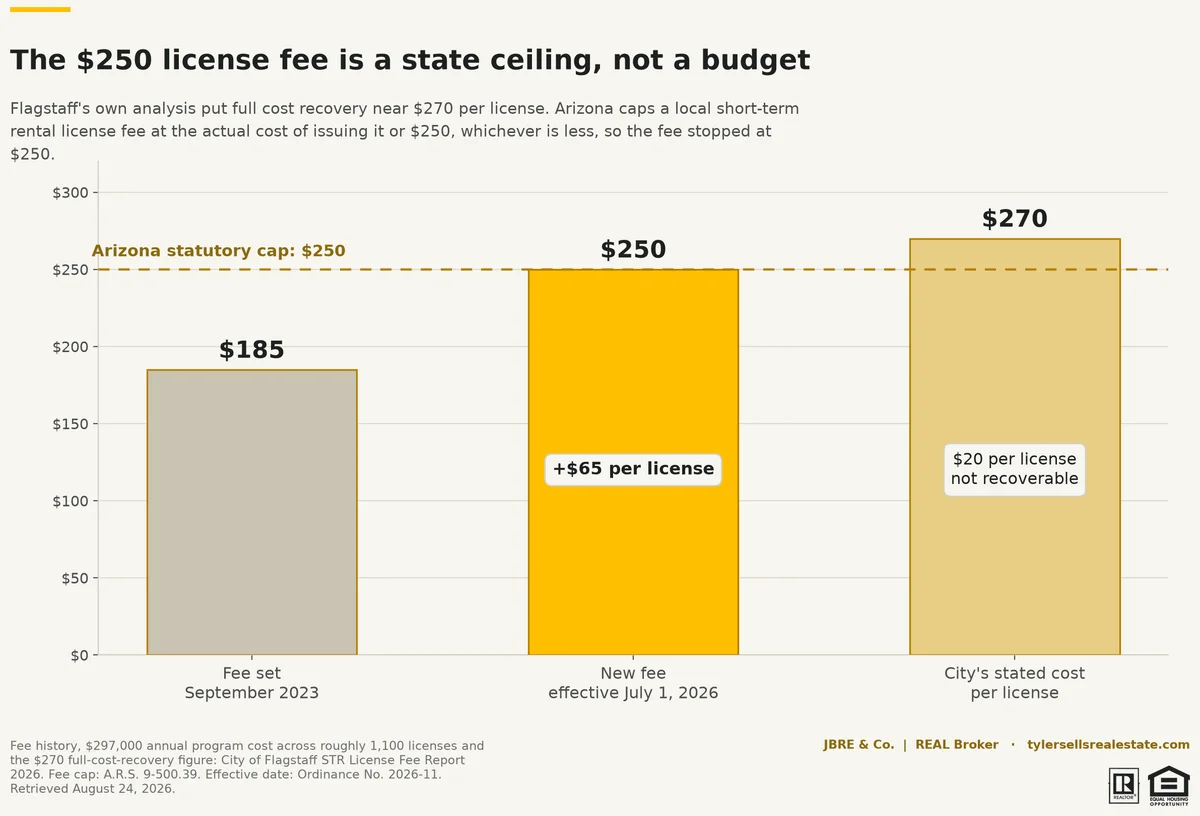
The annual city STR license went from $185 to $250, the maximum Arizona law allows (City of Flagstaff).
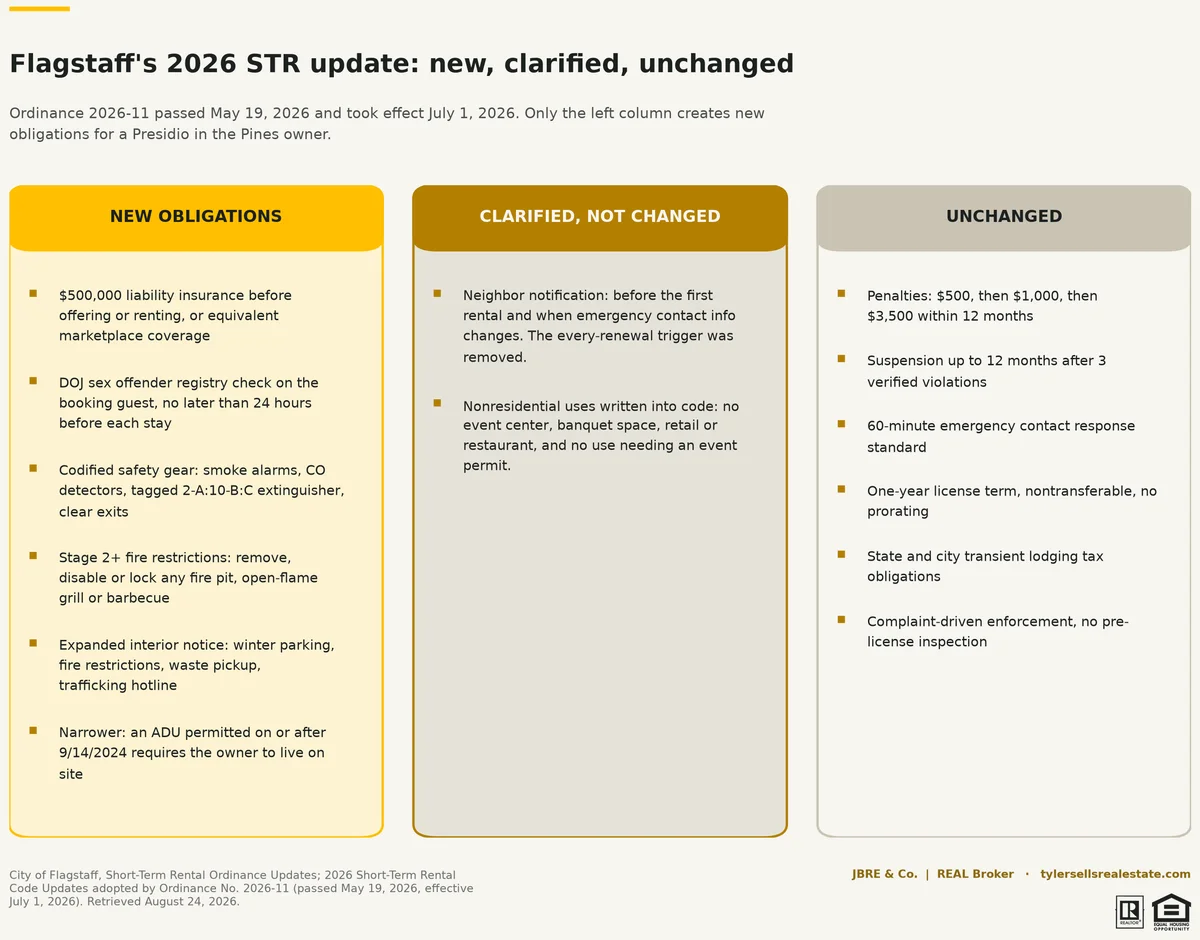
Five requirements are genuinely new: $500,000 liability insurance, a sex offender registry check on the booking guest, codified fire safety gear, disabling fire pits and grills during Stage 2 or higher fire restrictions, and an expanded interior notice.
A narrower new rule applies to properties with an accessory dwelling unit that received a certificate of occupancy on or after September 14, 2024. Those require the owner to live on the property.
Two items were clarified rather than changed: neighbor notification timing and the exclusion of nonresidential uses such as event centers.
The penalty ladder, the one-year license term, the tax obligations and the 60-minute emergency response standard all stayed the same.
Your association's recorded documents are a separate layer. Arizona law lets a declaration prohibit rentals or set a minimum rental period, and the city does not enforce association rules.
What changed in the Presidio in the Pines short-term rental rules on July 1, 2026
Five requirements are new obligations rather than restatements of what the code already said. All five come out of the 2026 Short-Term Rental Code Updates adopted by reference in Ordinance 2026-11 (2026 Short-Term Rental Code Updates).
Liability insurance. Before you offer or rent the property, you need liability coverage of at least $500,000 in the aggregate. New Section 3-12-001-0011 waives that if you advertise and offer the rental through an online lodging marketplace that provides equal or greater coverage, which is how most Airbnb and Vrbo listings satisfy it.
Guest screening. New Section 3-12-001-0012 requires the owner or the owner's designee to run the person who books the stay through the U.S. Department of Justice National Sex Offender Public Website no later than 24 hours before every stay. Keep the record for 12 months and produce it if the city asks. The requirement is satisfied or waived if the marketplace performs the check, and a marketplace failing to run it does not relieve the owner of liability.
Safety equipment, now codified. New Section 3-12-001-0013 puts hardware in the code: working smoke alarms with battery backup outside each sleeping area, inside each sleeping room and on every story; carbon monoxide detectors in any unit with a fuel-burning appliance, fuel-burning fireplace or attached garage; at least one fire extinguisher rated 2-A:10-B:C, serviced and tagged annually; and in most cases two distinct exit paths kept clear of furniture, storage, debris, snow and ice. That last clause matters more here than it would in Phoenix. Presidio sits near 7,000 feet in west Flagstaff and a plowed berm across a side door counts as an obstruction.
Fire pits and grills go dark at Stage 2. When Stage 2 or higher fire restrictions are in effect, the owner or designee must remove, disable or securely lock any fire pit, open-flame barbecue or grill so the device is inoperable. Gas-fueled appliances with a functional on/off switch designed for safe shutoff are exempt. Devices can come back when restrictions drop to Stage 1 or Stage 0. In a ponderosa pine subdivision surrounded by Coconino National Forest, this is the requirement most likely to catch an out-of-area owner off guard in June.
A longer notice by the door. The interior notice posted within ten feet of the primary entrance now has to cover winter parking restrictions, current fire restrictions with a link, waste and recycling curbside timing, and human trafficking hotline information, on top of the prohibited-use language, emergency contact and license number already required. The city says the updated wording is issued automatically with new and renewal licenses on or after July 1, 2026, and that the old complaint hotline number came off the notice because complaints now go through an online form (City of Flagstaff).
One more new rule is narrower. If the property contains an accessory dwelling unit whose certificate of occupancy was issued on or after September 14, 2024, the owner has to reside on the property as a primary residence to license the STR. That mirrors state law, which explicitly exempts ADUs approved on or before September 13, 2024 (A.R.S. 9-500.39).
What only got clarified, and what did not change at all
Two items in the update read as new but are alignment work.
Neighbor notification is the first. Written notice still goes to adjacent, directly across, directly behind and diagonally adjacent single-family properties before the first rental, and in a multifamily building to residents on the same floor plus the units directly above and below. The 2026 update struck the requirement to renotify at every license renewal, and the city now describes the trigger as before the first rental and when emergency contact information changes (City of Flagstaff). State law only authorizes additional notification when previously provided contact information changes, which is why the renewal trigger came out (A.R.S. 9-500.39).
The second is the definition itself. Chapter 3-12 now says explicitly that a short-term rental does not include a unit used for retail, restaurant, banquet space, an event center or a similar use, or any use requiring an event permit. Special events requiring a temporary use permit or a special event permit are named as prohibited uses. That language already existed in state statute. The city wrote it into its own code.
Plenty stayed exactly where it was. The license runs one year from issuance, is nontransferable, and the fee is nonrefundable and not prorated, so a Presidio home rented only for ski season pays the same $250 as one rented 300 nights. Transaction privilege tax obligations did not change. The emergency point of contact must still be on the premises, or reachable by phone or text, within 60 minutes of a police request tied to an emergency. And the escalating civil penalties for verified violations remained $500, then $1,000, then $3,500.
Why the fee is $250 and not more
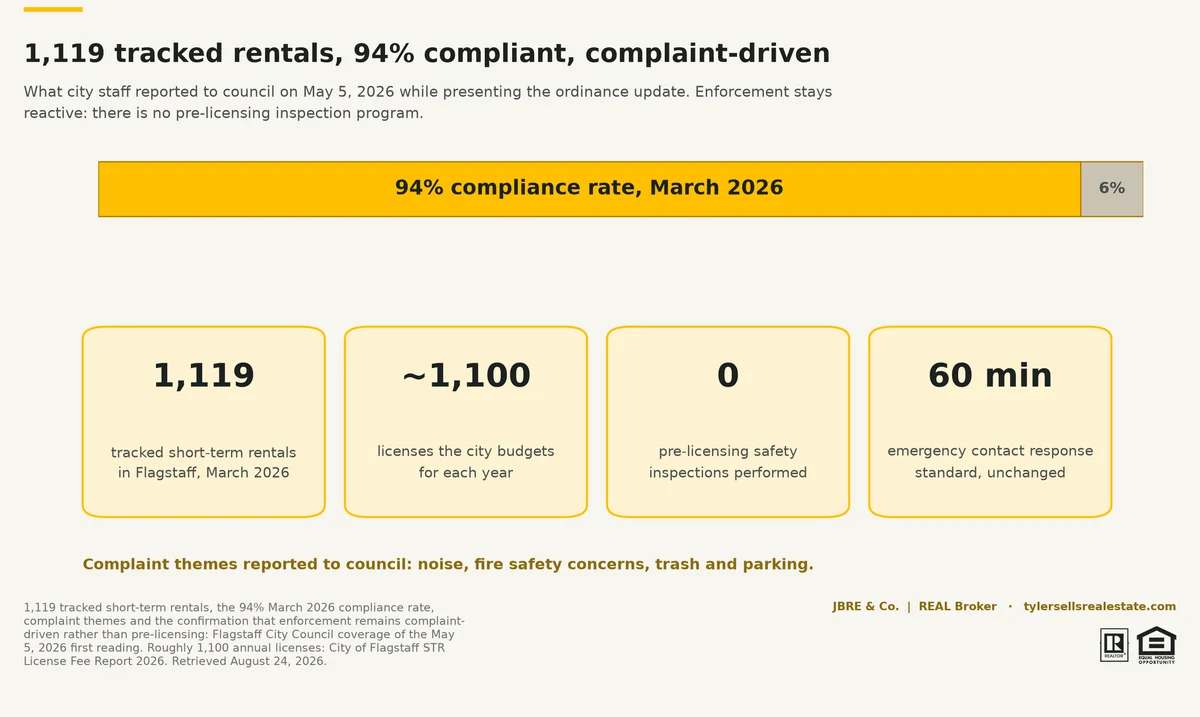
The city's own fee analysis put full cost recovery at roughly $270 per license, based on $297,000 in annual program cost across about 1,100 licensed properties. Personnel accounted for $193,000 of that, software services $75,000, indirect costs $27,000 and operating expenses $1,700 (City of Flagstaff STR license fee report).
Flagstaff could not charge $270. Arizona caps a local STR permit or license fee at the actual cost of issuing it or $250, whichever is less (A.R.S. 9-500.39). So the fee moved from $185 to the ceiling and stopped there. At roughly 1,100 licenses, the $65 increase is on the order of $71,000 a year in additional revenue, which staff and council discussed directing toward compliance staffing (Flagstaff City Council coverage, May 5, 2026).
What Arizona law lets Flagstaff do, and what it does not
This is the part owners misread most often. A city or town in Arizona may not prohibit short-term rentals, and may not restrict them based on classification, use or occupancy except in the specific ways the statute lists (A.R.S. 9-500.39).
What the statute permits is a defined menu: health and safety rules including fire and building codes, use and zoning ordinances applied the same way as to other residential property, a license or permit capped at $250, a 24-hour emergency contact, neighbor notification before the first rental, the license number in every advertisement, $500,000 of liability insurance or equivalent marketplace coverage, and the ADU owner-occupancy rule for units approved on or after September 14, 2024. Sex offender background checks on guests are allowed, and the city must waive the requirement when the marketplace performs the check.
What Flagstaff cannot do is cap the number of short-term rentals, zone them out of a subdivision, require a permit inspection before licensing, or set a minimum rental period. Every one of those requests has come up at council. None of them is available under current state law.
Which leaves the second layer.
The two-layer permission test in Presidio in the Pines
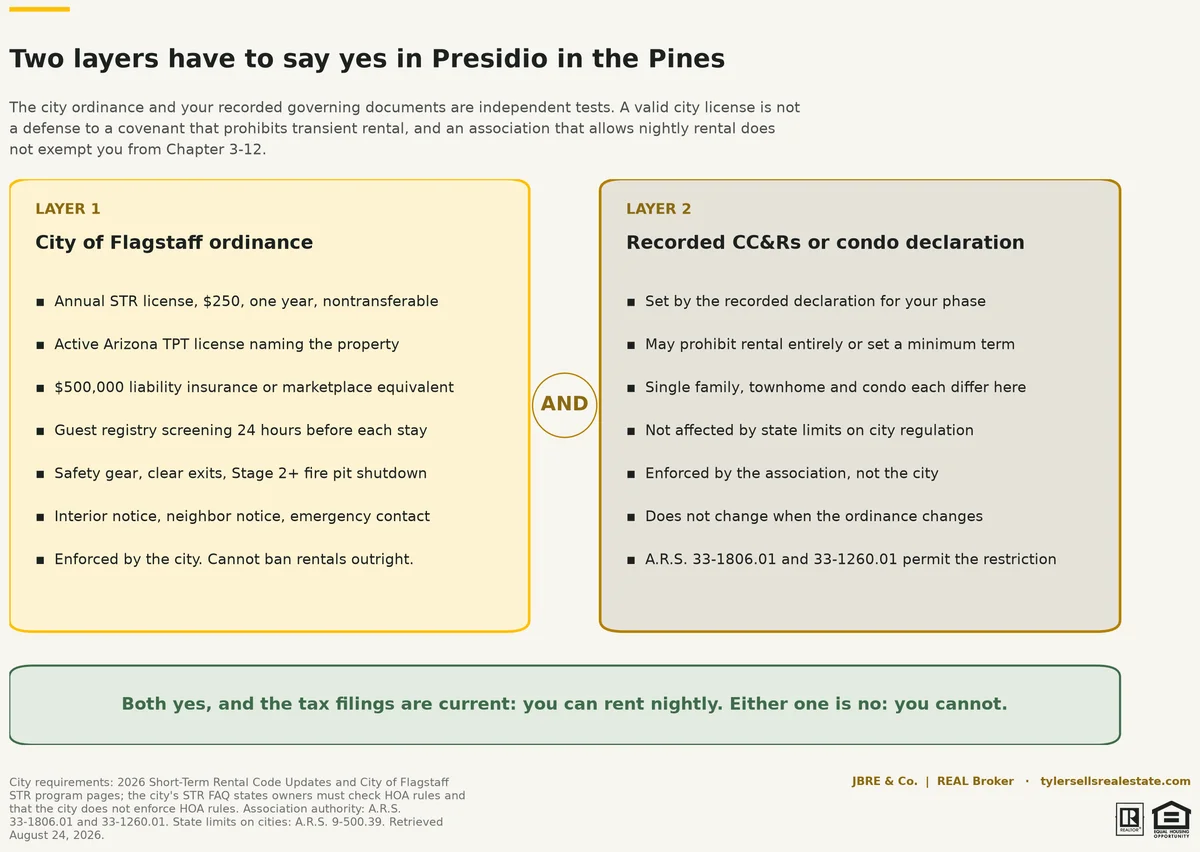
Two independent documents have to say yes before you can legally rent nightly here. The city ordinance is one. Your recorded governing documents are the other.
Arizona treats them separately on purpose. Under the Planned Community Act, a member may use their property as a rental unless prohibited in the declaration, and must comply with the declaration's rental time period restrictions (A.R.S. 33-1806.01). The Condominium Act uses nearly identical language for unit owners (A.R.S. 33-1260.01). In other words, the state preemption that stops the city from banning short-term rentals does not stop a recorded declaration from doing so.
The city says the same thing from its side. Its short-term rental FAQ tells owners to check HOA rules to determine whether short-term rentals are permitted and states plainly that the city does not enforce HOA rules (City of Flagstaff STR FAQ).
So a Presidio owner can hold a valid city license, be current on tax filings, have the insurance and the extinguisher and the posted notice, and still be in breach of a private covenant. The city license is not a defense to that. The reverse is also true: an association that allows nightly rentals does not exempt you from Chapter 3-12.
Presidio in the Pines is not one product, and the documents differ
This is the specific reason a generic Flagstaff STR article fails Presidio owners. The neighborhood is a phased Miramonte development off West Route 66 and South Woody Mountain Road, and it contains distinct product types with distinct governing documents.
Single-family homes across the earlier phases, on the streets off West Presidio Drive.
Attached townhome product, with shared-wall maintenance and insurance provisions that single-family owners do not carry.
A newer condominium regime. The condo building at 2950 West Presidio Drive, marketed as Three Peaks at Presidio and built in 2025, is governed by the Presidio in the Pines Condominium Association, with dues around $275 per month as reported on closed sales in the building (Compass record for 2950 W Presidio Dr Unit 204).
A condominium declaration and a single-family CC&R set are different instruments recorded at different times, and they can take opposite positions on rentals. Do not assume the answer for the condo building applies to a home on Pico Del Monte Circle, or the reverse. If you want the dues and association structure laid out first, start with our Presidio in the Pines HOA dues explainer, then read the actual recorded documents for your phase.
Three practical steps, in this order:
Get the current recorded declaration and any amendments for your specific phase or association, not the marketing summary.
Read the use and leasing sections for any minimum lease term, rental cap, registration requirement or transient-use prohibition.
Ask the association or its manager in writing whether nightly rental is permitted, and keep the answer.
The Coconino County Recorder is the office of record for declarations and amendments. Their public search sits behind a challenge screen, so the fastest route is usually your title company, your agent, or a direct request to the association's management company.
What a verified violation costs
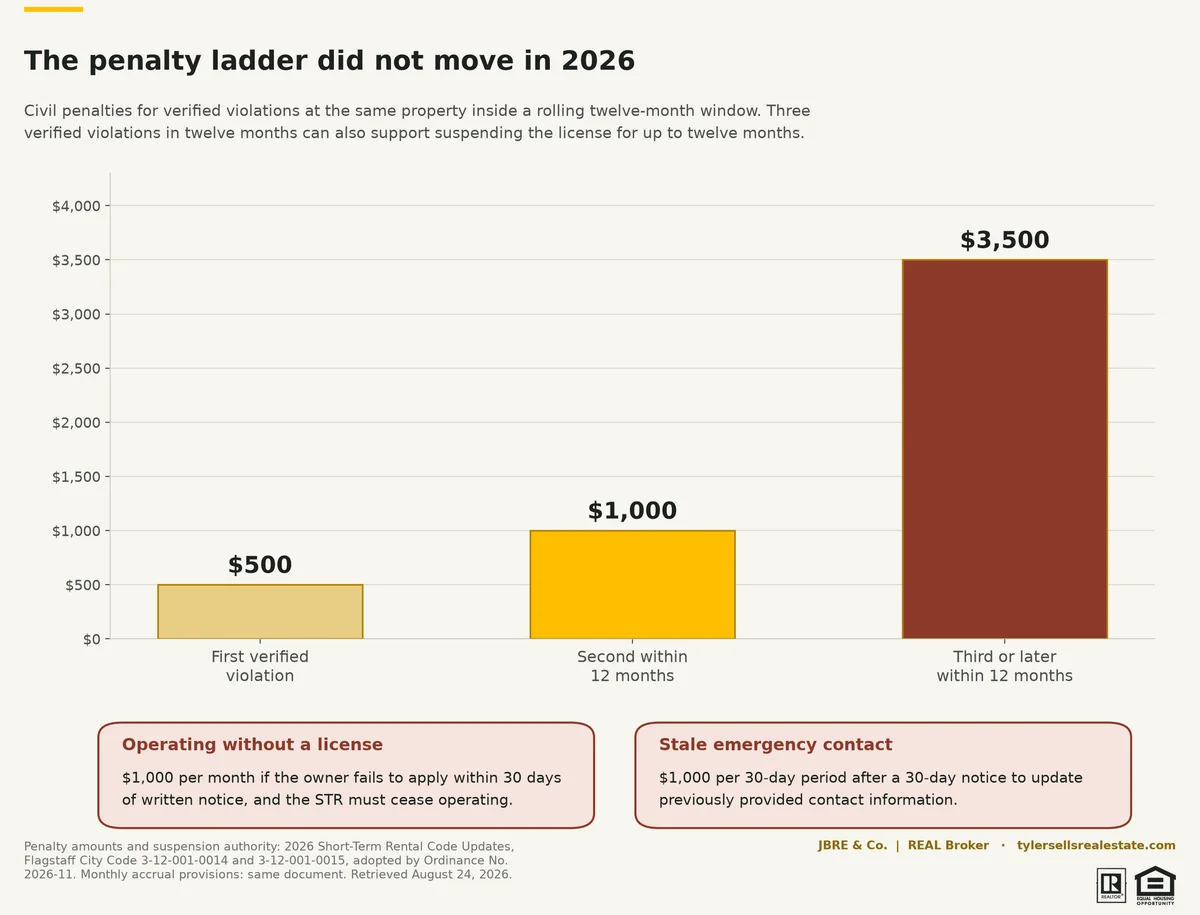
The penalty structure survived the update untouched. Within a rolling twelve-month period tied to the same property, a first verified violation carries $500, a second $1,000, and a third or later $3,500. Multiple violations arising from the same incident response count as one. Three verified violations in twelve months can support suspension of the license for up to twelve months, and a single serious violation can do it on its own.
Separate from that ladder, operating unlicensed is its own exposure. The city may impose $1,000 per month if an owner fails to apply within 30 days of written notice, and the property must cease operating until a license is issued. Letting emergency contact information go stale carries $1,000 per 30-day period after a 30-day warning. Both accrue monthly rather than landing once.
How enforcement actually works in Flagstaff
Complaint-driven, not inspection-driven. At the May 5, 2026 council meeting, staff reported 1,119 tracked short-term rentals and a 94% compliance rate as of March 2026, and described complaint patterns concentrated in noise, fire safety concerns, trash and parking. The fire chief confirmed enforcement would remain complaint-driven rather than pre-licensing inspection, and the city attorney noted that a proactive inspection program would require additional resources or a different legislative framework (Flagstaff City Council coverage, May 5, 2026).
Tyler's briefing on the council session also cited 307 complaints logged through the online portal since it launched in November 2024, mostly noise, parking and trash. We could not independently confirm that count in a city document, so treat it as directional rather than as a published statistic.
The practical read for a Presidio owner: nobody is coming to inspect your extinguisher tag. But the new requirements give code compliance more to work with once a property generates repeat complaints, because insurance, screening records and safety equipment are now code obligations rather than suggestions.
Taxes on a Presidio in the Pines short-term rental
Nothing in Ordinance 2026-11 changed the tax picture, and it is worth stating precisely because owners routinely underprice nightly rates against it.
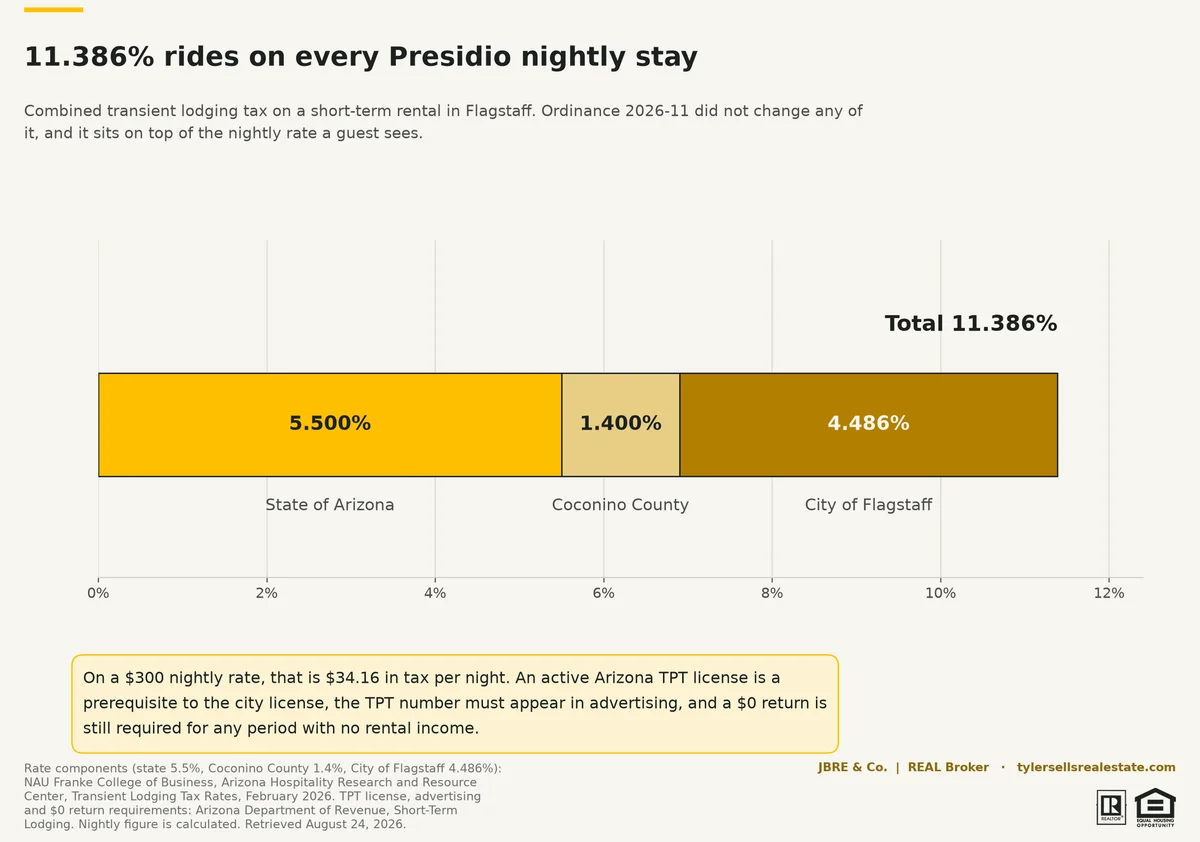
A transient lodging stay in Flagstaff carries a combined 11.386% in tax: 5.5% state, 1.4% Coconino County and 4.486% City of Flagstaff, which includes the city's Bed, Board and Beverage levy (NAU Arizona Hospitality Research and Resource Center, February 2026).
An active Arizona transaction privilege tax license naming the property is a prerequisite to the city license, and the TPT number has to appear in your advertising. The Arizona Department of Revenue requires a return for every filing period, including periods with no rental income (Arizona Department of Revenue).
What this means if you are buying or selling in Presidio in the Pines
For sellers, the rental question is now a document question. A buyer running numbers on nightly income will ask what the declaration permits, and a vague answer costs you leverage during inspection. Pull the recorded documents and the association's current position before you list.
For buyers, price the compliance load, not just the license. The $250 fee is the smallest line item. Insurance that actually covers transient occupancy, a tagged extinguisher, detectors, a local contact who can be at the property inside 60 minutes, and the tax remittance workload all carry real cost, and the 11.386% tax sits on top of your nightly rate.
Market context matters too. Realtor.com's Presidio in the Pines neighborhood data showed homes selling about 1.65% below asking on average in June 2026, at a 98% sale-to-list ratio (Realtor.com Presidio in the Pines market). Citywide, Best Flagstaff Homes counted 69 single-family sales in July 2026 at a $763,700 median with 76 average days on market (Best Flagstaff Homes, July 2026), while Redfin put the citywide median sale price at $700,619 for the three months ending June 2026, down 4.0% year over year (Redfin). Those figures disagree because they measure different sets on different windows. Use them as range, not as a single number.
Verified recent Presidio closings give a cleaner read on this specific neighborhood. Two are covered in detail in our Presidio condo sale breakdown at 2950 W Presidio Dr #204 and our 2938 S Tex Lane sale analysis. For the wider neighborhood picture, schools, trails and commute, see the Presidio in the Pines community guide.
Confirm the current Presidio in the Pines rules before you act
This article is general information about a municipal ordinance and is not legal, tax or insurance advice. Ordinances get amended and association documents get restated.
Confirm current requirements directly with the City of Flagstaff short-term rental program at 928-213-2231 or ShortTermRental@flagstaffaz.gov, and read your own recorded governing documents for your specific Presidio phase or association. If your situation involves a covenant dispute, an ADU, or a tax question, talk to an Arizona attorney or a tax professional.
Thinking about buying or selling in Presidio in the Pines?
Samantha works Presidio in the Pines specifically: pricing, comps, association documents, and whether a nightly rental plan actually pencils here after the 2026 ordinance update. Get a straight read on your home's value, or a rental-performance and ordinance review before you write an offer.
Samantha Landress · REALTOR®, JBRE & Co., brokered by Real Broker 928-978-2044 · samantha@jbreandco.com
Equal Housing Opportunity.

Written by
Tyler Vaughan
Northern Arizona's top-rated real estate agent with 350+ five-star reviews. Specializing in Sedona, Flagstaff, and Northern AZ luxury properties.
Ready to Make Your Move?
Whether you are buying or selling in Northern Arizona, Tyler is here to help you navigate the market with confidence.