

The Hospital Hill Flagstaff history is simpler than most people assume, and older than the hospital that gave the neighborhood its name. This rise on the north side of downtown Flagstaff was called Knob Hill before 1936. Then a 25-bed hospital opened on top of it, and within a generation nobody called it Knob Hill anymore.
That name has now outlived four separate identities of the institution behind it. Understanding the arc — from a lumber company's back-room infirmary in 1900 to a Level I trauma center serving a region larger than most states — tells you why this pocket of Flagstaff is built the way it is, and why one open question about its future matters to anyone buying here.
The short version:
Flagstaff's medical history starts around 1892 and 1900, not 1920.
The hill was Knob Hill until the Flagstaff Hospital opened on it in 1936 with 25 beds.
Dr. Charles Sechrist led the founding effort; Dr. R.O. Raymond donated the land.
The hospital became a community nonprofit in 1955 and merged into Northern Arizona Healthcare in 1995.
Today it is a state-designated Level I Trauma Center, the only one north of Phoenix.
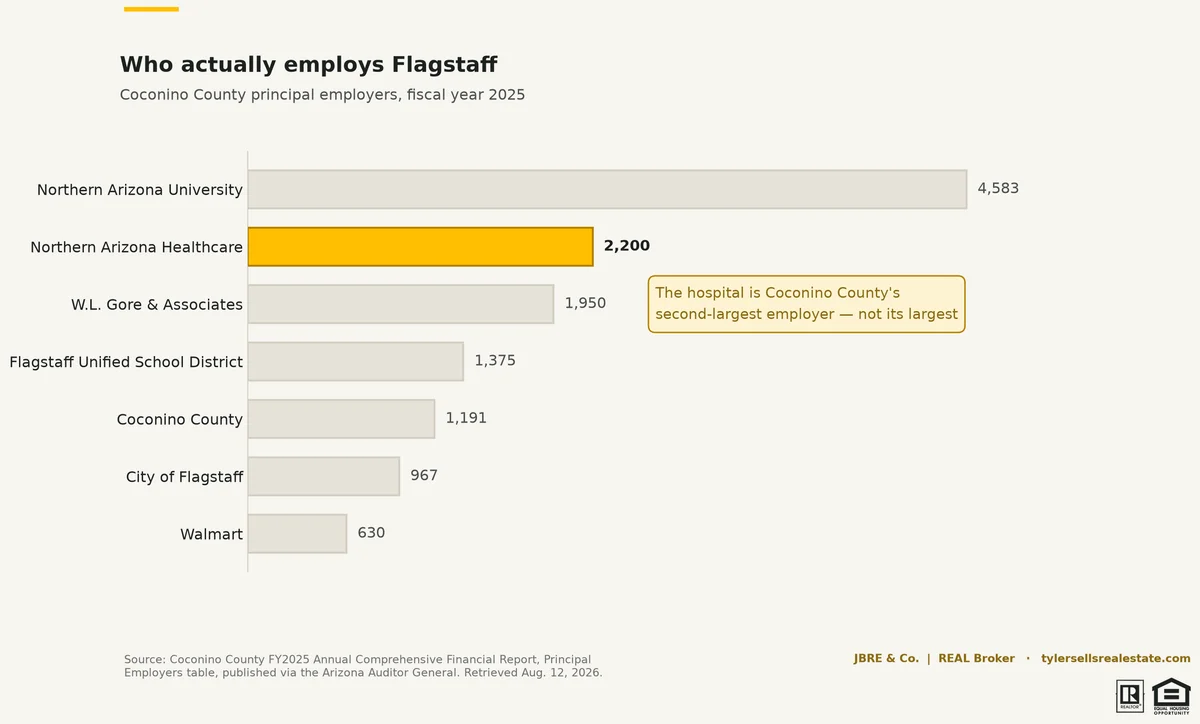
It is not Flagstaff's largest employer — NAU is, and W.L. Gore is the largest private employer.
Northern Arizona Healthcare wants a new hospital but as of August 2026 has no site and no timeline.
Why is it called Hospital Hill in Flagstaff?
Because a hospital was built on top of the hill and the name stuck. There was no plat map, no developer, no city council vote. Real estate listings and neighborhood guides now use Hospital Hill as the working name for the blocks around Flagstaff Medical Center, and the origin is exactly what it sounds like — the local-guide entry for the area explicitly traces the name to the hospital itself (Homes.com).
Two things are worth knowing if you are searching for homes here.
First, Hospital Hill is not an official municipal designation. It is an informal, in-market name that portals like Zillow, Redfin, Realtor.com and Trulia have adopted. You will also see agents use NoHo, short for "north of Hospital," for the residential blocks below the campus. Both names point at roughly the same ground.
Second, Hospital Hill is not the North End Historic Residential District. That is a separate, formally listed historic district with its own boundaries and its own rules. The two are often confused in casual conversation, and conflating them will lead you to wrong conclusions about what you can and cannot do to a house.
Before Hospital Hill: Flagstaff's first hospitals
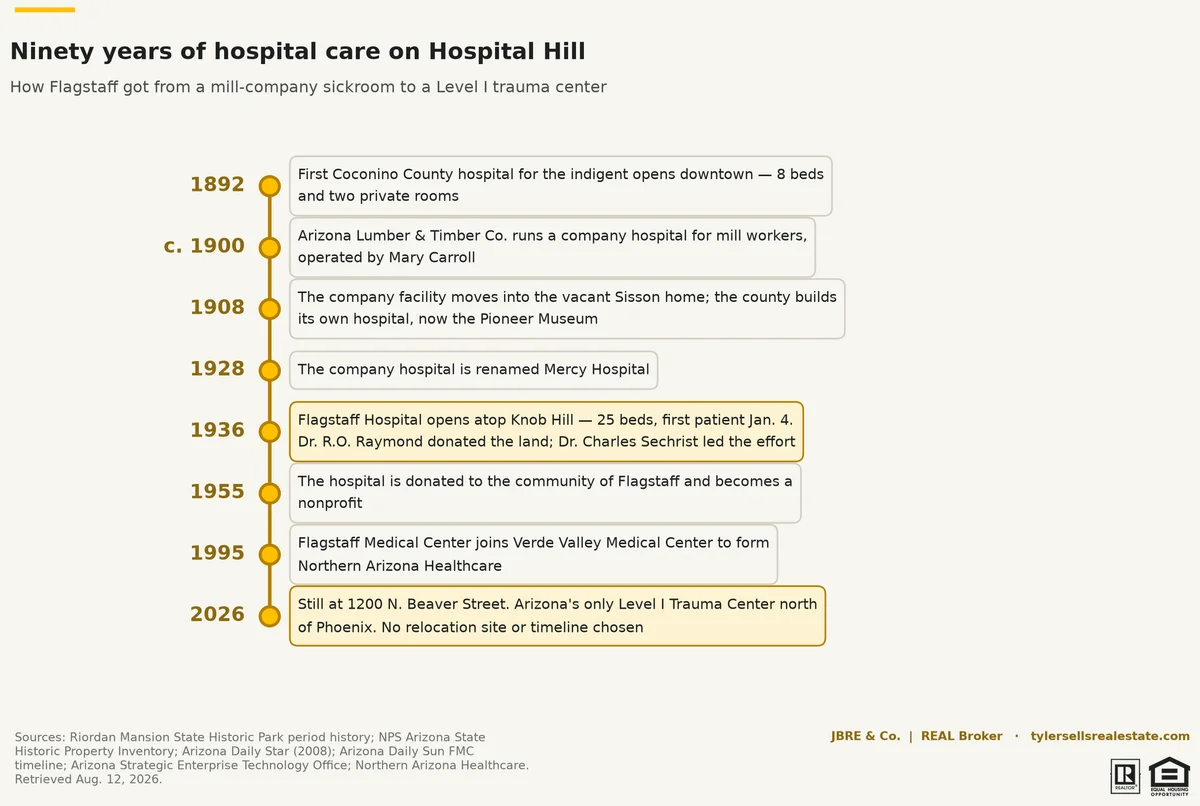
The common version of this story credits the Arizona Lumber & Timber Company with opening Flagstaff's first hospital in 1920. That date is wrong by about two decades.
Around 1892, Coconino County operated a hospital for the indigent with eight beds and two private rooms — the earliest organized hospital care in the area (Arizona Daily Star).
Around 1900, the Arizona Lumber & Timber Company was already running a company hospital for its mill workers, operated by Mary Carroll. In 1908 it moved into the vacant Sisson home, and by 1928 it was known as Mercy Hospital. It served Flagstaff until 1936 (Riordan Mansion State Historic Park; National Park Service inventory).
One more building deserves a note, because it survives. The 1908 Coconino County Hospital for the Indigent is today the Pioneer Museum on Fort Valley Road (Arizona Historical Society). It is a different building, a different institution, and a different site from anything on Hospital Hill. If you have heard that Flagstaff's first hospital is now a museum, that is the one — not the ancestor of Flagstaff Medical Center.
So when Mercy Hospital closed in 1936, it was not the start of Flagstaff medicine. It was a handoff.
Who founded Flagstaff Medical Center
Dr. Charles Sechrist led the effort to build a real community hospital for Flagstaff. Dr. R.O. Raymond donated the land on Knob Hill where it went up (University of Arizona Libraries Special Collections).
That distinction gets lost constantly. You will see it written that Sechrist donated the land. He did not. He drove the founding; Raymond gave the ground.
The Flagstaff Hospital opened with 25 beds atop Knob Hill and admitted its first patient on January 4, 1936 (Arizona Daily Star; Arizona Daily Sun timeline).
Sechrist's name is on two things you drive past regularly: Sechrist Elementary School at 2230 N Fort Valley Road (National Center for Education Statistics) and a residence hall at Northern Arizona University (NAU Cline Library). His descendants have publicly confirmed his role as a co-founder of the hospital (Arizona Daily Sun). So yes — the school is named for the man behind the hospital that named the hill.
From 25 beds on Knob Hill to a regional referral hospital
The institution changed hands and changed names three times after 1936.
In 1955, the hospital was donated to the community of Flagstaff — an organizational transfer that converted it into a community-owned nonprofit rather than a privately held facility (Arizona Department of Administration filing). This is another spot where the popular telling drifts: it was not a personal gift handed over by an individual founder. It was a structural change.
In 1995, Flagstaff Medical Center combined with Verde Valley Medical Center to form Northern Arizona Healthcare, the parent system that runs the campus today (Northern Arizona Healthcare).
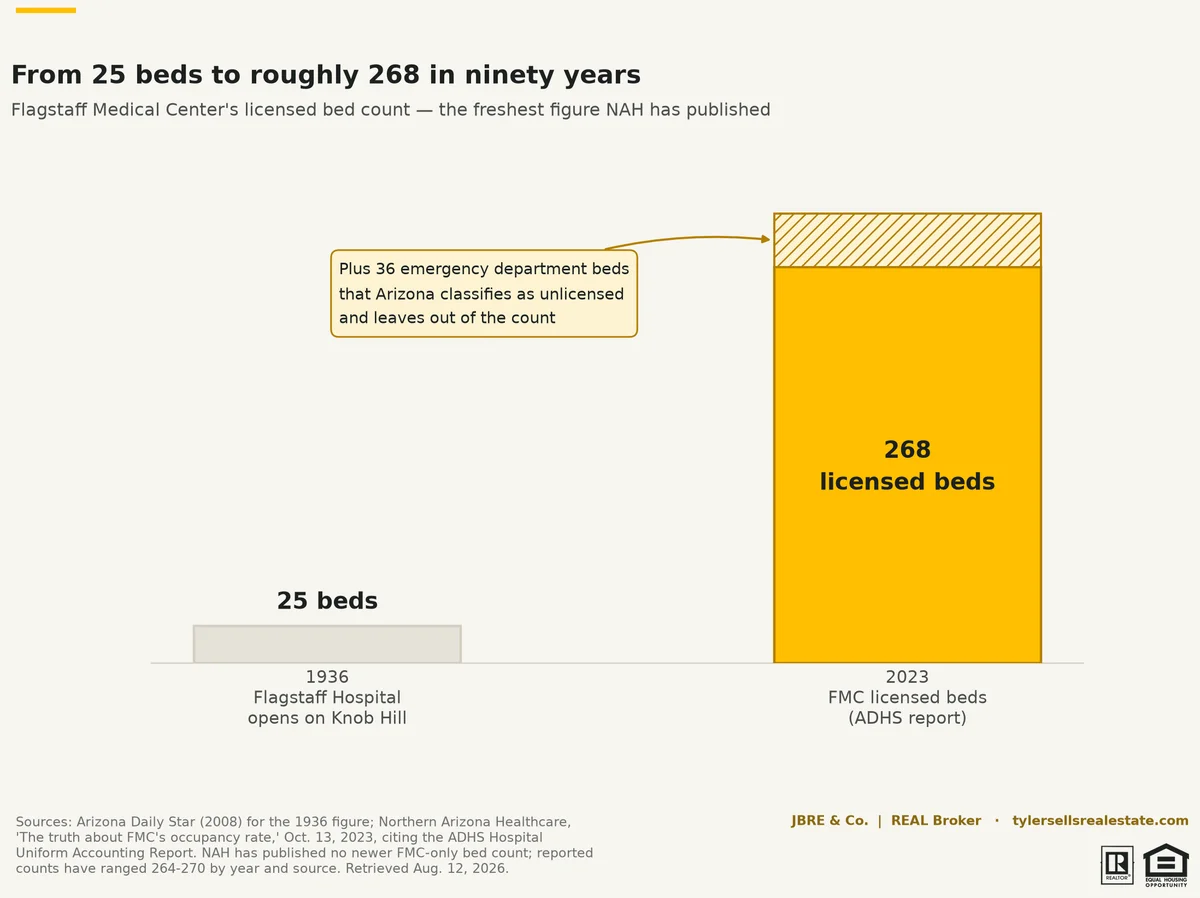
The bed count tells the scale story better than any adjective. Twenty-five in 1936. As of an October 2023 statement from the health system, 268 licensed beds plus 36 unlicensed emergency department beds (Northern Arizona Healthcare). No fresher hospital-only figure has been published, and counts cited elsewhere have ranged from roughly 264 to 270, so treat 268 as the best-sourced number rather than a live one.
Hospital Hill today: what Flagstaff Medical Center actually is
Flagstaff Medical Center still sits at 1200 N Beaver Street, on the same hill, and it functions as the referral hospital for an enormous and thinly populated region.
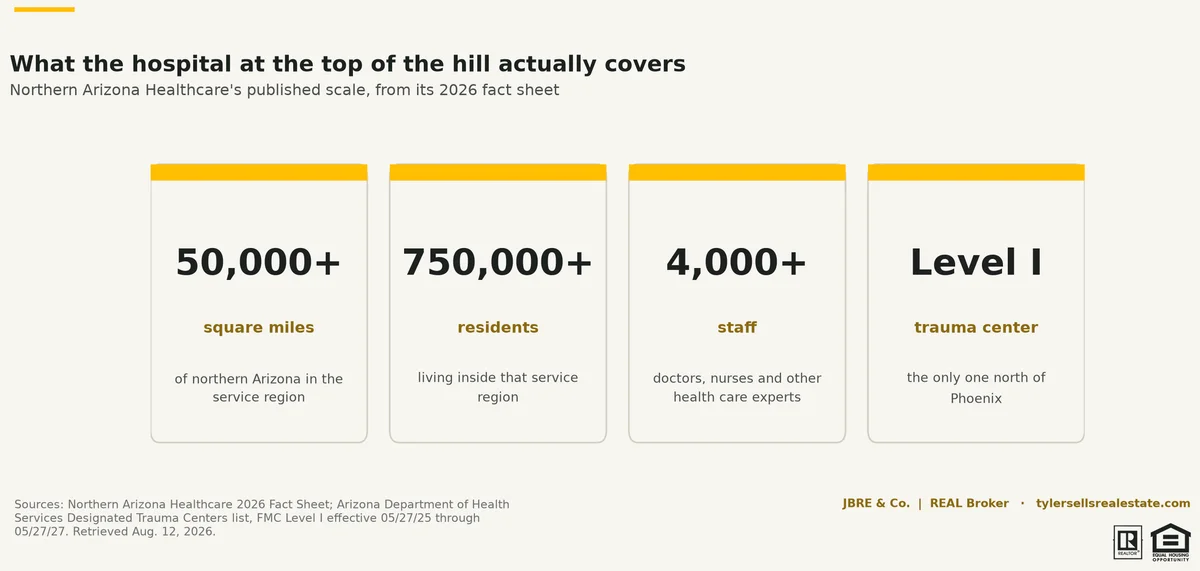
It is a state-designated Level I Trauma Center, effective May 27, 2025 through May 27, 2027, and the only Level I trauma center north of Phoenix (Arizona Department of Health Services).
There is a nuance here worth stating plainly, because it has been a source of local confusion. The American College of Surgeons separately lists the facility at Level II. Northern Arizona Healthcare's position is that the state designation governs its trauma status (Arizona Daily Sun). Both statements can be true at once — they are two different accrediting paths.
The service footprint is the part outsiders underestimate. Northern Arizona Healthcare covers a region of more than 50,000 square miles and more than 750,000 residents, with a workforce of over 4,000 (Northern Arizona Healthcare 2026 Fact Sheet). Add the seasonal load: Flagstaff is the closest full-service hospital city for travelers moving through the Grand Canyon, Sedona, Monument Valley and Lake Powell, so the emergency department absorbs visitor volume that has nothing to do with the local population count.
Is Flagstaff Medical Center the largest employer in Flagstaff?
No, and this is the single most repeated error about Hospital Hill.
Coconino County's principal employers for fiscal year 2025 rank as follows (Arizona Auditor General, Coconino County Annual Comprehensive Financial Report):
Northern Arizona University — 4,583
Northern Arizona Healthcare — 2,200
W.L. Gore & Associates — 1,950
Flagstaff Unified School District — 1,375
Coconino County — 1,191
City of Flagstaff — 967
Walmart — 630
Northern Arizona Healthcare is a strong number two. NAU is the largest employer, and the city's economic development office identifies W.L. Gore as the largest private employer (Choose Flagstaff).
Why does this matter to a buyer? Because "the hospital is the biggest employer" is often used as shorthand for "this housing demand is bulletproof." The real picture is better than that shorthand, not worse: Flagstaff's employment base is spread across a university, a health system, advanced manufacturing, two school-and-government layers, and tourism. That is a more diversified footing than a single-anchor town.
Is Flagstaff Medical Center moving off Hospital Hill?
This is the live question, and the honest answer as of August 12, 2026 is: unresolved.
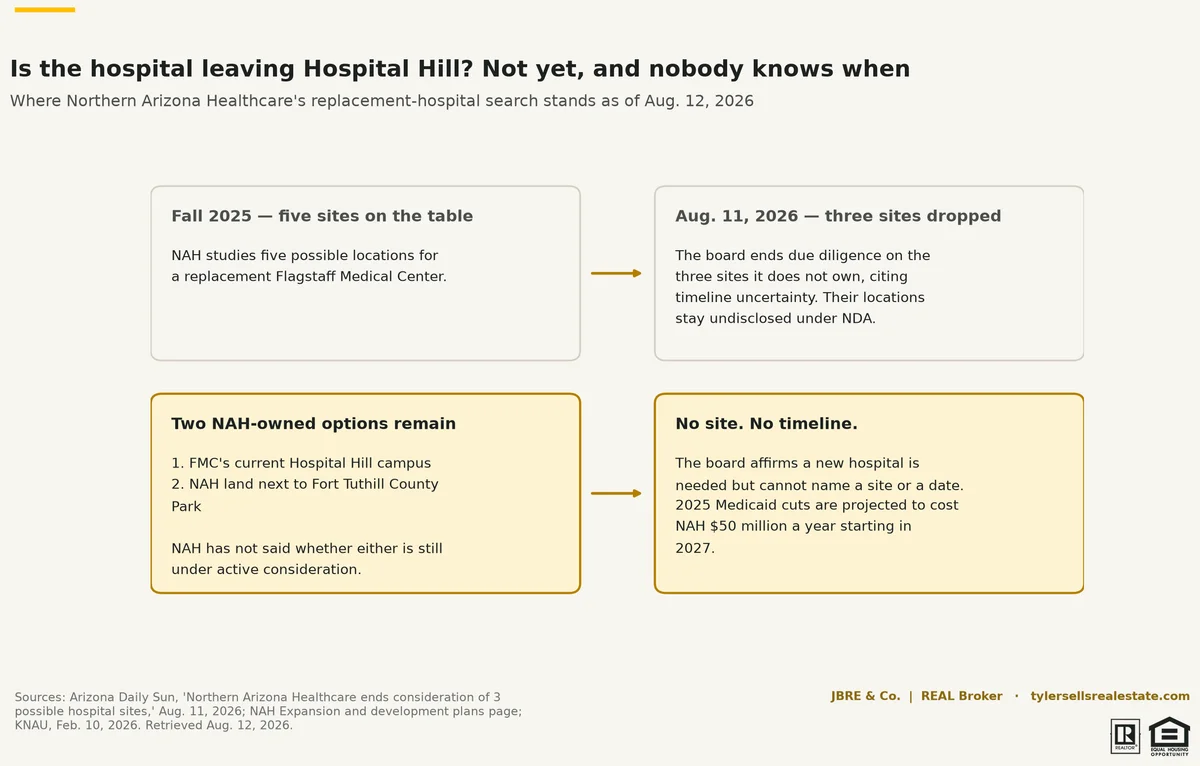
Flagstaff Medical Center remains on Hospital Hill. Northern Arizona Healthcare's board maintains that a new hospital is needed, but no site has been selected and no timeline has been set (Northern Arizona Healthcare).
The recent sequence matters:
In November 2023, Flagstaff voters rejected the rezoning tied to a proposed new campus near Fort Tuthill by 72.4%.
In February 2026, Northern Arizona Healthcare paused its plan to build a new Flagstaff Medical Center (KNAU).
On August 11, 2026, the system ended due diligence on the three non-NAH-owned sites out of five under review, citing Medicaid cuts projected to cost it $50 million a year beginning in 2027. Two options remain, both on land it already owns: the current Hospital Hill campus, and land near Fort Tuthill County Park (Arizona Daily Sun).
In the meantime, the system has completed phase one of an emergency department renovation and deployed a mobile MRI as interim capacity measures. Residents have been vocal about what happens to the hill either way (KNAU).
Read that carefully, because the two remaining scenarios point in opposite directions for the neighborhood. If the system rebuilds on the existing campus, Hospital Hill stays exactly what it is — the medical center of Northern Arizona, with the traffic, the shift changes, the helicopter, and the rental demand that come with it. If it eventually builds at Fort Tuthill, a very large parcel inside the city's oldest residential fabric changes use.
Nobody knows which. Anyone telling you it is settled is guessing.
What it's like to live on Hospital Hill
Set the institution aside for a moment. The residential blocks around the campus are some of the oldest housing stock in Flagstaff, and the character is specific.
You are walking distance to downtown from much of it. Flagstaff High School sits at 400 W Elm Avenue (Flagstaff Unified School District) and the Jay Lively Activity Center ice rink is at 1650 N Turquoise Drive (City of Flagstaff) — this is a part of town where kids get places on their own.
The elevation is approximately 7,000 feet. That governs everything practical: real snow load, a genuine heating season, ponderosa pine and volcanic cinder soil instead of lawn, and older homes that were built before anyone was thinking about R-values.
A few realities to plan around:
Housing stock is old. Expect to evaluate roofs, electrical panels, sewer lines, and insulation on their own merits, house by house.
Pre-1978 homes trigger federal lead-based paint disclosure. Most of this neighborhood qualifies. It is a disclosure and inspection item, not a dealbreaker.
Proximity to a hospital is a lifestyle trade. Some buyers want to be five minutes from an emergency department and a stable base of medical-professional neighbors. Others do not want ambulance routes nearby. Both are legitimate; know which one you are.
School attendance is by boundary, not by proximity. Confirm any address against the district's official locator (Flagstaff Unified School District boundary maps).
Parking and short-term rental rules vary block to block in the older core. Verify before you assume.
If you want the current for-sale picture rather than the history, that lives on the neighborhood page: Hospital Hill and NoHo homes for sale in Flagstaff. For a real example of how a 1937 home near the medical center actually traded, see what a 1937 home near Flagstaff Medical Center sold for.
What Hospital Hill's history means if you're buying here
History is not trivia when it explains the risk profile of an address. Three takeaways.
One: the name is durable, the institution is not fixed. Hospital Hill has been called that since roughly 1936 and the hospital has changed identity four times in that span. Buy the neighborhood on its own merits — location, walkability, housing stock, lot — not on the assumption that the campus stays put forever.
Two: the employment base underneath your resale value is diversified. NAU, Northern Arizona Healthcare, W.L. Gore, two school-and-government layers, and tourism. That is a broader foundation than the single-employer story people repeat.
Three: age is the negotiating surface here. In older Flagstaff neighborhoods, condition drives price far more than square footage does. We have seen this pattern repeatedly in nearby older areas — see the Upper Greenlaw Flagstaff real estate market report for how condition spread plays out in comparable stock. On Hospital Hill, a thorough inspection is your leverage, not your obstacle.
Hospital Hill Flagstaff FAQ
Why is it called Hospital Hill in Flagstaff? A 25-bed hospital opened on the hill in 1936 and the informal name replaced the older one, Knob Hill.
What was Hospital Hill called before? Knob Hill.
What was Flagstaff's first hospital? Not the 1936 facility. A county hospital for the indigent operated around 1892, and the Arizona Lumber & Timber Company ran a company hospital from about 1900, later renamed Mercy Hospital, which served until 1936.
Who founded Flagstaff Medical Center? Dr. Charles Sechrist led the founding effort. Dr. R.O. Raymond donated the land.
How many beds does Flagstaff Medical Center have? 268 licensed beds plus 36 unlicensed emergency department beds, per an October 2023 figure from Northern Arizona Healthcare. No newer hospital-only count has been published.
Is Flagstaff Medical Center a Level 1 trauma center? Yes, by Arizona state designation — the only one north of Phoenix. The American College of Surgeons separately lists it at Level II; the health system's position is that the state designation governs.
When did Flagstaff Medical Center and Verde Valley merge? 1995, forming Northern Arizona Healthcare.
Is Flagstaff Medical Center moving? Undecided. As of August 2026 the health system says a new hospital is needed but has named no site and no timeline. Only two options remain, both on land it already owns: the current campus and land near Fort Tuthill.
Is Sechrist Elementary named after the hospital founder? Yes — Dr. Charles Sechrist, whose name is also on a residence hall at NAU.
Thinking about buying or selling in Hospital Hill?
I write about this neighborhood because I know it block by block — which blocks are walkable to downtown, which houses have had the roof and the panel done, and what the medical center's unresolved future actually means for the value of an address here. If you are weighing a purchase or a sale on Hospital Hill or in NoHo, let's talk before you make assumptions from a portal listing.
Jake Martin · REALTOR®, JBRE & Co., brokered by Real Broker (928) 707-0504 · jake@jbreandco.com · Lic. #SA681649000
Equal Housing Opportunity.

Written by
Tyler Vaughan
Northern Arizona's top-rated real estate agent with 350+ five-star reviews. Specializing in Sedona, Flagstaff, and Northern AZ luxury properties.
Ready to Make Your Move?
Whether you are buying or selling in Northern Arizona, Tyler is here to help you navigate the market with confidence.